


Where Does Goodwill Money Go? A Donor's Guide
Have you ever dropped a bag at Goodwill and wondered whether your money stayed local, paid for training, or disappeared into some distant office? That question sounds simple, but the answer depends on which Goodwill affiliate handled your donation and how that affiliate is structured. The good news is that you can trace it.
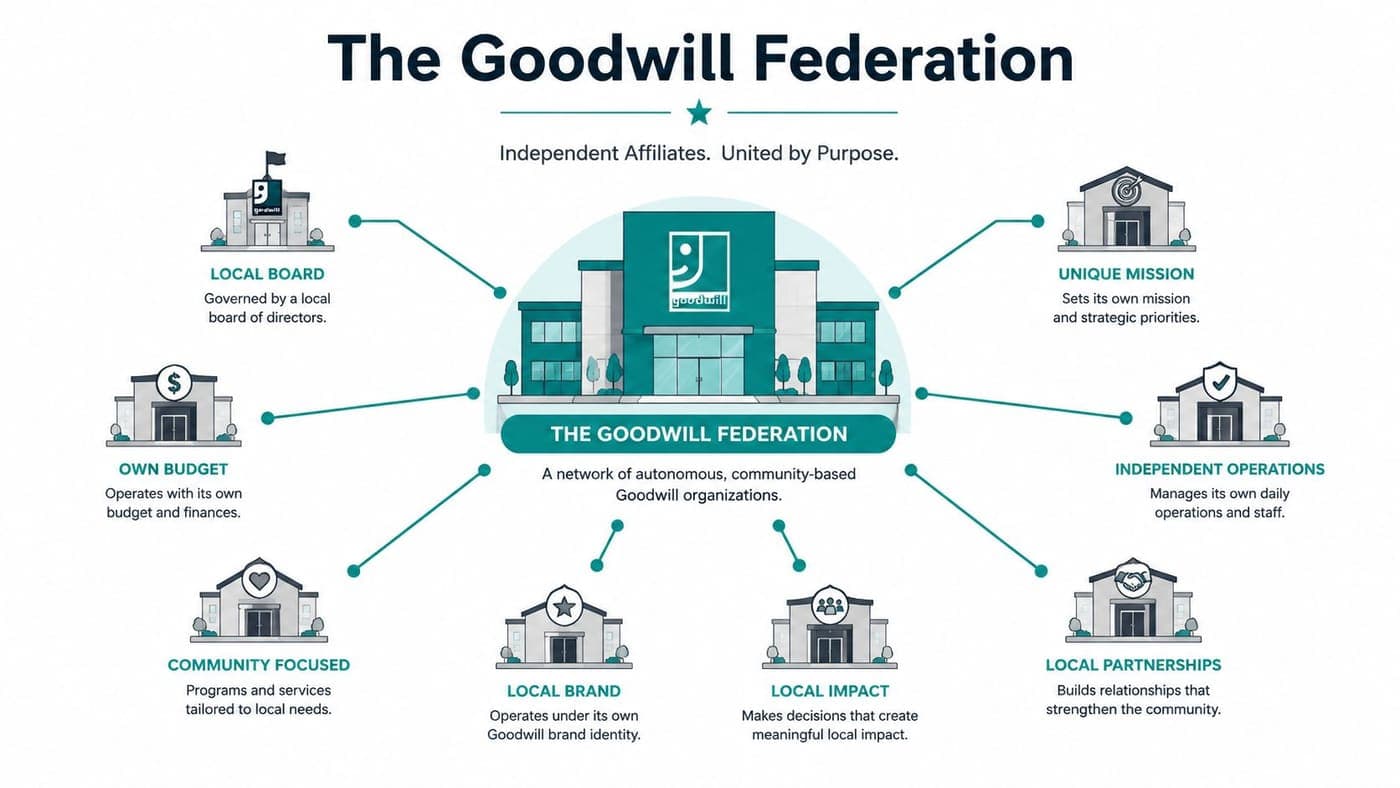
Quick Answer: Where Goodwill Money Goes
Goodwill is a federation of independent local organizations, so revenue and program spending vary by affiliate. To see where your donation goes, identify the local Goodwill, read its latest Form 990 and annual report, and look at program, management, fundraising, and revenue sections together.
Donor records and fund designations are easier to explain with donor management. For related reading, compare Form 990 basics for new nonprofits with stewardship of donors.
Why the Question Is More Complicated Than It Sounds
The common image of a single national Goodwill with one budget and one answer is inaccurate. Goodwill is a federation of independent local organizations, and Goodwill Industries International said those U.S. and Canada organizations served more than 2.1 million people in 2024 while recovering the value of 4.4 billion pounds of used goods Goodwill Industries International annual report.
That structure changes the question. A donation receipt from one store does not automatically tell you whether the money supported job training nearby, regional operations, or a wider network function. The answer depends on the affiliate that handled the goods, the sale, or the cash gift.
Start with the governance, not the slogan
Goodwill's public message says proceeds from donated goods are reinvested in the community and support job training, career placement, and related services Goodwill donation page. That's true at the mission level, but it still leaves a lot unsaid about where the dollars land.
One affiliate may keep funds tightly within its service area. Another may pool resources across a larger region or rely more heavily on earned income and grants. That's why donors get confused. They ask about Goodwill, but they really need to ask about their local Goodwill.
Practical rule: Treat a Goodwill donation like a local transaction until you confirm otherwise.
That distinction matters because it shapes accountability. If you care about nearby job training, you need to know whether your store, donation center, or monetary gift supports your neighborhood, your state affiliate, or a broader program structure. The governance answer comes before the financial answer.
Where Goodwill's Money Comes From
What a donor sees at the register is only one part of the picture. Goodwill money comes from a mix of earned revenue, contracts, membership dues, and contributions, and the mix can shift by affiliate. A 2024 summary says Goodwill received over $28 million in federal government contracts, over $26 million in membership dues, and about $20 million in contributions.
The money starts as goods, then becomes revenue
For donated goods, the path is usually slower than a cash gift. A shirt, chair, or toaster first becomes inventory, then gets sorted, priced, sold in-store, moved to another location, or sold online. Goodwill Greater Milwaukee & Chicago describes that process clearly, saying most items are sold where they are donated, some are moved to nearby stores, and others are sold through e-commerce channels.
That sequence matters because it explains why a donation receipt does not tell the whole story. The item has to turn into sale revenue before it can support payroll, store operations, or programs. In a local affiliate, donated goods work like stock for a small business, except the proceeds are meant to support a mission.
| Goodwill Revenue Streams at a Glance | Approximate 2024 Amount | Key Characteristic |
|---|---|---|
| Federal government contracts | Over $28 million | Restricted to specific deliverables |
| Membership dues | Over $26 million | Support network and organizational functions |
| Contributions | About $20 million | More flexible, but still tracked by restrictions |
| Thrift store and resale revenue | Not given as a network total in the verified data | Comes from selling donated goods |
The restricted-fund part is often where donors get lost. Contract money has to be tracked separately from unrestricted contributions, because it can only be spent on the authorized services in the contract. A cash gift can also be restricted, which is why what monetary donations do in a nonprofit is a useful frame when you compare a store sale with a direct gift.
If you compare Goodwill with another donation-driven mission, the same basic donor question still applies, but the structure changes. Some groups use gifts for direct service, while others rely more on earned revenue. That difference shows up in models like support emotional safety for kids, where the donation supports a very different set of programs and rules.
How Affiliates Categorize Every Dollar They Spend
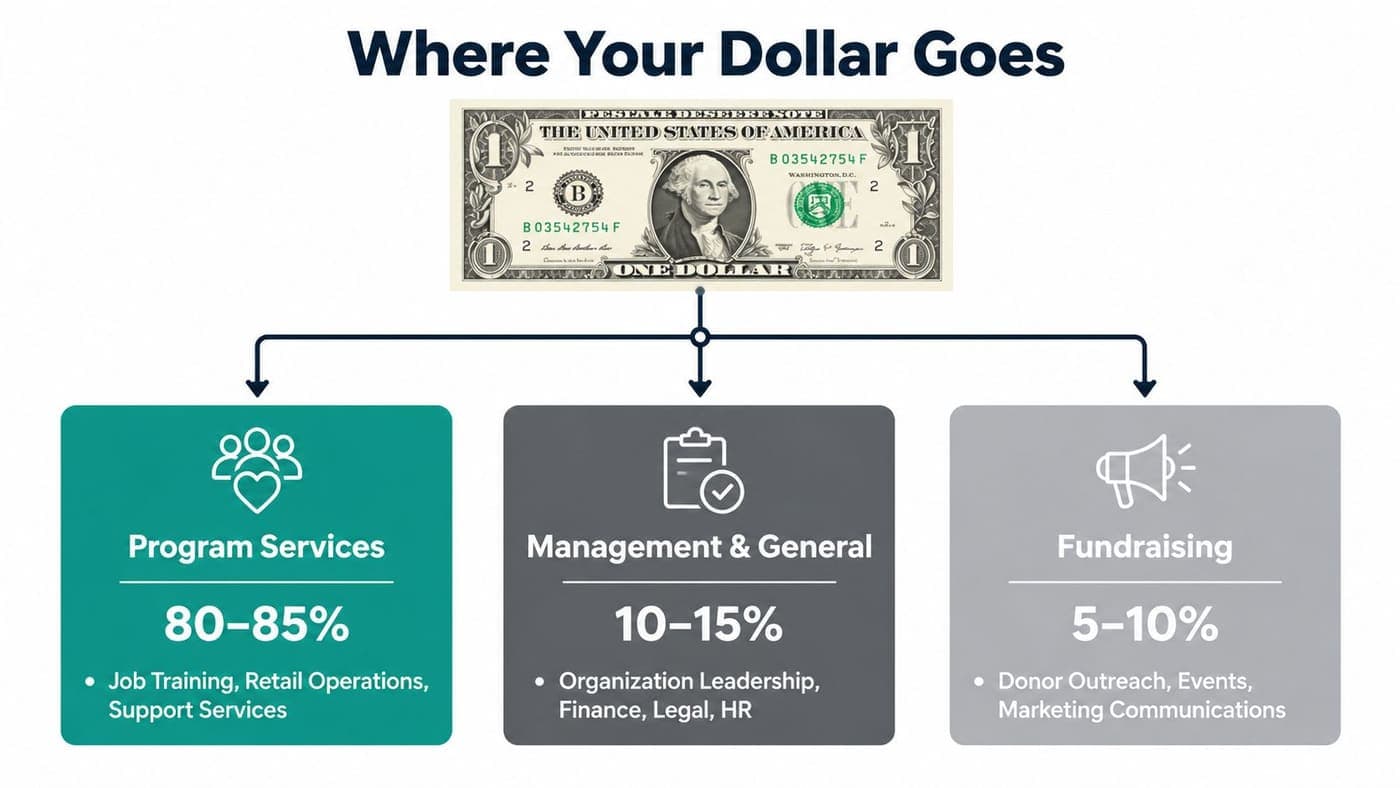
Once money comes in, Goodwill affiliates do not drop it into one general pile. They sort spending through the standard nonprofit Statement of Functional Expenses, which separates costs into program services, management and general, and fundraising. That structure shows whether an affiliate is putting most of its money into mission work or into the costs that keep the organization running.
Read the spending split like a nonprofit director
A good way to read the categories is to ask what each dollar is doing. Program services usually include job training, retail operations, and community programs. Management and general covers the systems that keep those programs organized, and fundraising covers bringing in new support.
Goodwill Industries International's latest consolidated financial report shows more than 90% of spending going to mission-related work rather than management or fundraising Goodwill consolidated financial report. That is a useful headline, but it still leaves room for a lot of local variation. A thrift-heavy affiliate, a contract-heavy affiliate, and an affiliate with a larger grant portfolio can all classify expenses differently while still following the same accounting rules.
A restricted dollar cannot shift without oversight into a different purpose just because another line item needs help. That is why fund accounting matters, and this guide to fund accounting for nonprofits is useful if you want the accounting logic behind the labels. If a contract requires labor tracking or training outputs, the money has to stay tied to those terms. If a donor designates a gift for a program, that gift should remain in that lane.
One affiliate's public analysis shows how the categories can look on the ground. It reported $23.8 million in program services, $16.6 million in grants, $3.0 million in management, and $0.5 million in fundraising, out of $43.9 million in expenses. Analysts at Paddock Post analysis also noted that the organization spent about $103 for every $100 in revenue because expenses exceeded revenue.
Another affiliate can present the same underlying work in a different way. South Carolina's financial reporting separates operating support, program costs, and other spending buckets in its own format, which is why you should read the affiliate's actual filing instead of assuming every Goodwill uses the same labels or ratios. Even when two affiliates both serve the mission, the way they classify a store sale, a grant, or a contract payment can change how the expense split looks on paper.
That is the key takeaway. The categories are not window dressing, they are the map that shows where each dollar went, and they are the first place to check when you want to understand what your local Goodwill is doing with your support.
Why Your Local Goodwill Can Look Different From the Next State Over
Two Goodwill affiliates can serve the same mission and still depend on very different revenue streams. One may rely heavily on thrift store sales, while another depends more on contracts, grants, or other local support. In a decentralized system, that difference is normal, and it changes how the books look even when the mission stays the same.
Compare the local stories, not just the brand name
Goodwill of South Carolina reported $60.791 million in total expenses and said it devoted more than 90 cents of every dollar to its mission Goodwill of South Carolina financials. Goodwill Akron said 91% of expenses supported its mission and 97% of revenue came from its businesses rather than donations. Those numbers point to the same broad message, but they show that the path to mission spending can look different from one affiliate to the next.
A thrift-heavy affiliate often has a revenue mix shaped by store traffic, resale volume, and donor drop-offs. A contract-heavy affiliate may show a very different balance because program agreements and service contracts bring in money in another way. A donor who drops off clothing may be supporting a store that feeds local program funding, or a program operation that is financed more directly through outside contracts.
Goodwill Central Texas adds another layer. It says monetary donations fund the mission locally while store revenue supports community programs in its region Goodwill donation page. That is why the better question is often not whether money goes to Goodwill, but which affiliate holds it, spends it, and keeps it close to home.
A quick comparison helps. One affiliate can look store-driven, another can look contract-driven, and both can still be doing mission work. The headline ratio alone does not tell you which operating model you are looking at, and that is where donors can get tripped up by a simple brand comparison.
Ask where the funds stay
When a donor asks where the money goes, the useful answer starts with the local affiliate name. Which Goodwill are you talking about? That question sounds blunt, but it is the right one, because the board, service area, and budget decisions belong to that affiliate, not to a single national ledger.
If local impact matters, treat each affiliate like its own nonprofit.
That also explains why one summary number can hide a lot of variation. The mission is shared, but the financial path is local. To compare affiliates fairly, look at how much revenue comes from stores, how much comes from contracts, and how the mission spending ratio is explained in the affiliate's own filing.
How to Read Your Affiliate's Form 990 in 20 Minutes
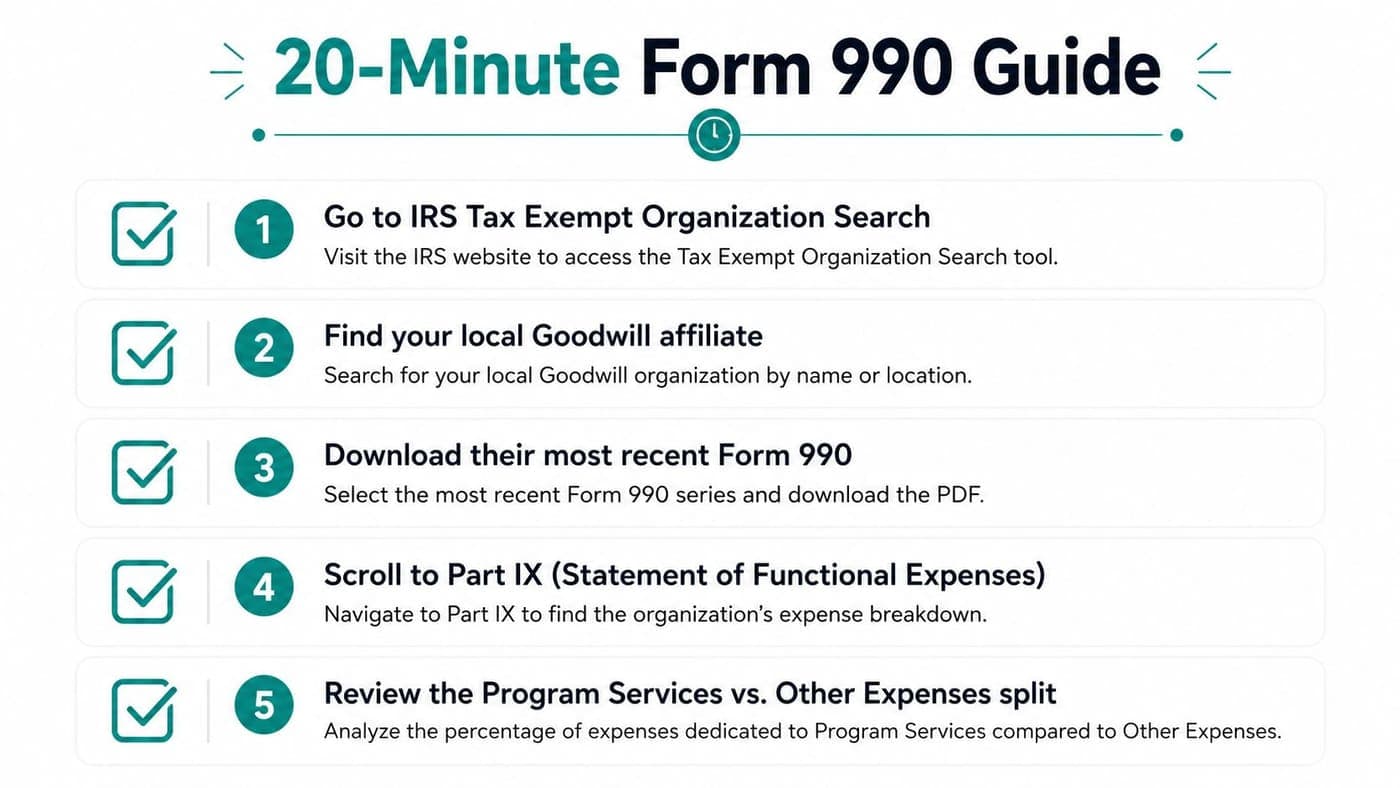
The cleanest way to verify Goodwill claims is to read the affiliate's Form 990. You don't need accounting training to get the basics right. You just need to know where the numbers live and which lines matter.
Find the right form, then go straight to the right pages
Start with the IRS Tax Exempt Organization Search and find your local Goodwill affiliate. Download the most recent Form 990, then go to Part IX, Statement of Functional Expenses, and Part VIII, Revenue. Those two sections show where money came from and how it was spent.
Look for the split between program services, management and general, and fundraising. Then compare that split across more than one year if you can. A single year can be noisy, but a pattern tells you more about how the organization runs.
| Form 990 Quick-Reference Checklist | What to Find | Healthy Benchmark |
|---|---|---|
| Part VIII | Revenue breakdown | Revenue sources should make sense for the affiliate's model |
| Part IX | Functional expense split | Program services should usually dominate |
| Management and general | Overhead share | Lower isn't always better, but it should be explainable |
| Fundraising | Cost to raise money | Should match the affiliate's funding strategy |
If the numbers look thin, ask one direct question: what changed? A good affiliate should be able to explain whether a shift came from grant timing, store performance, staffing, or a service expansion.
Our guide to Form 990 basics for new nonprofits walks through the same pages from the filer's side. That can help you spot what a well-kept return should look like.
A strong Form 990 doesn't prove impact by itself. It does give you a solid starting point. If you want to compare affiliates more carefully, ask for the latest annual report and the most recent audited financials, then see whether the story matches the filing.
What the 90 Cents on the Dollar Headline Really Means
The phrase “90 cents of every dollar” sounds reassuring because it suggests efficiency. It also leaves out a lot. That ratio usually tells you how spending is categorized, not whether the organization is investing enough in future capacity.
Efficiency is not the same as impact
A high program percentage can still hide weak fundraising, thin reserves, or underinvestment in infrastructure. The opposite can also be true. A slightly higher overhead share may reflect better systems, stronger compliance, or the ability to serve more people over time.
That's why the headline needs context. Goodwill of South Carolina and Goodwill Akron show mission-heavy spending, but those percentages don't tell you everything about program quality, hiring, or local outcomes. They tell you that most dollars are being routed into mission work, which is useful, but incomplete.
The same caution applies to executive pay questions. A salary line by itself doesn't tell you whether leadership is expensive, underpaid, or managing a large local operation. You need the full filing, the service area, and the program mix.
Ask what the ratio leaves out
When you see a strong mission ratio, ask three things. First, are the dollars restricted or flexible? Second, is the affiliate building enough administrative capacity to keep serving people well? Third, do the programs themselves match the community's needs?
Healthy question: Does this spending pattern support the mission this year, and next year too?
That's the more mature way to judge nonprofit efficiency. It keeps you from rewarding paper-perfect overhead ratios that starve the programs behind them. It also keeps you from assuming every dollar spent outside program services is wasted.
For a plain-language refresher on how expense categories work, see our guide to the statement of functional expense.
A Donor's Playbook for Maximizing Local Impact
If you want your Goodwill donation to do the most good, start local and ask specific questions. Bring items that your affiliate can sort and sell quickly, and be thoughtful about bulky goods that cost more to process. Cash gifts can be especially useful when an affiliate needs flexible support for a named program or local gap.
Use the donation type that fits the need
When you're unsure whether to give goods or cash, ask the affiliate which gift type helps most right now. A local store may need inventory. A workforce program may need unrestricted support. A school or church partner may need different kinds of help altogether.
If you're claiming a charitable deduction, keep your paperwork clean and save your receipt. A practical reminder on donation receipts for tax claims can help you understand why documentation matters, even when the gift itself is small.
Before your next drop-off, send one short email or make one quick call. Ask where proceeds stay, how the affiliate reports outcomes, and whether donated goods, cash gifts, or event support helps most. That question shows respect, and it usually gets a clearer answer than a slogan ever will.
Our guide to donor stewardship can help you think about that relationship over time.
For any nonprofit platform, the useful test is whether local gifts, programs, and reporting records remain traceable from the source transaction to the public filing.
Ready to try AlignMint with your nonprofit?
Start free — set up donor tools, giving pages, and Minty. Upgrade when you need accounting.