


Stock you held for more than one year and give to a public charity or a donor-advised fund generally supports a deduction at full fair market value, up to 30% of your adjusted gross income, and the appreciation avoids capital gains tax. Any unused deduction generally carries forward for up to five years.
It's the last week of December, and a donor emails to say the shares left her brokerage account yesterday. She wants the gift counted this year. Your gift-entry volunteer is away until January 4, the broker statement in your inbox shows a transfer with no donor name attached, and the board wants a year-end total on January 6.
The gap between the day a donor gives up the shares and the day your organization controls them is where small charities lose the thread. Below is the tax math, the transfer sequence, the valuation rule, and the records that hold up when a treasurer asks how you booked a $40,000 gift you never saw in a check register.
Quick Answer: Appreciated Stock Gifts
Stock held more than one year and given to a public charity generally supports a fair-market-value deduction, and the gain is not taxed. This page is the transfer sequence and the records. It is not a general donation-receipt guide.
Start with fund accounting and donation receipts for nonprofits. For the letter, see donation acknowledgment letters.
Tax Benefits at a Glance
Start with the arithmetic a donor cares about. Say someone paid $10,000 for shares now worth $40,000. A direct gift of the stock generally supports a deduction measured against $40,000, not the $10,000 that left the account years earlier. Sell first and donate the proceeds, and the gift shrinks by the tax on the $30,000 gain.
| Holding period and recipient | Deduction basis | AGI limit | Carryforward |
|---|---|---|---|
| More than one year, public charity or donor-advised fund | Fair market value | 30% of AGI | Up to 5 years |
| One year or less, public charity or donor-advised fund | Lesser of cost basis or fair market value | 50% of AGI | Up to 5 years |
| More than one year, private foundation | Generally cost basis | Set by the foundation's status | Up to 5 years |
The top row is the one most donors want. Long-term shares given to a public charity or a donor-advised fund generally support a gift valued at fair market value, which is how a $40,000 position can outperform a $40,000 check. Fidelity Charitable's guide to donating stock lays out both effects: the deduction at market value and the absence of capital gains tax on the appreciation.
The ceiling on that generosity is the adjusted gross income cap. The Congressional Research Service traces the current structure to the Tax Reform Act of 1969, which lifted the general individual limit to 50% of AGI and set a 30% limit for gifts of appreciated property. Excess amounts generally carry forward, which matters to a donor giving a large block relative to income.
The rows donors get wrong
Short-term shares behave differently. Hold the stock one year or less and the deduction is generally limited to the lesser of cost basis or fair market value. Your gift officer should ask for the acquisition date before anyone in the room promises a tax result.
Private foundations sit in the third row, and donors rarely expect it. Long-term stock given to a private foundation is generally deducted at cost basis, so the donor should confirm the treatment with a tax adviser before committing the shares.
The second half of the benefit is the avoided gain. On a $30,000 long-term gain, a donor at the top bracket could face a combined federal long-term rate and 3.8% Medicare surtax of up to 23.8%, as Fidelity's tax-efficient giving guide notes. Selling first puts that bill in the same year as the gift.
If a donor asks why the same $30,000 is taxed on a sale and untouched on a gift, walk through what counts as a capital gain together. Realization is the hinge. The recipient also has to be a qualified 501(c)(3) public charity for market-value treatment, and the donor has to itemize to use the deduction at all.
Two questions settle it: Does the donor itemize, and have the shares been held more than one year? A no on either one changes the math before you discuss anything else.
Broker Transfers Compared With Donor-Advised Funds
Four routes reach the same charity, and they are not interchangeable. Use this table to compare them and to see why a gift can take three weeks between the donor's instruction and your control of the shares.
| Route | How the shares move | Paperwork handled by | Best fit |
|---|---|---|---|
| Direct broker-to-broker transfer | Donor's broker moves shares to the charity's brokerage account | Donor sends instructions; charity supplies account details | One-time gift to a charity with a brokerage account |
| Donor-advised fund transfer | Shares move to the donor's fund, and grants follow later | Fund sponsor handles grant records; charity still records the gift | Donors giving over several years |
| Intermediary or fiscal sponsor | Intermediary receives the shares and redirects them | Intermediary and charity both confirm the gift | Small charities without securities staff |
| Sell first, then give cash | Shares are sold and the cash is donated | Standard cash receipt | Donors with a loss position or a need for cash now |
The chart shows the same four routes side by side.
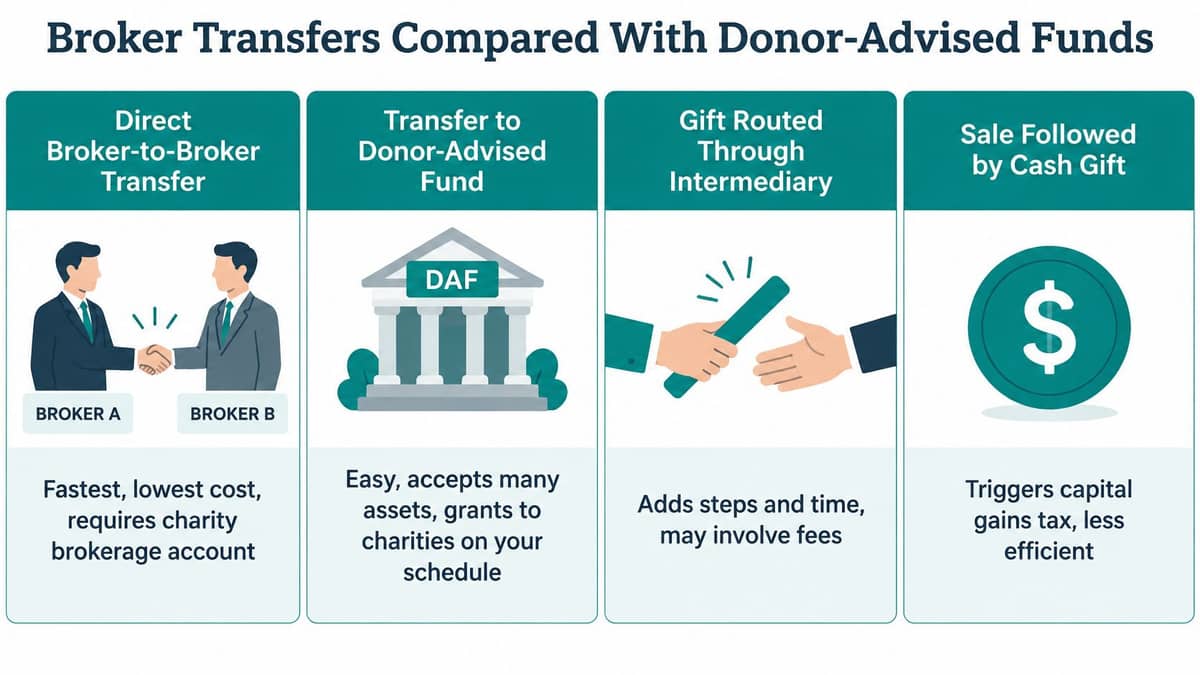
Direct broker-to-broker. The donor's firm moves shares into your account and nothing else touches them. Fastest and cheapest, provided your finance lead can produce a DTC number, an account number and the exact legal name of the organization without hunting. While the shares sit in transit your charity controls nothing yet, so hold the receipt until they settle in your account.
Donor-advised fund. Fidelity Charitable, Schwab Charitable and Daffy run established processes for receiving stock and paying grants, and their donor instructions are clear. Daffy reported that its members contributed more than $92 million in stock and cryptocurrency during November and December 2024, including $32 million in public stock and $23 million in private stock, according to Daffy's recap of that giving season. The gap that matters to your books is records. The donor-advised fund sponsor's letter documents the donor's contribution to the fund; your receipt, fund coding and acknowledgment remain your own work, and the grant can arrive weeks after the donor's paperwork was done.
Intermediary or fiscal sponsor. Useful when you have no securities account of your own, and slower by a step because the gift passes through a second set of books. Insist the shares arrive with the donor's name attached, or you will spend February matching an anonymous transfer to a pledge.
Sell first, then give cash. Still correct when the position sits at a loss, since the donor can realize the loss, or when the donor needs cash this month. Otherwise the tax on the gain comes straight out of the gift.
Rule of thumb: pick the route your team can receive, value and record without rebuilding the process in January. A slower route with a clean receipt beats a fast one that leaves an unmatched transfer on your statement.
How to Transfer Appreciated Stock Step by Step
Mechanics decide whether the gift works. A donor generally instructs the brokerage firm to move shares directly rather than selling first, because a sale triggers the gain and reduces what arrives, as Fidelity Charitable's note on highly appreciated stock explains. Here is the sequence, with the reason for each step and the mistake we see most.
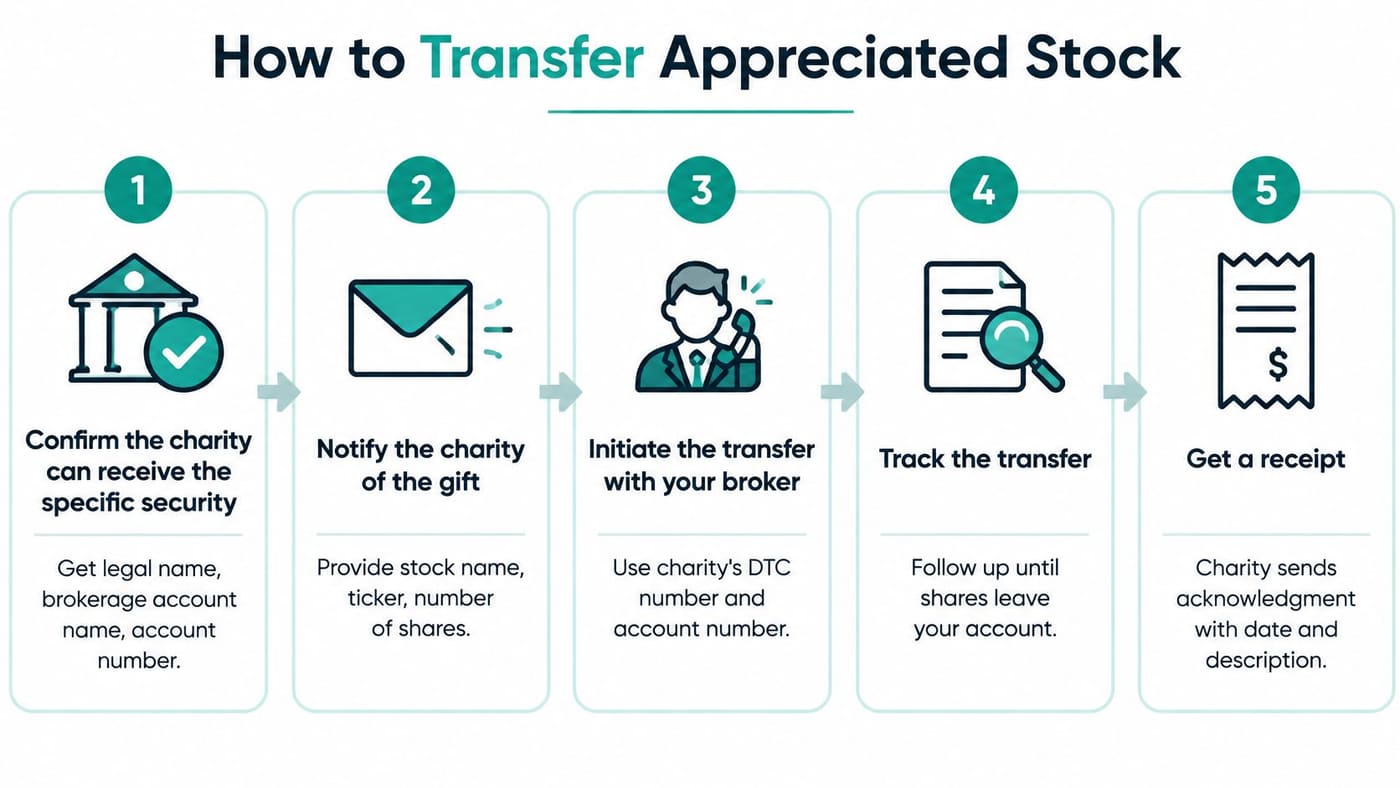
-
Confirm you can receive the specific security, then send exact instructions. Give the legal name, brokerage account name, account number and delivery details. The common slip is a legal-name mismatch, where the donor's form says "First Baptist Church" and your account says "First Baptist Church of Millbrook."
-
Pull the purchase date and cost basis from the donor's account. These decide which deduction row applies and whether anyone mentions a market-value gift. The slip is a donor quoting the date of the most recent dividend reinvestment rather than the original purchase.
-
Ask the broker for a transfer in kind. Say the words, in writing, because a default form can liquidate a position before it moves. Selling first realizes the gain and takes a slice of the gift.
-
Tell your staff the intended send date. A one-line email lets your bookkeeper watch for the arrival instead of discovering it at month end. The slip is a transfer that lands on a Friday with no one looking until the following Wednesday.
-
Verify posting in both accounts and save the confirmation. Ask the donor to forward the broker confirmation, and check your own account for the same share count. Partial fills happen, and a partial transfer needs its own record.
-
Issue a written acknowledgment after receipt. It should describe the shares received and the date, without assigning a value you aren't responsible for. The donor needs it for gifts of $250 or more, and you need it in the file.
The four word check
Run confirm, transfer, verify, record in ten minutes and most year-end stock problems disappear before they start. When the shares land, record the donation against the right fund the same week, while the broker statement is still on your desk.
Valuing the Gift and Choosing the Right Date
A donor calls on December 30 with a transfer confirmation in hand. The shares left her account, but your broker shows nothing until January 3. Which tax year owns that gift?
The answer starts with the valuation date, and the paperwork looks settled on the donor's side long before it looks settled on yours.
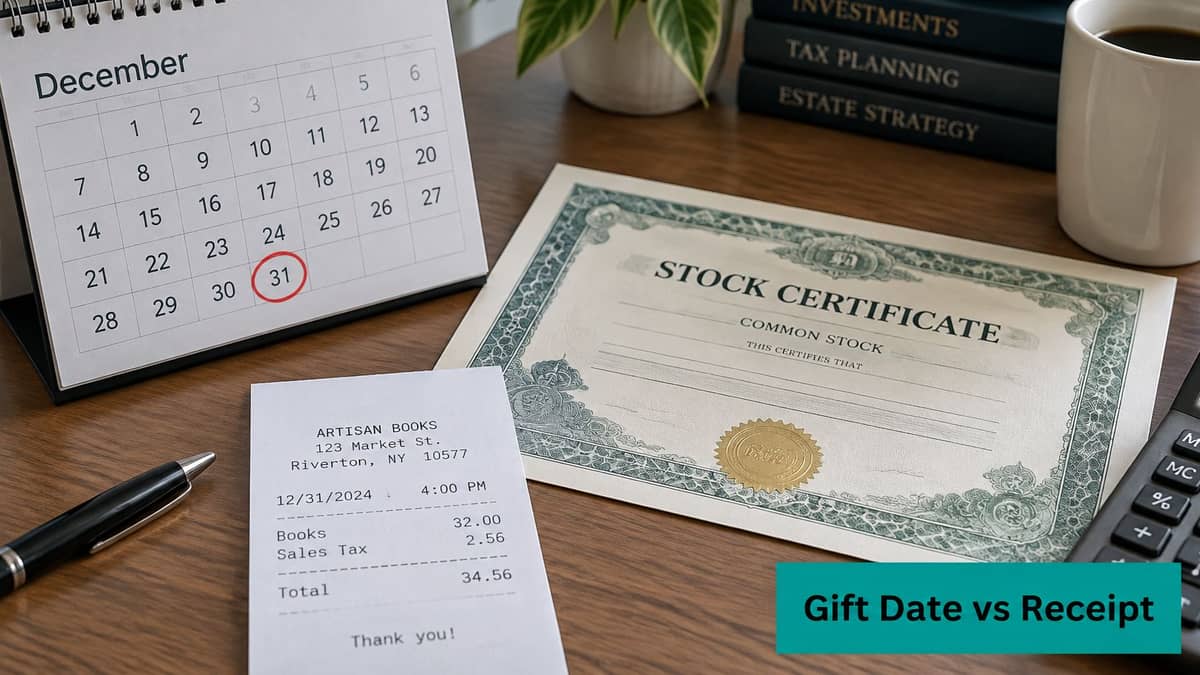
For publicly traded stock, the IRS generally measures fair market value using the average of the day's high and low prices, not the closing price, as Akron Community Foundation's note on stock gifts explains. A day with a $52 high and a $48 low values each share at $50, so 200 shares support a $10,000 gift. Meanwhile the relevant date can shift with the mechanics of the transfer, which is why "same-day donation" is not the same as same-day tax completion.
Failed and partial transfers
A rejected transfer needs a fresh instruction, and the clock restarts. A partial transfer needs separate receipts for each piece, because the valuations may land on different days. Your internal receipt date does not establish the donor's federal tax date, so never promise a tax year on the strength of your own records.
Record both the day the donor instructed the transfer and the day the shares reached your account. Tell donors to start early enough that a rejection leaves room to fix it.
Three dates belong in every gift file: the instruction date, the completion date and the acknowledgment date. If you can produce all three, a question about timing answers itself.
Records Donors and Charities Must Keep
Records are the unglamorous half of granting and the half that decides whether a deduction survives a review. Split them by party before the first gift arrives.
| Record or threshold | Who keeps it | Rule |
|---|---|---|
| Noncash gift over $500 up to $5,000 | Donor | Form 8283 Section A |
| Noncash gift over $5,000 | Donor | Form 8283 Section B with qualified appraisal |
| Gift of $250 or more | Charity | Written acknowledgment |
| Instruction date and receipt date | Charity | Record both dates |
| Broker confirmation and cost basis | Donor | Proof of transfer and holding period |
Section A of Form 8283 covers noncash gifts over $500 and up to $5,000. Section B covers gifts above $5,000, where a qualified appraisal supports the value. Donors attach the form; charities never prepare it and never state a value on a receipt. The IRS Publication 526 definition of qualified appreciated stock, corporate stock that is capital-gain property with readily available market quotations, is worth keeping open when a donor asks what you owe them.
On the charity side, the acknowledgment has to exist for any gift of $250 or more, and it should name the fund or purpose the shares support. A donation acknowledgment letter template saves an hour in January if your letter writer is new.
The monthly reconciliation
Match each broker transfer record to a donor receipt, then confirm the gift is coded to the right fund. Flag anything still pending at month end on a one-line list, with the expected settlement date beside it. Keep the broker record next to the donor record, in the same folder or the same finance system, so the two can be compared without email archaeology.
The three items missing most often at audit time are the instruction date, the cost basis and a signed acknowledgment.
Private Shares and Nonstandard Assets to Evaluate
A $200,000 gift of pre-IPO shares sounds like the best news of your fiscal year. Run the net proceeds before you celebrate. Publicly traded stock is straightforward to value; privately held and restricted shares are not, and a headline value is not the same as cash in your account.
For non-publicly traded assets, fair market value is generally established through a qualified appraisal, as Fidelity's guide to gifts of complex assets sets out, and the donor may need Form 8283 when claiming a large noncash deduction. The appraisal must generally be completed no earlier than 60 days before the contribution date and no later than the donor's return due date, including extensions. That window alone can complicate a December close.
| Asset type | Valuation method | Extra documentation | Acceptance question |
|---|---|---|---|
| Publicly traded stock | Average of high and low on the valuation date | Broker confirmation and acknowledgment | Can the charity receive and sell the shares? |
| Privately held shares | Qualified appraisal | Appraisal dated within 60 days of the gift and Form 8283 where required | Who pays for the appraisal and legal review? |
| Restricted stock | Appraisal with discounts for transfer restrictions | Restriction documents and Form 8283 where required | Is there a sale window and a realistic buyer? |
| Unvested equity awards | Depends on vesting, exercise and ownership | Plan documents and proof of donor ownership | Does the charity receive stock, an option or only a promise? |
Restricted securities typically need an appraisal, and the discounts for transfer restrictions cut the value the charity can realistically book, as a guide to donating stock options and shares from myStockOptions notes. Compare net proceeds, not the number on the appraisal cover page. Subtract appraisal fees, legal review, custody costs and the months before a sale completes.
What the acceptance policy should say
Put it in writing and let the board approve it once, so no one negotiates under pressure in December. Cover minimum gift size, prohibited securities, the representations you require from the donor, and who pays for the appraisal and legal review. State plainly whether you may sell immediately or may hold an in-kind contribution of that type.
Say no when two things are true: there is no realistic buyer, and the charity cannot cover the cost of finding one.
Confirm the Transfer Before Year End
A stock gift you can prove in one afternoon is the goal. It means the board total is defensible, the donor's receipt matches your bank record, and nobody is reconstructing December in late January with three browser tabs open.
Work backwards from the deadline. Send your account details and the transfer instruction at least two weeks before December 31, so a rejected transfer still has time to be corrected. Once the shares post, file the broker confirmation and the signed acknowledgment beside the donor record, then run the same monthly reconciliation you use all year. One row per gift, with the instruction date and the posting date, keeps the file complete.
Software helps most at that filing step. AlignMint is free for nonprofits with up to $100K in annual donations, and no credit card is required. Free is one user and includes donor records and giving pages. Fund accounting starts on Plus at $199 per month, or $1,704 billed annually, and keeps restricted and unrestricted dollars tied to their purpose from the first receipt through the year-end report, which is the step small charities skip when stock arrives late. If you want a walkthrough, our team offers a free setup call and will go through fund accounting, donations and reporting on your plan.
You don't need a new system to accept appreciated stock. You need a date, a basis, a receipt and a place to keep all three.
AlignMint puts the stock gift, its acknowledgment and the fund it supports on one record, so January's reconciliation takes an afternoon instead of a week. Donor records keep the giving history, receipts, notes and pledges together, and fund accounting carries each restricted dollar through to the year-end report. Visit AlignMint to see how donations, fund accounting and reporting fit together, and book a free setup call when you're ready to put your first stock gift on the books.
Frequently Asked Questions
Stock held more than one year and given to a public charity generally supports a deduction at fair market value, up to 30% of adjusted gross income, and the gain is not taxed. This page is the transfer and records guide.
Free is one user for nonprofits with up to $100K in annual donations, and no credit card is required. Fund accounting starts on Plus at $199 per month, or $1,704 billed annually.
Ready to try AlignMint with your nonprofit?
Start free — set up donor tools, giving pages, and Minty. Upgrade when you need accounting.