

You're preparing board reports, and your bank balance looks healthy, but several unpaid bills tell a different story. Understanding what is the modified cash basis of accounting helps you explain that gap without promising more than your statements show. You'll also know which written rules to check before relying on the results.
Quick Answer: Modified Cash Basis
The modified cash basis records some accruals and leaves other items on cash. The label is not enough. Write down which balances you include before the board relies on the report.
Start with fund accounting and the not for profit income statement. For restricted balances, see restricted funds.
Modified Cash Basis Defined in Plain Terms
Your board needs to understand financial timing, not just whether money arrived before the bank statement closed. Consider a hypothetical nonprofit receiving a $20,000 grant check in December, then paying a $6,000 program invoice in January.
The grant supports a full program year, but cash accounting separates the receipt and payment across reporting periods. December looks stronger, while January looks weaker, even though both transactions support the same work.
Modified cash basis starts with cash accounting, then adds selected accrual-style treatments under your organization's written policy. Everyday receipts and payments usually follow cash timing, while equipment, depreciation, and long-term debt may receive different treatment.
The American Institute of Certified Public Accountants treats cash, tax, and modified-cash statements as special-purpose-framework reports, rather than GAAP statements. Its guidance also explains that authoritative GAAP literature doesn't prescribe a single all-encompassing preparation model for these reports.
What the modifications actually change
You might record a purchased vehicle as an asset, then recognize its cost gradually through depreciation. You might also record its loan balance while leaving ordinary unpaid supplier invoices outside your financial statements.
Those choices don't automatically move the December grant into the periods when your nonprofit delivers the program. That requires a relevant recognition policy, not just calling your books modified cash.
For a fuller explanation of recognition timing, the accrual accounting glossary provides useful background without changing your current bookkeeping method.
Cash, modified cash and accrual bases compared
| Feature | Cash basis | Modified cash basis | Accrual basis (GAAP) |
|---|---|---|---|
| When revenue is recorded | When cash is received | When cash is received, with selected accrual treatments | When earned or pledged, subject to applicable recognition rules |
| When expenses are recorded | When cash is paid | When cash is paid, plus selected accruals | When incurred |
| Property and equipment | Expensed when paid | Capitalized and depreciated under a written policy | Capitalized and depreciated under applicable policies |
| Accounts payable and accrued expenses | Not recorded | Usually omitted unless the policy adds them | Recorded |
| Long-term debt | Not recorded | Often recorded under the policy | Recorded |
| Reporting standard | Not GAAP | Special-purpose framework, not GAAP | GAAP |
The most important difference isn't the label printed above your balance sheet. It's the list of transactions your policy includes and excludes.
Practical rule: Ask for the accounting policy before comparing two organizations that both describe their statements as modified cash.
One nonprofit might include payroll accruals, while another includes only equipment and debt. Their reported operating results won't necessarily measure the same activity, even when their bank transactions look similar.
Your practical test is straightforward: can you name every modification and explain how your bookkeeper applies it? If you can't, you haven't established a dependable modified-cash framework, even if someone has already used that label.
How Modified Cash Records Revenue, Expenses and Assets
You can understand the entries more easily by following one purchase from authorization through the year-end financial statements. Keep the asset, its financing, and any separate unpaid invoice distinct throughout the example.
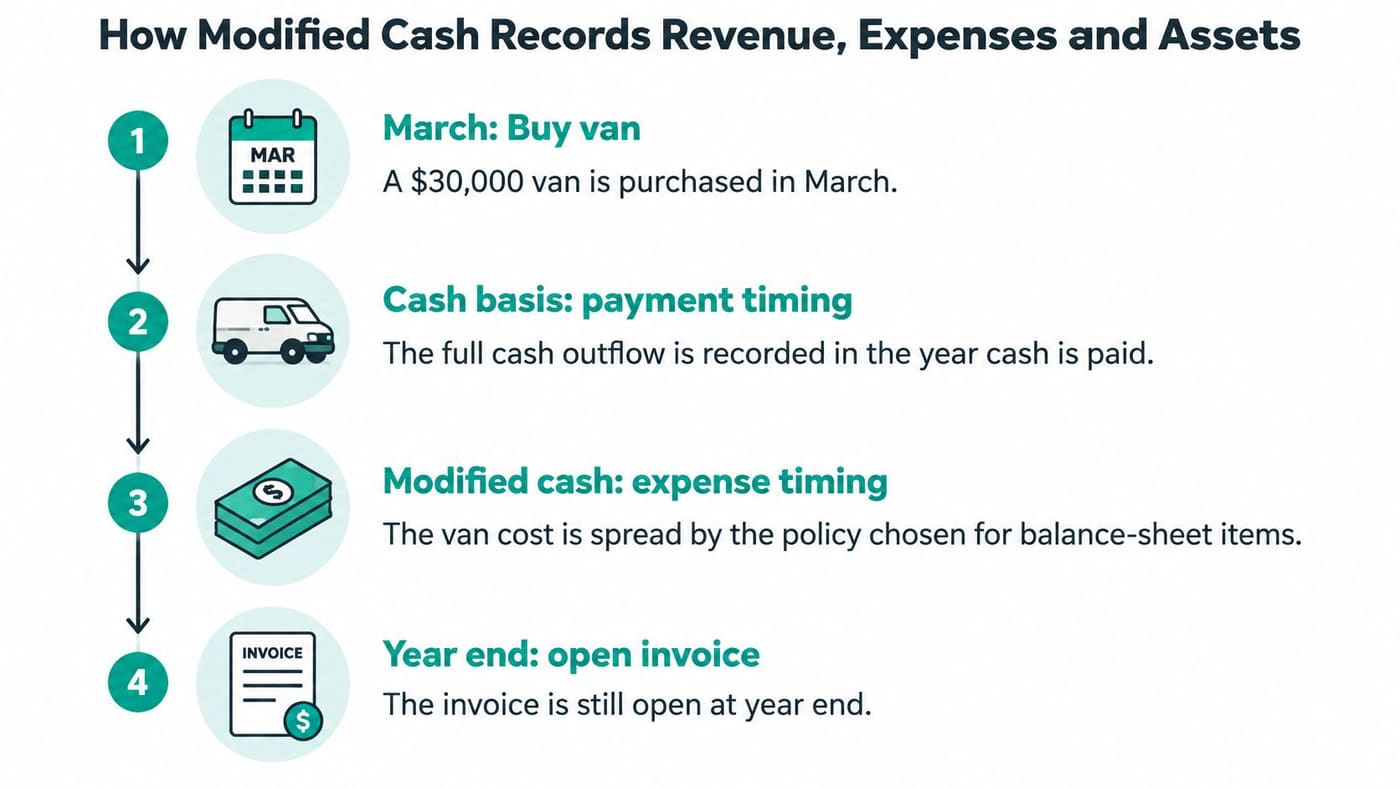
Suppose your nonprofit buys a $30,000 van in March, financed over 36 months, with no initial cash payment. For this hypothetical policy, equipment above $5,000 is capitalized and depreciated over five years, assuming no residual value.
Also suppose a separate maintenance invoice remains unpaid at year end. That invoice tests your payable policy, not whether you should recognize the financed vehicle.
Follow the van through the year
Under pure cash accounting, your bookkeeper records payments when cash leaves the bank, without presenting the van as an asset. With financing, that means recording actual payments across their payment years, not pretending the entire purchase was paid immediately.
Under the hypothetical modified-cash policy, your bookkeeper records the van and corresponding loan when the purchase occurs. Your balance sheet therefore shows both something your nonprofit owns and an obligation it must repay.
Each loan payment needs separating into principal and interest. Principal reduces the recorded debt, while interest becomes an expense under the policy.
Depreciation records the vehicle's use without another withdrawal from your bank account. In this example, straight-line depreciation would equal $6,000 for a full year, with the purchase-year amount following the policy's commencement convention.
Your general ledger should let your reviewer follow those separate entries rather than treating every withdrawal as operating expense.
Van purchase under cash and modified cash bases
| Event | Cash basis | Modified cash basis |
|---|---|---|
| March van purchase | Payments recorded only as cash moves; van not an asset | Record the hypothetical $30,000 van as equipment and recognize its financing |
| Monthly loan payments | Recorded as cash paid | Principal reduces long-term debt; interest is recorded separately |
| Annual depreciation | Not recorded | Hypothetical $6,000 full-year charge, adjusted for the policy's first-year convention |
| Open invoice at year end | Not recorded | Omitted unless the policy accrues payables |
Review the entries in sequence
A useful timeline helps your treasurer distinguish missing transactions from transactions intentionally excluded under your reporting basis.
- March purchase: Record the equipment and financing, then retain the purchase agreement and repayment schedule.
- Monthly payments: Separate principal from interest and reconcile the remaining loan balance with the lender's records.
- Depreciation entries: Apply the approved method and commencement convention, retaining the calculation with your asset register.
- Year-end review: Examine the unpaid maintenance invoice and apply the documented rule for ordinary accounts payable.
The unpaid invoice illustrates the method's limitation particularly well. Your organization can show its van and loan accurately while still omitting a genuine obligation to a supplier.
Check the final balance sheet for equipment, accumulated depreciation, and the remaining loan balance. Then check that your operating statement includes depreciation and interest without incorrectly expensing principal repayments again.
Pros and Cons of Modified Cash for Nonprofits
Why keep a method that leaves things out? Because a manageable reporting process can still serve your team well, provided everyone understands its limits.
FASB's historical discussion of nonprofit accounting explains that most nonprofits used cash or modified cash before shifting toward accrual reporting during the 1960s. That shift reflected the need to report resource consumption more completely, rather than relying only on payment timing.
Your decision today should address the same practical question: what information do your board and funding partners need? A familiar monthly process isn't enough if it regularly conceals obligations that affect spending decisions.
Weigh convenience against completeness
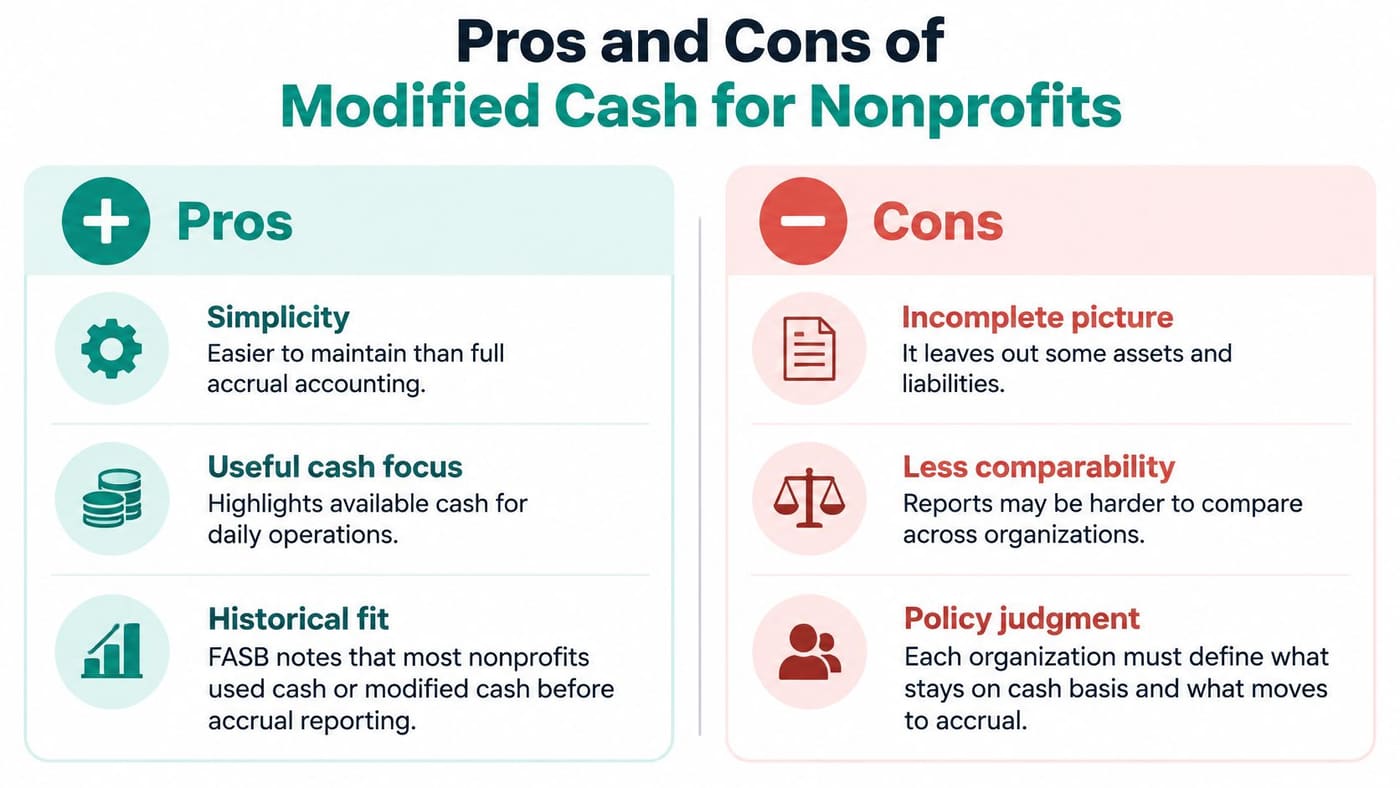
The advantages matter most when your finance team can explain the reports without maintaining extensive adjustments elsewhere. The disadvantages become serious when directors need separate spreadsheets to understand the obligations missing from those reports.
| Advantages | Drawbacks |
|---|---|
| Bank-centered bookkeeping: Routine entries follow familiar receipts and payments. | Hidden unpaid bills: Excluded payables can make available resources look stronger. |
| Useful cash focus: Payment activity supports short-term spending conversations. | Uneven program costs: Late payments can move expenses away from the work they support. |
| Better asset visibility: Capitalized equipment remains visible beyond its purchase. | Limited comparability: Different modifications weaken comparisons between organizations. |
| Selected cost allocation: Depreciation spreads major asset costs across their use. | External reporting limits: Your reporting basis may not satisfy a GAAP requirement. |
For example, delayed payment of a program contractor can make an operating statement appear unusually favorable. Your program director may know the work happened, while your treasurer sees no corresponding expense in the report.
That mismatch doesn't make the method dishonest. It means your board needs an accompanying view of commitments before approving additional spending.
Choose the method your team can maintain reliably, but don't confuse simpler bookkeeping with complete financial information.
Recognize the switching triggers
Review your basis when a lender, grantor, or auditor specifically requires GAAP financial statements. An audit itself doesn't automatically mean GAAP is required, so confirm the actual engagement and funding requirements.
Also reconsider the method when unpaid obligations materially affect your operating budget. If leadership routinely reconstructs accrued expenses before making decisions, full accrual reporting may be the more practical ongoing choice.
For a small team with straightforward grants, modified cash may remain a sensible fit. The decision concerns reporting needs and staff capacity, not whether one organization is more responsible than another.
How Restricted Funds Fit a Modified Cash Ledger
A $50,000 government grant arrives in March, restricted to a youth program through December. It lands in the same checking account as your general donations, and the combined balance does not reveal what you may spend.
Assuming the agreement is a restricted contribution, its purpose has to stay visible from receipt through every report. The historical framework in FASB Statement No. 117 distinguished unrestricted support from contributions carrying donor restrictions, using temporarily and permanently restricted classifications. The operational lesson still holds: when cash arrives says nothing about what that cash can fund.
Your accounting basis adds a second question on top of that. Modified cash is a set of choices rather than one standard method, so two nonprofits can use the same label and handle this grant differently. One records the receivable when the award letter arrives; the other waits for the cash. Both approaches can work, as long as your written policy states which one you chose and the March grant is treated the same way every time.

Connect each receipt to its permitted use
A restricted fund works like a labeled envelope inside your checking account: the cash mixes, the purpose doesn't. Your donor record should retain the award letter, purpose, applicable period, and conditions governing spending or release, and your ledger should connect that documentation to the receipt and the fund receiving it.
Each month, charge eligible youth-program spending to that fund and review what remains. A payment doesn't qualify because your bookkeeper selected the youth-program account. It qualifies because the spending fits the award terms.
Endowment records need the donor's terms on principal, earnings, and permitted distributions preserved in full. Board-designated reserves should stay distinguishable too, because an internal board designation is not the same commitment as an external donor restriction.
Churches face similar questions with building gifts, missions support, and benevolence funds. CEFCore's guide to building a church chart of accounts offers useful context for organizing those ministry purposes. For schools, the parallel task is separating scholarship gifts from general tuition support and event proceeds, while fiscal sponsors need project-level balances that stay readable inside consolidated organizational reporting.
Choose fund records rather than transaction labels alone
QuickBooks classes can categorize transactions, but classes alone won't enforce donor restrictions or carry a running balance for every fund. Aplos is a common small-nonprofit choice for fund-focused accounting, and Blackbaud Financial Edge addresses dedicated nonprofit financial management needs. No software selection removes your responsibility to read the award terms and approve eligible spending.
The practical test is whether someone besides your bookkeeper can open the records and see each restriction's remaining balance. AlignMint's fund accounting keeps restricted and unrestricted dollars tied to their purpose from gift through report, and a restricted-funds workflow keeps supporting documents next to the balances they justify.
- Separate restriction records: Maintain a distinct fund or clearly identifiable subfund for each independently managed restriction.
- Release timing: Record the release date, qualifying condition, or ongoing restriction rather than assuming every award expires.
- Monthly balance review: Compare remaining balances against eligible spending, grant terms, and the figures reported to leadership.
How to Set Your Modified Cash Policy Step by Step
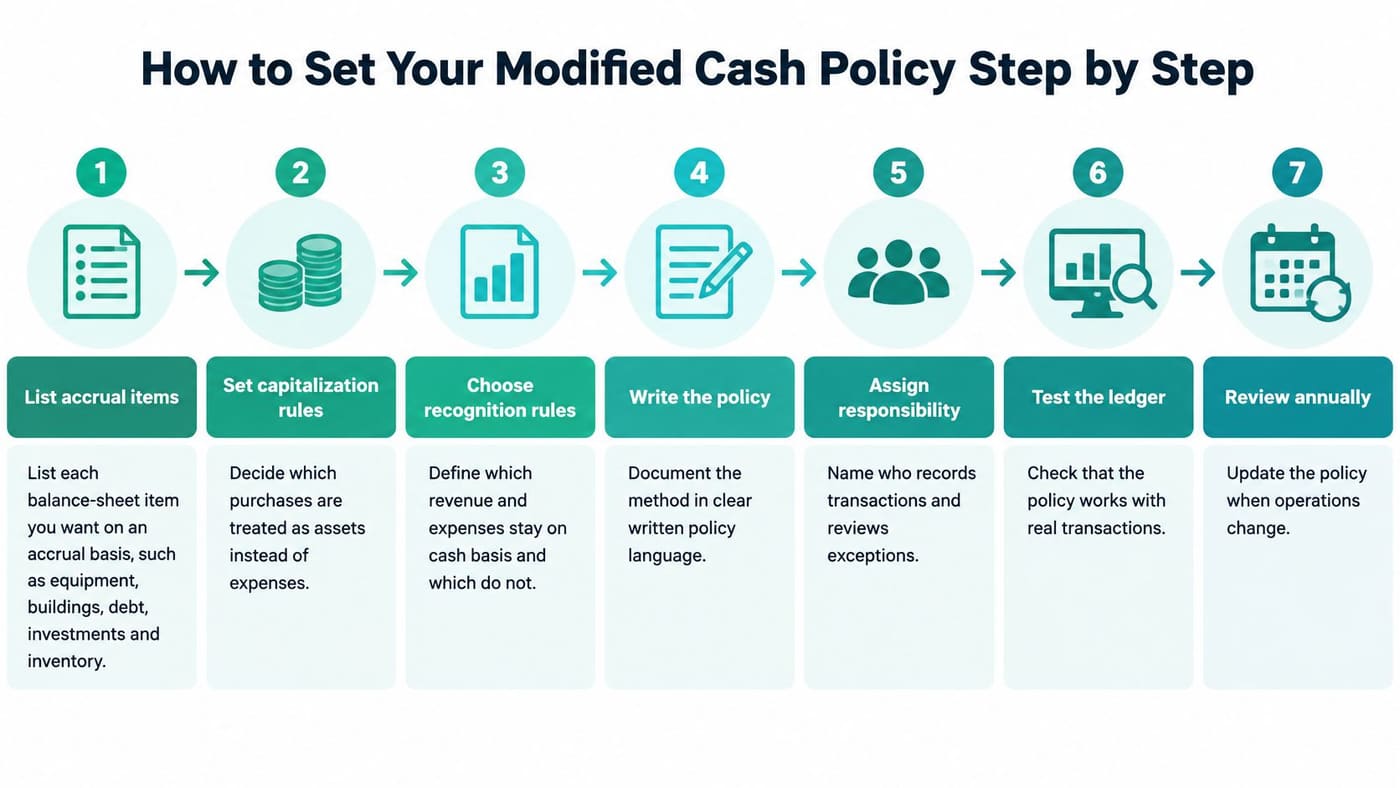
A written policy saves your staff from making the same accounting decision differently whenever someone new handles the books. It also gives your board a concrete explanation of what your statements include.
The IRS accounting-method guidance describes methods as rules governing reporting timing and emphasizes consistent treatment of material items. Your financial-statement policy should similarly translate accounting choices into repeatable instructions, without assuming tax and financial reporting are interchangeable.
Write decisions your bookkeeper can apply
-
List the balance-sheet items you'll recognize. Identify equipment, buildings, debt, investments, inventory, and any other selected items, including their measurement rules. The common slip is listing assets while forgetting their related liabilities.
-
Set a capitalization threshold. For example, your hypothetical policy might capitalize individual purchases above $5,000 with useful lives exceeding one year. Avoid splitting a single asset purchase into smaller invoices merely to bypass that policy.
-
Choose depreciation methods and useful lives. State the method, asset categories, residual-value assumptions, and when depreciation begins, so staff can reproduce the calculation. A frequent mistake is selecting a useful life without documenting the first-period convention.
-
Decide which short-term accruals belong. Address accounts payable, payroll, receivables, and other relevant timing items explicitly, including anything deliberately excluded. Don't add an accrual only because it improves a particular month's result.
-
Prepare a concise accounting policy. Aim for a practical, one-page core document listing modifications, adoption dates, reasons, and responsibility for approving exceptions. The common failure is writing broad intentions without enough detail to determine an entry.
-
Apply the policy consistently and test it. Review a sample quarterly, comparing source documents, posting dates, accounts, and treatment against the approved rules. Watch for modifications introduced midway through a year without a documented transition.
-
Prepare an accrual reconciliation when required. List omitted receivables, payables, accrued expenses, and other adjustments needed for the requested reporting framework. Don't assume recognizing equipment and debt completes a conversion to full accrual statements.
Make the policy usable beyond the finance office
Capitalization and depreciation spread reported asset costs across benefiting periods, supporting more meaningful program budgets. Keep a separate cash forecast, because depreciation doesn't show when purchase payments or loan installments leave your bank.
These choices don't automatically produce GAAP- or IFRS-compliant statements. With no single prescribed modified-cash model, your written policy is the clearest record of your reporting boundaries.
Handover test: A new staff member should be able to predict an entry without asking what the previous bookkeeper preferred.
Give that staff member a hypothetical $12,000 invoice, its purchase details, payment status, and your policy. They should identify whether it becomes an asset, an expense, a payable, or an item awaiting cash payment.
Form 990 Reporting When You Use Modified Cash
You can use modified cash for financial statements without gaining permission to choose timing freely on your tax return. Your preparer still needs to identify the reporting method and apply the relevant rules consistently.
The IRS Schedule A instructions require the accounting method used for Schedule A to match the method selected on Form 990. They distinguish contributions received under cash reporting from contributions accrued under accrual reporting.
Your written modifications therefore need mapping to the return's cash, accrual, or other-method categories. Don't assume the wording used in your board packet answers that classification question.
Match the return to documented timing rules
A pledge illustrates the distinction between fundraising information and financial recognition. Your donor-management record can track the commitment even when your reporting method doesn't yet recognize contribution revenue.
Likewise, recording a grant payment in your ledger doesn't independently establish the proper schedule or classification. Your preparer needs both the transaction details and the agreement explaining its purpose.
The Form 990 glossary can help your board understand the return's role without treating it as another bank report.
The IRS unrelated-business guidance states that $1,000 or more of gross unrelated business income generally requires Form 990-T.
Form 990 reporting points by accounting method
| Reporting point | Cash method | Accrual method |
|---|---|---|
| Schedule A contributions | Amounts actually received | Amounts accrued |
| Foreign grant expenses | Paid amounts, consistent with the rest of the return | Accrued amounts, including unpaid expenses |
| Method identified on Form 990 | Identify cash method and apply it throughout | Identify accrual method and apply it throughout |
| Unrelated business gross income | Apply the Form 990-T gross-income filing test | Apply the same Form 990-T gross-income filing test |
Review sponsorship agreements separately
A sponsor acknowledgment isn't necessarily advertising, even when the sponsor supports a visible fundraising event. The IRS guidance in Publication 598 distinguishes qualified name or logo acknowledgments from promotional advertising and other substantial return benefits.
Review what your agreement promises, not merely whether your deposit description says sponsorship. Keep the promised benefits, delivered materials, and accounting classification together for your preparer.
Before filing, reconcile these records rather than adjusting the return through undocumented judgment calls:
- Modified-cash books: Identify included accruals and intentionally omitted balances.
- Form 990 classifications: Document the selected method and any necessary reporting adjustments.
- Grant agreements: Confirm contribution terms, spending restrictions, and relevant recognition differences.
- Board reports: Explain material differences so directors don't mistake unlike totals for bookkeeping errors.
Confirm Your Accounting Basis Before the Next Board Report
"Modified cash" on a board packet tells directors less than they assume. Two organizations can use that label while accruing different items, so your directors need the written policy, not the label alone, before they approve anything.
- Name the basis: Label every financial statement and attach the accounting-policy note that lists which accruals you record.
- Check restricted balances: Match remaining amounts with grant agreements and supporting fund records.
- Confirm filing treatment: Reconcile Form 990 classifications with your books and document necessary adjustments.
Use the board reporting readiness check to organize that review before your treasurer finalizes the packet. Nonprofit accounting tools model funds differently, so compare reporting fit rather than promises of simplicity.
Keep your reporting and operating records connected
At AlignMint, fund accounting, fundraising, donor management, volunteers, events, and payments share the same operating record. Restricted dollars stay tied to their purpose from gift through report.
Accounting starts on Plus, which includes fund accounting, bank feeds, and financial reports. Statements by fund start on Pro. Nonprofits with up to $100K in annual donations can start on the free plan, with no credit card required.
Online payments keep every confirmed payment connected to its donor, fund, receipt, and accounting record, and Minty lets you ask about fund balances and financial records while the ledger and team permissions stay in control. Connected records support clearer board conversations. They do not replace an approved accounting policy that states which accruals your version of modified cash includes.
Pull last year's restriction list and compare each remaining balance with the balance sheet before approving your next report.
We offer a free setup call covering fund accounting, donations, and reporting on your plan. Visit AlignMint to arrange a walkthrough, bringing your accounting policy and restriction list so we can discuss your reporting needs.
Frequently Asked Questions
It records some accruals and leaves other items on the cash method. Two organizations can use the same label and still accrue different balances, so the written policy matters more than the name.
Accounting starts on Plus, with fund accounting, bank feeds, and financial reports. Statements by fund start on Pro. Nonprofits with up to $100K in annual donations can start on Free, with no credit card required.
Ready to try AlignMint with your nonprofit?
Start free — set up donor tools, giving pages, and Minty. Upgrade when you need accounting.