

Online fundraising can grow while your donor base shrinks. A 2025 benchmark of humanitarian organizations found active donors fell 3.2% while revenue per active donor rose 2.9% (RKD Group's mid-year benchmark). Your plan should track both sides of that story, so stronger receipts don't conceal weaker donor breadth.
Quick Answer: Online Fundraising Plan
Online fundraising for a nonprofit is a plan: each gift should land on a donor, a campaign, and a fund, and you should measure gifts rather than opens. Choosing among platforms is a separate roundup.
Start with donation pages and how to set up an online fundraising page. For campaign ideas, see fundraising online ideas.
How to Build Your Online Fundraising Plan
Online giving is now a core revenue channel, especially for small nonprofits. A clear plan helps you connect campaigns to donors and financial records, instead of treating the donation page as the whole operation.
In 2024, online donations represented 13.4% of giving for small U.S. nonprofits with less than $1 million in annual revenue, compared with 4.1% for large nonprofits, according to a Candid summary of the Blackbaud Institute's analysis. The analysis covered 5,151 nonprofits, making the difference a practical reminder: online giving can carry more weight for smaller organizations.
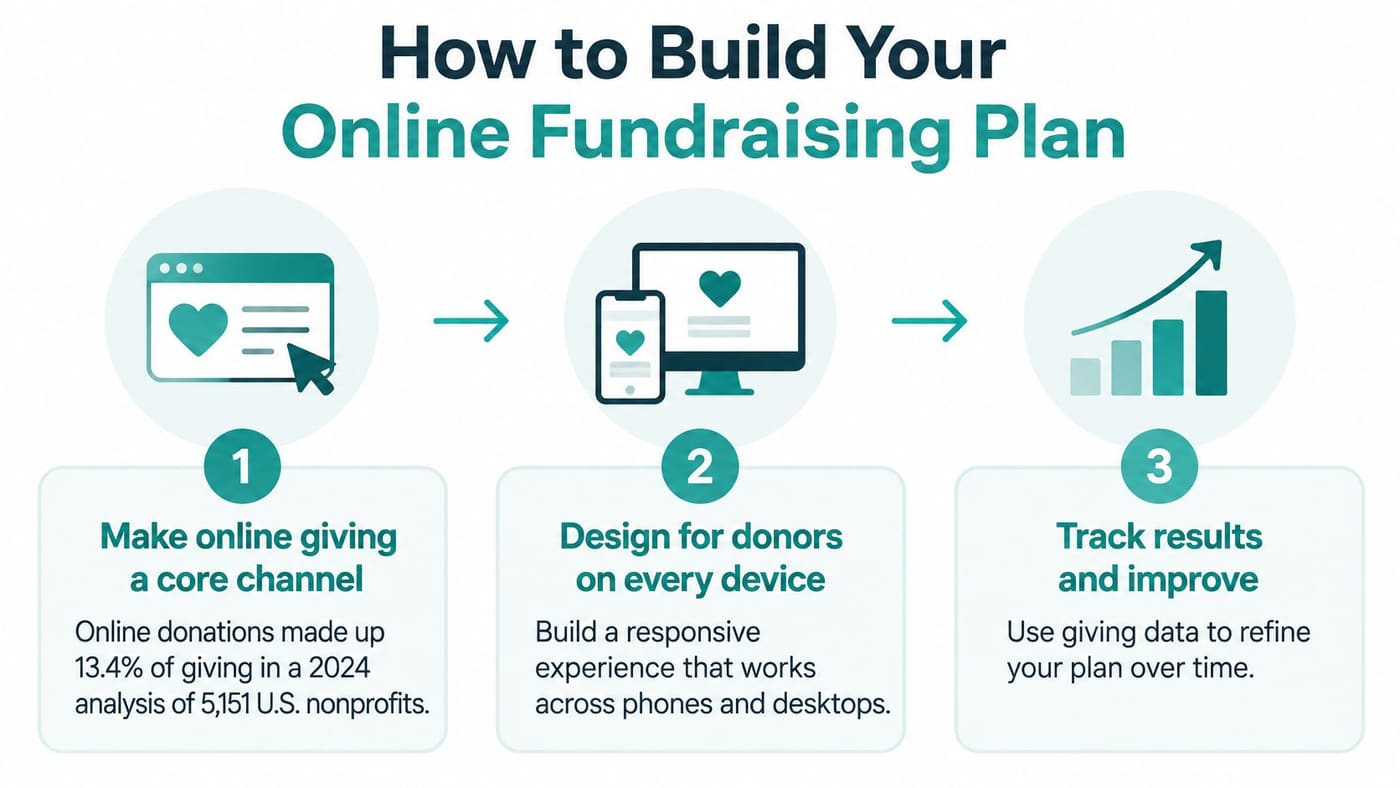
Use this routine to turn that importance into a manageable calendar:
- Set a baseline. Pull last year's online revenue, gift count, and donor count from your records. You need a starting point before choosing a growth goal.
- Choose one measurable goal. Set online giving as a share of total giving, rather than writing “grow digital” on a planning sheet.
- Pick two or three campaigns. A year-end appeal, spring event, or giving day can give your team a focused calendar without requiring constant new appeals.
- Name one owner for each campaign. Give that person responsibility for a short weekly check-in, so decisions don't disappear between departments.
- Connect the campaign pieces. Use one giving page, an email sequence, and a text reminder, with each message pointing to the same appeal.
- Choose your measures before launch. Track completed gifts, revenue per delivered email, and donors who return.
Your donation process should connect each gift to the donor, campaign, and fund, not just record a payment. Explore online giving pages, practical donor-management workflows, and the fund accounting features that support accurate reporting.
A useful test: Can you fit the campaign goal, owner, dates, and measures on one page? If not, simplify before you launch.
Segment Donors So Each Message Has One Job
Sending one appeal to everyone is convenient, but it treats a first-time donor, a volunteer, and a longtime supporter as if they have the same relationship with you. They don't. A message with one clear job is easier to write and more relevant to the recipient. Name that job at the top of the draft: thank, renew, reactivate, invite, upgrade, or schedule a conversation. If you can't name one, the message is not ready.
Export your contacts and tag each record with the date and type of the last gift. Add the source, such as an event, giving page, or referral, then remove duplicates and check unsubscribe status before sending. A donor-management workflow keeps giving history, receipts, notes, pledges, and the next relationship step on one record, so segments come from the relationship rather than from memory.
| Donor segment | Who belongs | Message job | Ask |
|---|---|---|---|
| First-time donors | Gave once in the last 12 months | Thank and show impact | Second gift, modest amount |
| Repeat donors | Gave two or more times | Report progress on a named project | Recurring gift offer |
| Lapsed donors | No gift in 18 months or more | Reactivation story showing what changed | Smaller one-time gift |
| Recurring donors | Active monthly or quarterly gift | Behind-the-scenes update | Upgrade on the gift anniversary |
| Event and volunteer contacts | Attended or served, not yet given | Invitation to join the mission | First gift, low amount |
| Major-gift prospects | Large past gifts or board referrals | Personal note from leadership | Call or meeting, not a form |
A church with 400 contacts might have 60 first-time givers, 120 repeat givers, 150 lapsed donors, and 70 volunteers who haven't given. Those counts matter as much as the revenue they produce. If repeat donors shrink while total online revenue rises, one large gift can hide a weakening base of support.
This week, build three working segments, starting with lapsed donors. Give each group a message with one job, then review responses before expanding the list. Count each segment before you send, and count it again next quarter. The second count is the useful one.
Giving Pages That Work on Phones and Desktops
A 2025 analysis of millions of donations across 500 nonprofits in the United States, Canada, the United Kingdom, and Australia found an average gift of $152 on mobile and $254 on desktop (Fundraise Up's donor analysis). The gap matters less than what it hides: mobile often brings in new donors at lower amounts, while desktop can concentrate larger gifts among fewer supporters. Watch donor count next to revenue so online growth does not mask a shrinking base.

On phones, shorten the form. Remove any field that does not help complete the gift, and offer wallet payment options where they are available. Give recurring giving a clear place on the page. A monthly option can suit a donor who arrives ready to make a small gift, even when the first amount is lower.
Desktop donors may be more likely to make larger gifts, so test a clearly presented larger-gift option with your audience. For diaspora communities and international programs, check the details that shape trust: local currency, tax-receipt wording, language, payment preferences, and privacy expectations.
Compare outcomes, not devices
Track completion rate, average gift, recurring conversion, refunds, and retention by device, country, campaign, and payment method. Add new-donor count and repeat-gift rate to that list. If mobile gifts are smaller but bring in more first-time donors, mobile is widening the base. If desktop revenue grows while active donor count falls, you have a concentration problem, not a healthy campaign. Don't judge mobile solely by average gift, or desktop solely by conversion.
A giving-page builder should connect gifts to donor records, campaign details, and fund designations. AlignMint's donation pages keep each gift connected to its donor, campaign, and intended purpose. That link makes reconciliation and follow-up easier, and it shows which device journeys build lasting support rather than one-time spikes.
Email and Text Appeals Measured by Gifts, Not Opens
Open rates can make an email campaign look healthier than it is. Apple Mail Privacy Protection can inflate opens, so use completed gifts and revenue to judge whether an appeal did its job. M+R's email fundraising benchmarks provide a starting point for measuring delivered messages, clicks, donations, and unsubscribes.
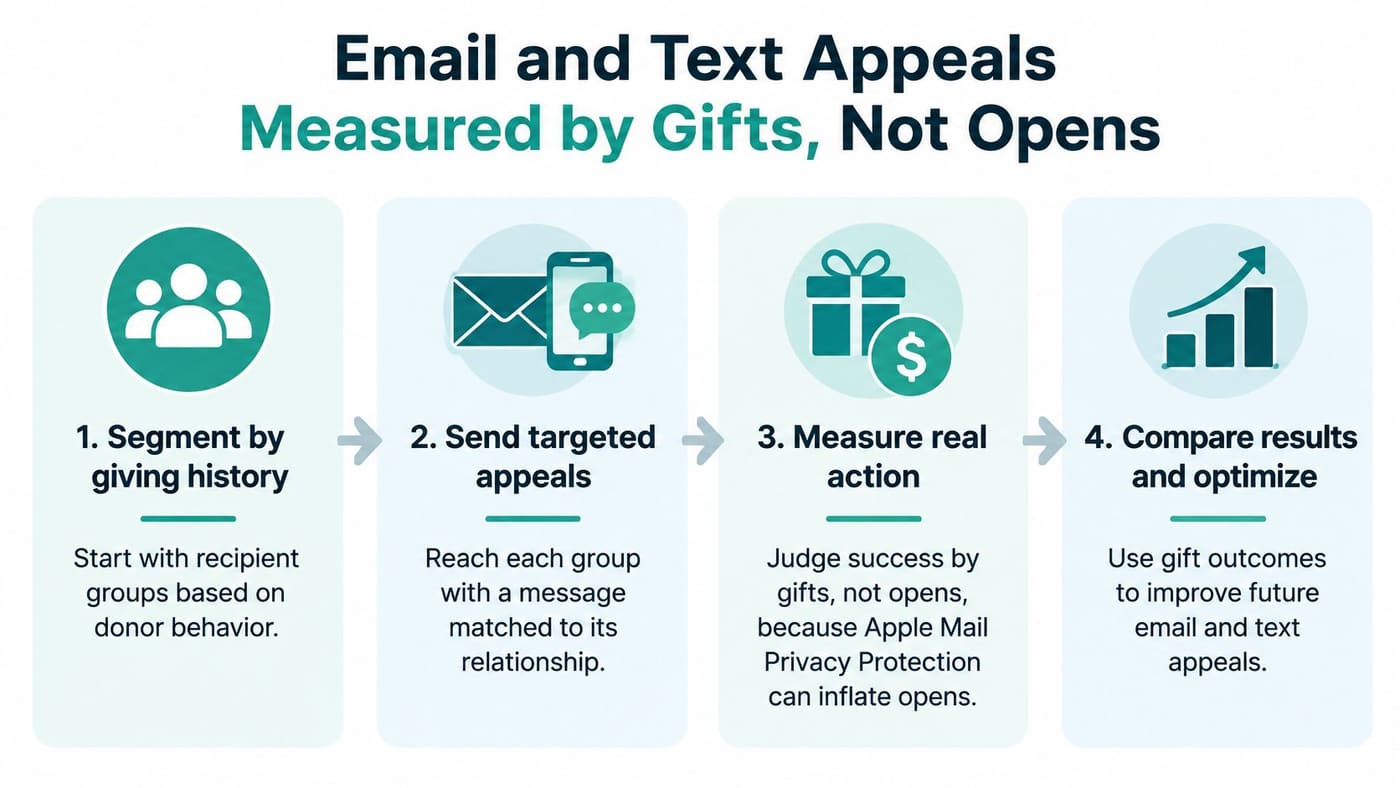
Build a simple funnel before you send:
- Segment recipients by donor status, giving history, and engagement. A lapsed donor and an active monthly donor shouldn't receive an identical ask.
- Give each segment one appeal. Track delivered messages, clicks, completed donation pages, gifts, revenue, and unsubscribes.
- Compare results fairly. Hold back 10% of a segment when practical, or compare with a similar prior campaign.
- Follow up with clickers who didn't give. Send a short reminder that answers a likely question or makes the next step clear.
Benchmark the results
| Fundraising email benchmarks at 100,000 recipients | Benchmark | What It Means for 100,000 Recipients |
|---|---|---|
| Click-through rate | 0.59% | About 590 clicks |
| Response rate | 0.05% | About 50 donations |
| Revenue per 1,000 emails | $54 | About $5,400 raised |
| Open rate | Not a reliable KPI | Can be inflated by mail privacy features |
These are average benchmarks, not a forecast for your organization. M+R's figures imply about 50 donations and $5,400 in revenue from 100,000 delivered fundraising emails at the stated average response and revenue levels. Measure the number delivered, not the total size of your contact database.
Use text for concise event alerts, urgent deadlines, and reminders that benefit from quick attention. Keep messages short, make the action obvious, and send only to people who opted in. Your email and text workflow should make it easy to follow a click through to a gift; see these email campaign practices for a useful operational reference.
Measure behavior, not curiosity: A click is a step toward a gift. An open, by itself, isn't.
Run Events and Giving Days That Build Your Donor Base
An event can raise funds and introduce your organization to people who already care about its work. It can also consume staff time without building donor relationships if you don't plan invitations, follow-up, and records together.
Choose one event that suits your mission and calendar, such as a spring dinner or a one-day giving campaign. Invite event attendees and volunteers who haven't given, and make the first-gift option accessible. Set one donation goal; if a sponsor will match gifts, explain the challenge clearly on the giving page.
Record volunteer assignments and hours as part of event management. Independent Sector and the Do Good Institute estimated the value of a U.S. volunteer hour at $34.79 using data collected in 2024 (their volunteer value report). That's a way to describe community capacity, not cash revenue or an automatic contributed-income entry.
Tag event expenses as fundraising when they relate to conducting a campaign or soliciting gifts. The IRS explains that fundraising costs belong in fundraising expenses, including allocable overhead connected with fundraising activity (IRS Form 990 instructions). Discuss classification with your finance lead, especially when an event also includes program activity.
Within several days, send attendees a thank-you without another ask. Then invite new donors into the appropriate follow-up sequence. An event-management workflow can keep ticketing, attendance, and donor follow-up connected.
Keep First-Time Donors Coming Back
A successful first gift isn't the same as a healthy donor relationship. M+R reports that about half of online one-time donors in 2024 returned to make another online one-time gift in 2025, a directional benchmark rather than a promise (M+R fundraising benchmarks). Build the next steps into the giving process instead of waiting until renewal season.
- Send an immediate receipt and impact confirmation. A prompt, compliant receipt gives donors a clear record of their gift.
- Follow up within several days without asking again. Show what the gift helped make possible.
- Invite donors to set preferences or give regularly. Let people choose how they hear from you and whether a recurring gift suits them.
- Schedule renewal based on the original gift date and channel. A relevant reminder is more useful than a generic calendar blast.
- Review second-gift conversion by cohort, source, device, and gift type. Those comparisons help distinguish a campaign that acquired donors from one that kept them.

Don't judge campaigns only by the cost or conversion rate of the first gift. A channel that brings in inexpensive first-time donors may lose its advantage if few return, while another channel may build stronger long-term relationships. Track payment failures, refunds, recurring-gift cancellations, and the timing of the second gift, too.
A practical cohort measure is cumulative net revenue divided by donors acquired. Review it regularly, alongside donor retention, so the team can see whether acquisition produces lasting support. A donor journey workflow can help keep the receipt, impact message, and renewal sequence organized.
Track Donor Health, Not Just Revenue
Revenue can rise while the number of active donors falls. A strong total often hides a narrower base: the donors who remain give more, a few major gifts cover the gap, and acquisition slows without anyone noticing. Watch donor breadth alongside revenue so growth in the total does not mask a shrinking group of supporters.
Track several measures together each quarter. Read the pattern across donor counts, gift behavior, and retention. A single campaign total rarely shows whether the base is widening or thinning.
| Measure | Why it matters | Warning sign |
|---|---|---|
| Active donors | Shows whether your base is growing | Falling for two years in a row |
| First-time vs repeat donors | Shows whether new donors stay | Repeat share shrinking each year |
| Median gift | Shows typical giving, not outliers | Rising while donor count falls |
| Recurring conversion rate | Shows steady, predictable income | Flat after a campaign push |
| Revenue share from top donors | Shows concentration risk | Top donors supply most of the total growth |
| Channel retention | Shows which channels build loyalty | Cheap channel with a low second-gift rate |
Keep acquisition success separate from revenue success. A campaign can lift average gifts while fewer people participate or return. If high-value appeals grow, pair them with accessible recurring-gift options and reactivation efforts, then compare results by donor retention. The test is whether new names become second gifts, not whether one appeal beat its goal.
Classify campaign expenses carefully, including the overhead tied to fundraising. On functional expense reports for U.S. tax-exempt organizations, fundraising costs belong in fundraising, not program services. Review those classifications with your finance lead before the board meeting, alongside the donor-health measures. Misclassifying fundraising as program spending makes the cost of donor growth look lower than it is.
Confirm Your First Campaign This Month
Pick one campaign, name one owner, and set a launch date within the next month. Confirm the audience segments, agree on the measures, and check that each gift will connect to its donor and fund record before the appeal goes out.
Use the confirmation meeting to lock the scorecard, too. Put revenue beside donor breadth: active donors, repeat-gift share, and median gift. That stops a strong total from hiding a shrinking base.
A practical system should connect each gift to the donor and intended fund while giving your finance lead usable reporting. AlignMint brings fund accounting, donor records, volunteers, events, and marketing onto one operating record, with user limits that scale by plan, starting at one user on the free tier. It is free for nonprofits with up to $100K in annual donations, and no credit card is required. AlignMint also offers a free setup call to walk through fund accounting, donations, and reporting for your plan.
Write the campaign goal, owner, launch date, and donor-health measures on one page today, then share it with your board treasurer.
Visit AlignMint to see whether it fits your next campaign.
Frequently Asked Questions
A named audience, one campaign owner, and a path that posts each gift to the donor, the campaign, and the fund. Judge the result by gifts and returning donors, not by opens.
No. This page is the operating plan. The separate platform roundup compares checkout tools, fees, and recurring gifts.
Ready to try AlignMint with your nonprofit?
Start free — set up donor tools, giving pages, and Minty. Upgrade when you need accounting.