

Form 990-N is the IRS e-Postcard for small tax-exempt organizations whose gross receipts are normally $50,000 or less. It is due on the 15th day of the fifth month after your tax year ends.
Your board may treat that accepted notice as proof the books are clean. What happens when a donor asks where a restricted gift went?
The postcard only tells the IRS you still qualify. It doesn't prove restricted-fund records or donor receipts. Three missed years can end your exemption even when there's no late fee.
You want a filing decision you can explain in a board meeting, plus books that still answer the questions the notice never asks. The rules below are short. The recordkeeping habit beside them is what keeps gifts, grants, and volunteers from turning into a spring scramble.
Quick Answer: Form 990-N e-Postcard
Form 990-N is the IRS e-Postcard for small organizations whose gross receipts are normally $50,000 or less. It confirms you are still operating. Form 990-EZ and the full Form 990 are separate returns.
Start with fund accounting and the Form 990-EZ guide. For the EZ size test, see Form 990-EZ requirements. For the full return, see Form 990 reporting and the Form 990 guide for new nonprofits. To look up a filed return, see how to find a Form 990.
What Form 990-N Really Is
Picture a short yearly postcard, not a stack of financial statements. You send it only after the tax year closes, then you wait for the IRS to accept it.
Form 990-N is the Electronic Notice, also called the e-Postcard, for small tax-exempt organizations that aren't required to file Form 990 or Form 990-EZ. You confirm the tax year, legal name, EIN, that the organization is still operating, and that gross receipts are normally $50,000 or less.
Gross receipts means total amounts received from all sources during the year, before any costs or expenses. A dinner, a grant, and a Sunday offering all count the same way. Spending the money later doesn't shrink the figure.
The IRS e-Postcard filing page says this notice applies to tax periods beginning after December 31, 2006. That same page states that organizations failing the annual filing requirement for three consecutive years are subject to automatic revocation of exemption.
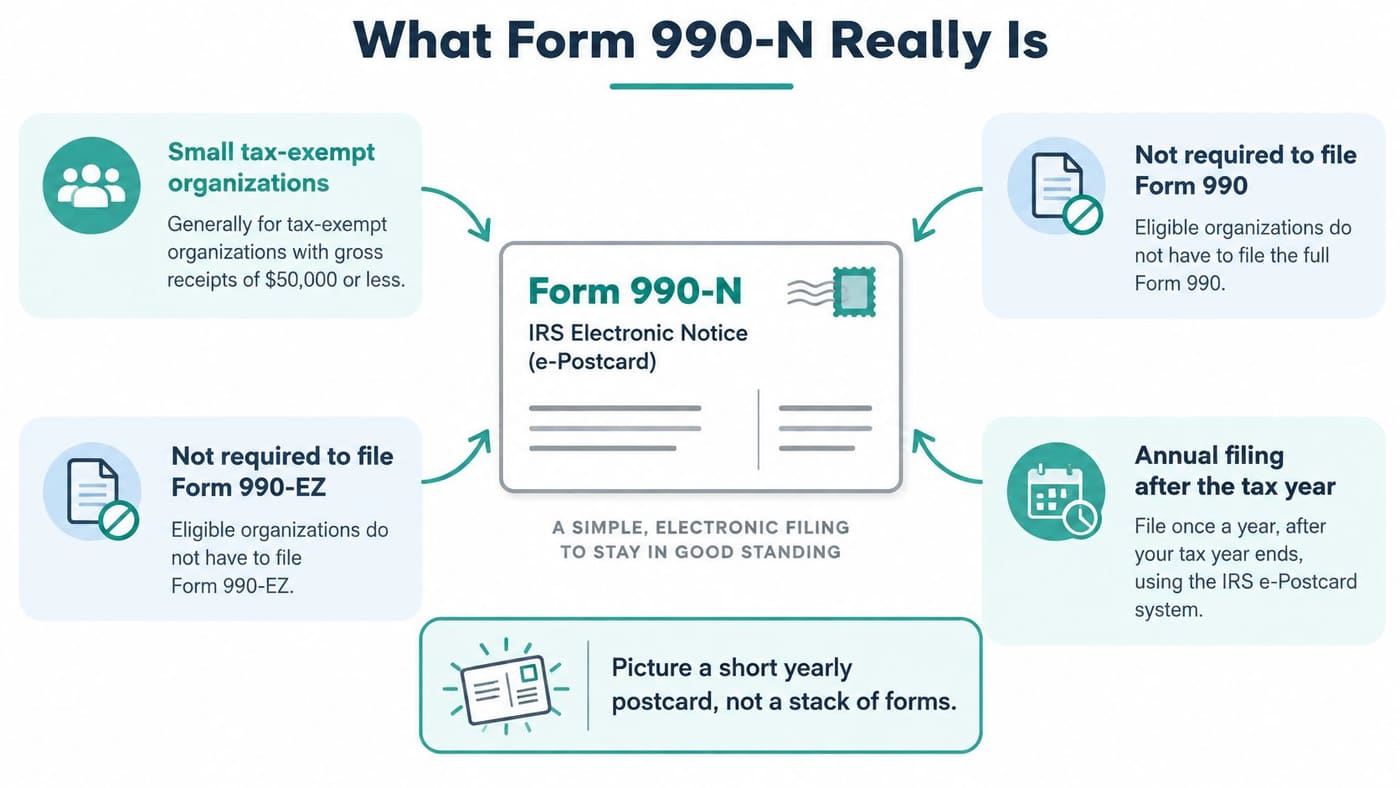
An accepted notice helps the IRS see that the exemption is still active. It is not a full return, and nobody at the IRS is reviewing your ledger, your donor list, or your volunteer hours.
If status is lost, restoring it may require a separate IRS application and can add administrative and tax work. A dated reminder and a saved confirmation are the cheap protection.
What the notice is for
Practical rule: Treat the e-Postcard as a status check, not as a financial statement your finance committee can rely on.
Directors often ask what a 990-N is when a volunteer says "we already filed taxes." You filed a short electronic notice. You didn't file a picture of programs, restricted gifts, or who may spend which dollars.
Who Can File the e-Postcard
| How long you have operated | What you average | Qualify for 990-N when |
|---|---|---|
| First tax year | Projected or pledged gross receipts | Up to $75,000 |
| Two or three years old | Average of the first two tax years | $60,000 or less |
| At least three years | Current year plus the two prior years | $50,000 or less |
Read your row before you tell the board the postcard is enough. The test uses gross receipts, not profit and not cash left in the bank.
Add donations, grants, program fees, ticket sales, and any other amounts received. Don't subtract rent, food, stipends, or the cost of the event. A year that "broke even" can still sit over the line.
The default row
The IRS annual electronic filing requirement says an organization operating for at least three years generally qualifies when average annual gross receipts for the current year and the two years just before it are no more than $50,000.
Say the last three years brought in $46,000, $51,000, and $48,000. Add them, divide by three, and you land at $48,333. That average fits the postcard. One strong year didn't push you off the form by itself.
A new organization has more room in year one. Projected or pledged receipts may be up to $75,000. In years two and three, the usual test is an average of $60,000 or less across the first two tax years.
When the postcard is the wrong notice
If the average is over your row, 990-N is the wrong notice for that year. You look at Form 990-EZ or Form 990 instead. Filing the short notice anyway doesn't shrink the receipts.
You still wait until the tax year ends. The filing is due by the 15th day of the fifth month after year-end. For a calendar-year organization, that standard deadline is May 15 of the following year. A weekend or legal holiday moves it to the next business day.
Most groups asking this question are 501(c)(3) organizations, though the receipt test is about size, not about your mission statement. Churches and some other groups have their own filing duties, so confirm yours before you assume the postcard applies.
A year under the cap still needs a closed set of books. The IRS is checking the size test, not whether restricted gifts stayed in the right pot.
How to File the e-Postcard
Filing takes one online session after the tax year closes. Gather the facts first, and the notice itself takes only minutes.
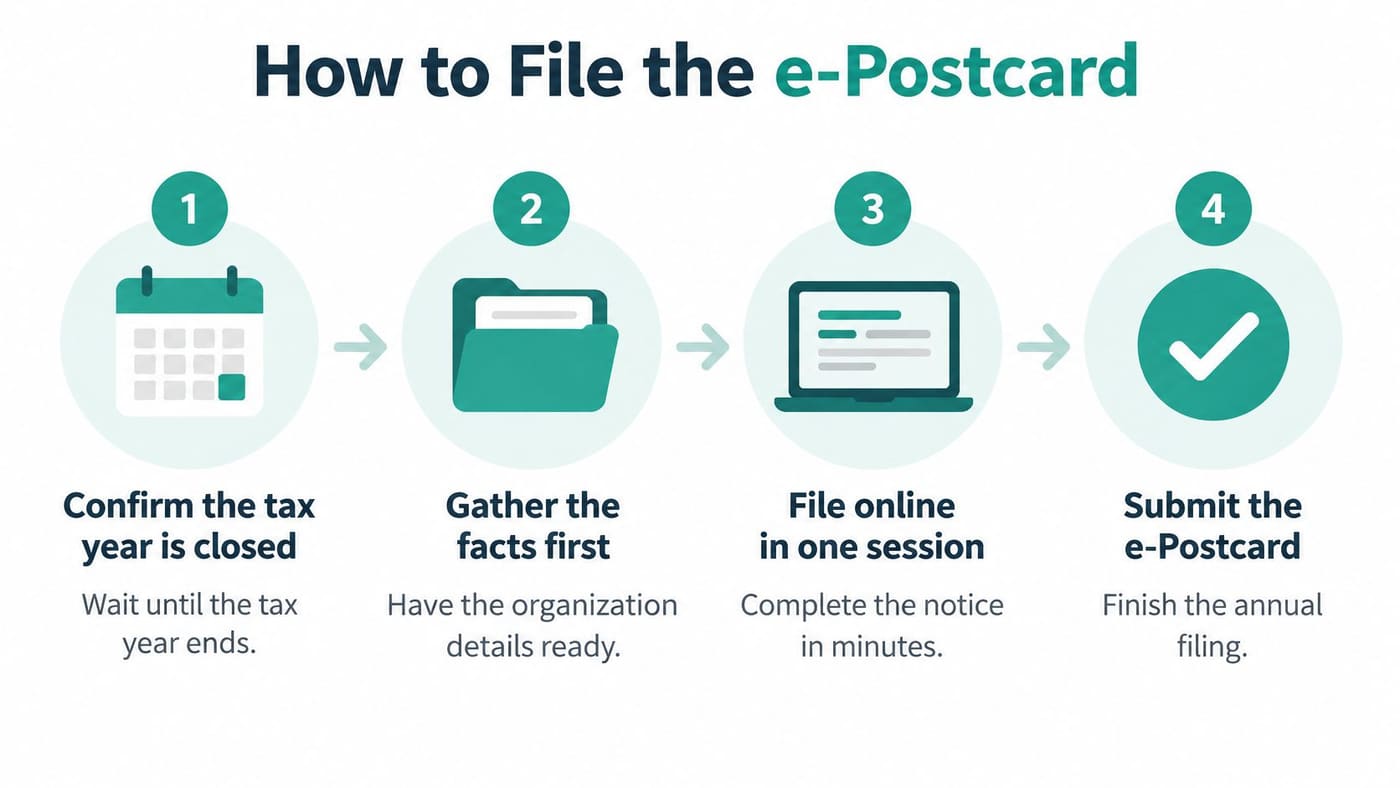
Work in this order. Each step exists because a later treasurer has to trust what you sent.
- Confirm the year is closed. Finish the books for that period before you answer the receipt question. An open month can change the average.
- Match the EIN and legal name. Use the IRS determination letter, not the name on the Facebook page or the bank's shorthand.
- Update the mailing address. A letter about a rejected notice is useless if it goes to a former church office or a past treasurer's home.
- Name a principal officer. Pick someone who will sign and who will still answer if the IRS writes next spring.
- Confirm you are still operating. A paused program is not the same as a closed organization. If you are shutting down, this notice is the wrong vehicle.
- Confirm the receipt test. Use your row from the eligibility table, including pledges in year one. Don't use the bank balance.
- Submit and save the acceptance. Put the IRS acceptance record in that year's financial file, next to your completed month-end close checklist, Balance Sheet, Income Statement, and other year-end records from fiscal year close.
- Check the public exempt list. Search it a few weeks later. A rejected notice can sit unseen while everyone assumes the job is done.
Why the file matters more than the screen
The ordinary deadline is that fifth-month date. Weekends and legal holidays move it to the next business day. There is no money penalty for a late 990-N, but a missed year still counts toward revocation.
Save the login with two officers, not in one person's email. Leadership turnover is how a five-minute notice becomes a three-year gap.
990-N Compared with Longer Forms
| Form | Usual size test | What you send | What the public file shows | Late-fee note |
|---|---|---|---|---|
| Form 990-N | Gross receipts normally $50,000 or less | Electronic notice of identity and status | Little beyond name, EIN, year, and that you filed | No 990-N late fee, but three misses can revoke exemption |
| Form 990-EZ | Generally under $200,000 receipts and under $500,000 assets | Shorter exempt-organization return | Summary finances and program information | Monetary late-filing penalties can apply |
| Form 990 | Over the 990-EZ limits, or you choose the full return | Full annual information return | Programs, functional expenses, governance, and compensation highlights | Monetary late-filing penalties can apply |
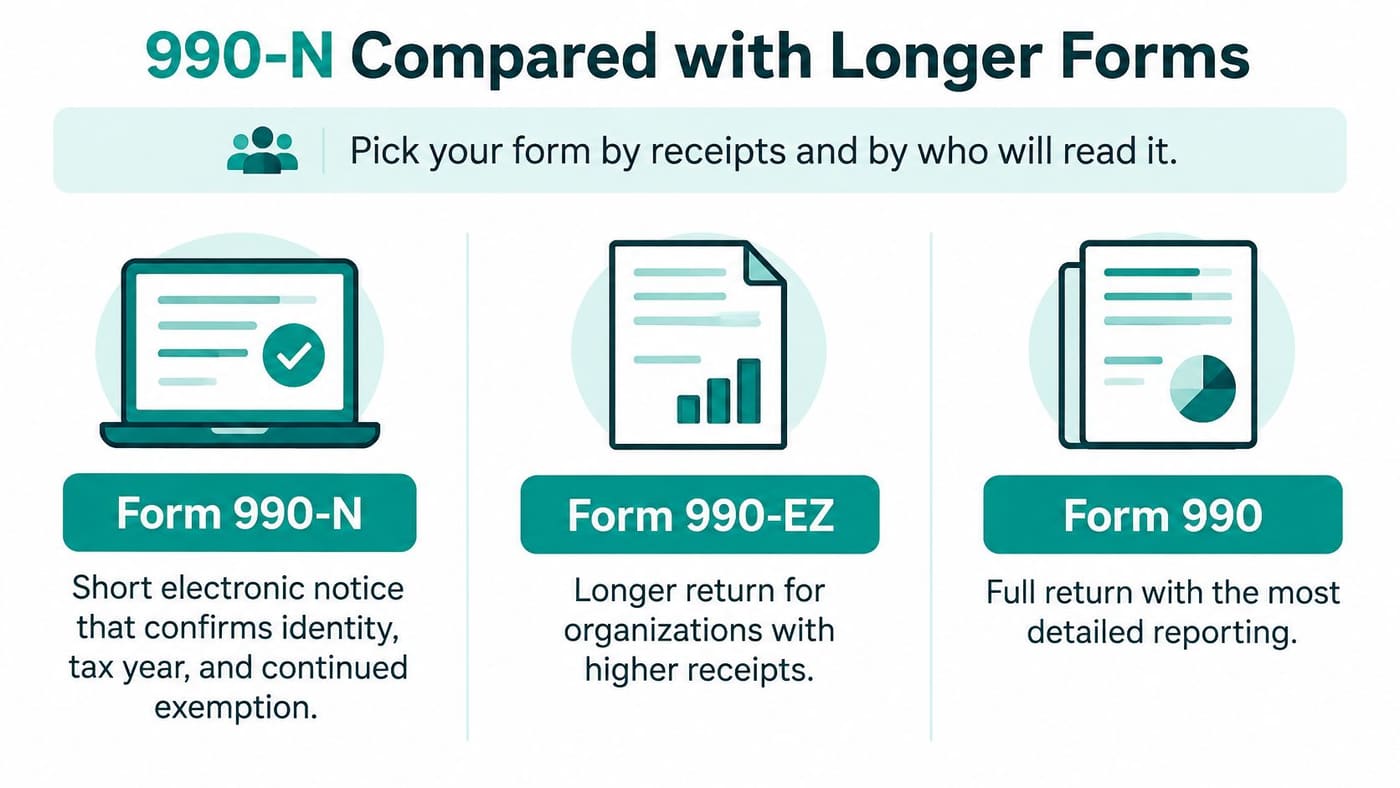
Pick the form by receipts and by who will read the public file. The three forms are built for different audiences.
What each form does well
Form 990-N is quick. It confirms identity, tax year, and continued eligibility. It shows the public little beyond that, which is fine when no grantmaker is asking for program spending.
Form 990-EZ is the middle return. It carries summary finances and program information without the full Form 990 package. Many growing food pantries, booster clubs, and small schools land here once receipts rise.
Form 990 is the full annual information return. It shows programs, functional expenses, governance, and compensation highlights. Donors and grantmakers who want to see how money was spent look for this one, or for the EZ, not for the postcard.
You may file a longer form by choice even when the postcard is allowed. Some foundations ask for that picture. If this year fits 990-N but next year may cross the small-receipt line, keep records that could support Form 990-EZ so you aren't rebuilding the year in April.
Our Form 990 glossary is the place to see how the longer return is organized when you outgrow the notice. The verdict is simple. Stay on the postcard while your average fits and nobody needs a public spending picture. Move up when the size test or a real reader says you should.
What a Filed 990-N Does Not Prove
Say a pantry takes in $32,000 of donations, $4,000 of program fees, and $6,000 from a spring dinner. Gross receipts are $42,000. The $28,000 spent on food doesn't reduce that figure.
If the three-year average stays at or under the small-organization line, the postcard is the right federal notice. The acceptance still doesn't show a donor that scholarship money, or a food-restricted gift, stayed out of operating cash.
Churches, schools, and sponsored projects
A church treasurer shouldn't assume the pantry's answer. Confirm that congregation's own IRS filing duty before you skip or send the notice. Some congregations have a different obligation than a standalone charity of the same size.
A school booster club or a project under a fiscal sponsor can sit below the receipt line and still juggle restricted gifts, volunteers, and events. The sponsor's books and the project's books are not the same file. Parents and grant reviewers will ask which dollars belong to the team trip and which dollars are free.
The IRS Form 990-N FAQ describes the notice as a short electronic filing for most tax-exempt organizations whose gross receipts are normally $50,000 or less, rather than the detailed Form 990 or 990-EZ. It asks for basic identity and status items: tax year, legal name, EIN, that you are still operating, and that receipts are normally within the threshold.
The records the postcard never shows
That FAQ's narrow list is the whole public story. The notice doesn't provide a public picture of restricted funds, program spending, grants, functional expenses, donor concentration, or governance practices.
You can submit it successfully and still lack fund accounting, grant files, donation receipts, state charity registration, or the packet an auditor wants. That gap shows up often for churches, schools, fiscal-sponsorship projects, and new nonprofits whose dollars are small and whose operations are not.
Keep restricted and unrestricted balances visible. Limit who can open donor records. A financial readiness check is a useful board conversation beside the acceptance email, because the IRS confirmation was never designed to replace it.
The postcard answers "are we still small and still here?" Your donors are asking "did you keep my gift for the purpose I named?"
When Three Missed Years Revoke Exemption
No late fee doesn't make the notice optional. The missing dollars aren't the risk. The missing status is.
Under Internal Revenue Code section 6033(j), an organization required to file Form 990-N, Form 990-EZ, or Form 990 that misses its filing requirement for three consecutive years loses federal tax-exempt status automatically. The IRS FAQ on when to file states that the revocation becomes effective on the filing due date of the third missed year, not the day after the first miss.
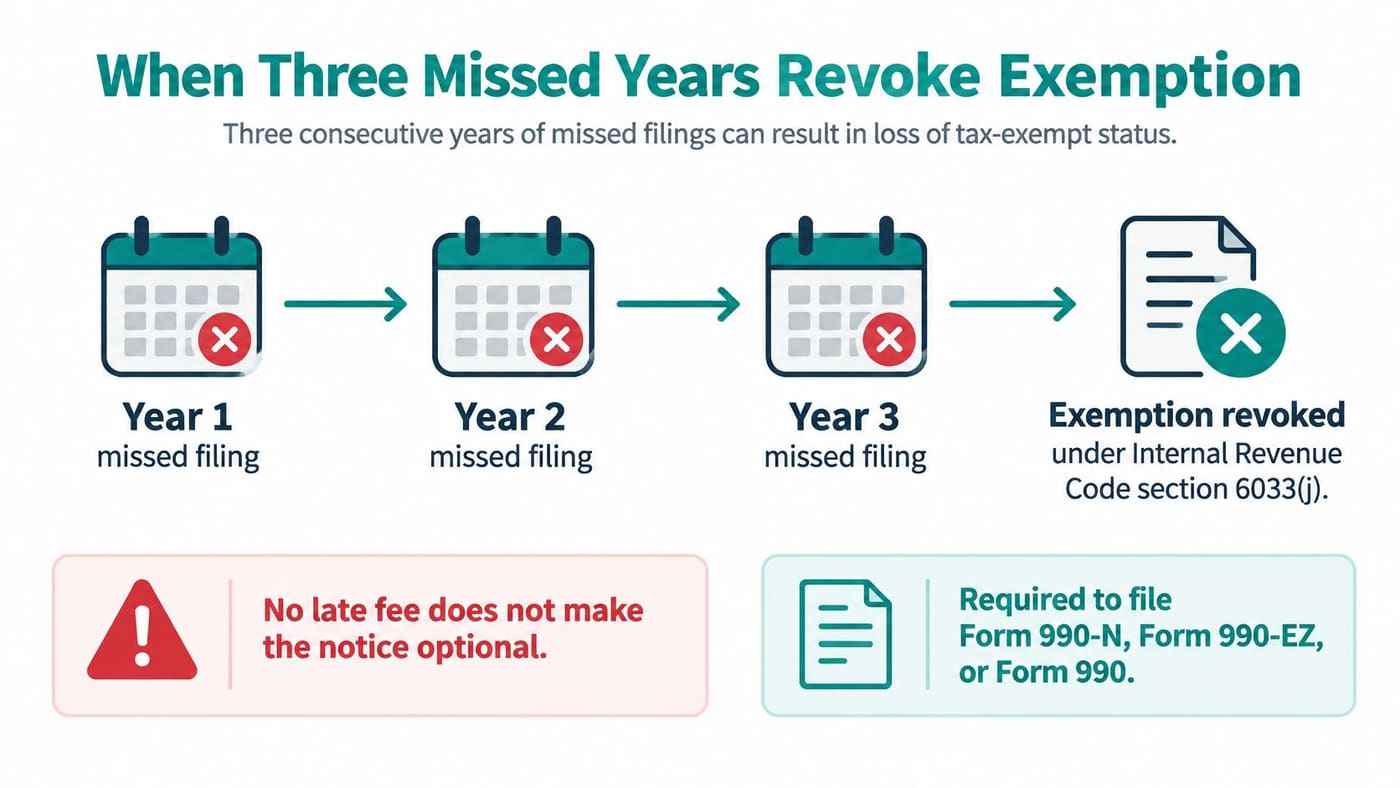
For a calendar-year filer, that ordinary due date is May 15, moved when it falls on a weekend or legal holiday. Three quiet springs can end on that third date. The IRS doesn't impose a late-filing penalty for a missing Form 990-N. The legal risk is loss of exemption anyway.
What breaks when status drops
Donors may question whether gifts are deductible. A grant, a bank account, or a contract that requires active exempt status can stall. Reinstatement takes a separate IRS application, and normal exempt treatment waits until you meet those requirements. The paperwork doesn't rewind the months you couldn't receipt gifts with confidence.
A habit that survives turnover
- Name the filer in the board minutes each year, so the job isn't "whoever remembers."
- Store the EIN and e-Postcard login with two officers, not in one inbox.
- Put the fifth-month date on the calendar when you close the books, while the year is still fresh.
- Save the acceptance notice with that year's financial file, and note who checked the public status.
One missed year is a warning. The third missed due date is the one that can change your status. A volunteer treasurer who treats the postcard as trivial can hand the next board a revoked exemption and a reinstatement project.
File the Postcard and Ready the Books
Decide from your row in the eligibility table. If your average fits, file the e-Postcard after year-end and keep the confirmation. If you are near the line, keep records that could support Form 990-EZ without a spring rebuild.
The postcard answers one IRS question. Your board, donors, and grantmakers need to know which dollars are free to spend. Restricted gifts, volunteer hours, and event income still have to land in the right place.
Event nights are a common leak. Planstone on audit-ready event records is a clear reminder that ticket lists and attendance notes should survive past the thank-you email. Pair that habit with a year-end Form 990 checklist so the notice and the books close together.
One set of books behind the notice
We built AlignMint so accounting, donor management, volunteers, events, and marketing live in one platform. Your team isn't juggling five logins for one mission. Fund accounting tracks restricted and unrestricted money in true fund ledgers, not as a label on a class.
QuickBooks Online remains a strong choice for bookkeepers who already work there. Its classes sort activity inside a familiar company file. Those classes don't act as a fund ledger that carries a restricted balance from the gift through the report.
Minty, our AI assistant, answers plain-language questions about balances you already keep. Free is one user for nonprofits with up to $100K in annual donations, and no credit card is required. Plus adds teammates. Form 990 Builder starts on Pro and prepares filing information from connected financial records. You can export financial reports to PDF or Excel. The balance sheet starts on Plus.
File the postcard on time. Keep the books that explain the gifts the postcard never lists.
AlignMint keeps fund balances, donor receipts, volunteers, and giving pages in the same records you use when the e-Postcard is due. You can see which dollars are restricted before a board member or a grantmaker asks. Visit AlignMint and start a free account if your annual donations are within the free tier.
Frequently Asked Questions
It is the IRS e-Postcard for organizations whose gross receipts are normally $50,000 or less. It confirms identity and that you are still operating. It is not Form 990-EZ or the full Form 990.
No. Free is one user for nonprofits with up to $100K in annual donations, and no credit card is required. Form 990 Builder starts on Pro. The balance sheet starts on Plus.
Ready to try AlignMint with your nonprofit?
Start free — set up donor tools, giving pages, and Minty. Upgrade when you need accounting.