

Fund accounting tracks each dollar by its purpose, source, and restrictions, instead of treating all cash as one pool. That's why a nonprofit reporting $500,000 of spending on Form 990 must also show how much went to programs, administration, and fundraising. You open the operating account, see a number that looks healthy, and feel fine. Then a grant manager asks whether the after-school money is still intact, and the balance stops being reassuring. This article explains the method in plain terms, with examples, and shows where teams misread their own bank balance.
Quick Answer: Fund Accounting for Beginners
Fund accounting tracks each dollar by its purpose, source, and restriction. This page is the beginner explainer. The leader's operating guide, the restricted-versus-unrestricted comparison, and the journal-entry guide are separate pages.
Start with fund accounting and the fund accounting leader's guide. For the side-by-side comparison, see restricted vs unrestricted funds. For the practical restricted-funds guide, see restricted funds. For the journal entries, see restricted fund accounting.
What Fund Accounting Means in Plain Terms
A business ledger answers one question: did the enterprise make money. A fund ledger answers a different one: did the money go where it was promised. That shift in question changes everything about how a transaction gets recorded.
The IRS instructions for Form 990 make the expectation concrete. Tax-exempt organizations must separate total expenses from functional expenses, splitting Part IX into program services, management and general, and fundraising. Filers also describe their three largest program services by expense. A single "total expenses" line can't satisfy that, because the form is asking what the money did, not just how much left the account.

Think of your operating account as the office fridge. One box, one door, one balance. But inside, each shelf is labeled: the youth grant, the building campaign, the scholarship fund, general operations. Everyone can see the fridge is full. Nobody should eat from a shelf that's already spoken for. Fund accounting is the labeling system, and the discipline of checking the label before you take something out.
Three building blocks carry the whole method:
- The fund. A self-contained group of money with its own inflows, outflows, and balance. A restricted grant to a youth program stays identifiable as its own resource so you can prove the spending matched the grantor's purpose.
- The restriction. The limit a donor or grantor attaches, either on what the money can do or on when it becomes usable.
- The purpose. The work the money must serve, which is what your board, your auditor, and the grant report all ask about.
Run one test this week. Point at each dollar in the bank and name the fund it belongs to. If any dollar has no name, your balance is overstating what you can spend.
How Restricted and Unrestricted Funds Are Tracked
Start with the categories, because most confusion dissolves once you can see the whole map at once.
| Fund type | Who sets the limit | Example | Reporting treatment |
|---|---|---|---|
| Net assets without donor restrictions | Board and management | Annual appeal gifts and earned fees | Available for any mission purpose |
| Net assets with donor restrictions, purpose | Donor or grantor | Youth scholarship gift | Held until scholarships are paid, then released |
| Net assets with donor restrictions, time | Donor | Three-year pledge paid in annual installments | Held until the year the funds become usable |
| Endowment principal | Donor or governing law | Original gift to a permanent endowment | Principal kept, gains and income assessed separately |
Under U.S. GAAP, the IRS draft instructions for Form 990 set out two net-asset classes to report: net assets with donor restrictions and net assets without donor restrictions. Every row above lands in one of those two, which is why the table is short even though the situations aren't.
A reliable fund ledger carries eight fields for every fund:
- A fund ID that staff use in conversation, not just in the system
- The restriction type, purpose or time
- The allowable purpose in the funder's own words
- The expiration or release condition
- The approved budget
- Expenses charged to date
- The remaining balance
- The supporting documentation, meaning the award letter, the pledge card, or the donor email
Now the mechanics, using a $25,000 gift restricted to youth scholarships. The full amount sits in restricted net assets on day one. You award $6,000 in scholarships in the spring, so $6,000 releases into net assets without donor restrictions. The restricted balance drops to $19,000, and your financial statements now show that the donor's purpose was met.
A release reclassifies money you already hold. It never adds a dollar to the bank, which is the single most common misunderstanding we see in board packets.
An endowment works the same way in miniature, with three parts assessed separately: the original gift, its investment gains or losses, and the interest or dividends it throws off. Monthly, match every fund balance to the general ledger and to the grant schedule. That comparison catches overspending, early releases, and restriction changes nobody wrote down.
Seasonal campaigns need the same care, because a purpose-restricted activity still needs its own line. A Christmas wreath fundraiser is a good example: the money raised supports one named project, and every sale should land in that fund rather than in general revenue. Once your fund structure is settled, the chart of accounts setup is where it becomes usable day to day.
Restrictions Versus Conditions on Grant Money
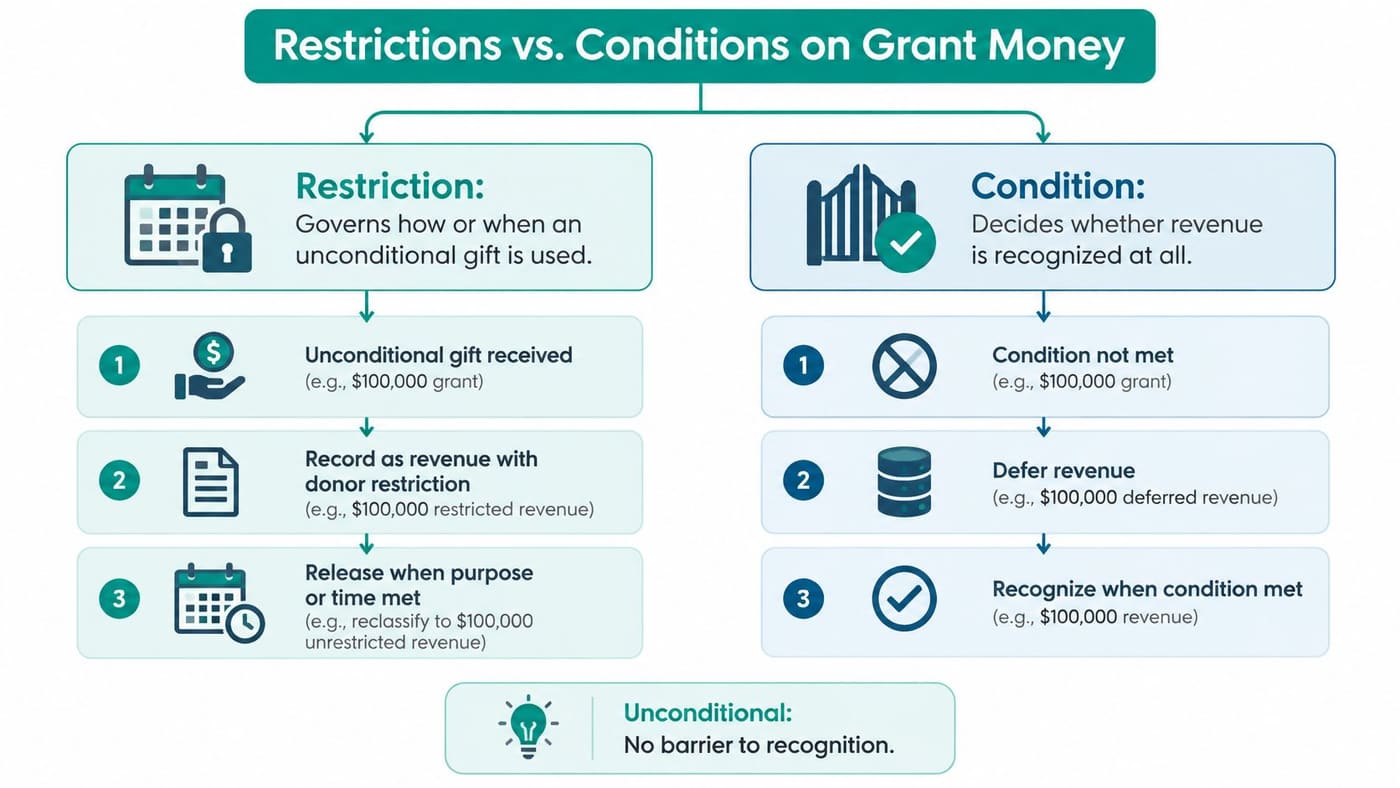
Here's the distinction that decides whether a grant is revenue today or a liability until June. A restriction governs how or when an unconditional gift may be used. A condition decides whether contribution revenue gets recognized at all. NetSuite's guide to restricted funds puts the same point sharply: an unconditional contribution is generally revenue when received or promised, while a conditional contribution may stay a liability until you overcome a substantive barrier and the donor's right of return lapses.
The practical test is four questions, in this order.
- Does the award carry a milestone, a matching requirement, or a cost-reimbursement rule you must meet before the money is yours?
- Can the funder take the money back, or refuse to release it, if you miss that barrier?
- If both answers are yes, record the cash as a liability until the condition is met.
- If either answer is no, record revenue now, restricted by purpose or by time.
Apply it to four awards you'll meet this year.
| Award | Cash flow | Journal consequence |
|---|---|---|
| Conditional grant reimbursing approved program costs | Cash arrives after approved costs are incurred and reported | Liability until the barrier is overcome and the right of return lapses |
| Purpose-restricted gift | Cash received on receipt | Revenue recognized now in net assets with donor restrictions |
| Time-restricted three-year pledge | Cash in annual installments | Revenue recognized when promised, held as restricted until usable |
| Cost-reimbursement award | Cash follows documentation of qualifying costs | Liability until qualifying costs are incurred and documented |
Notice how differently these behave in a cash-flow forecast. The conditional grant shows up as a receivable at best, so you can't pay March payroll with it. The purpose-restricted gift is already yours, and only its use is limited.
Ask before you book: should this be revenue, restricted revenue, or a liability today, and which document proves it? If nobody can name the document, the entry is a guess.
The revenue recognition glossary covers the timing rules in more depth when an award letter mixes milestones, reporting deadlines, and a right of return in one document.
How Shared Costs Get Split Across Funds
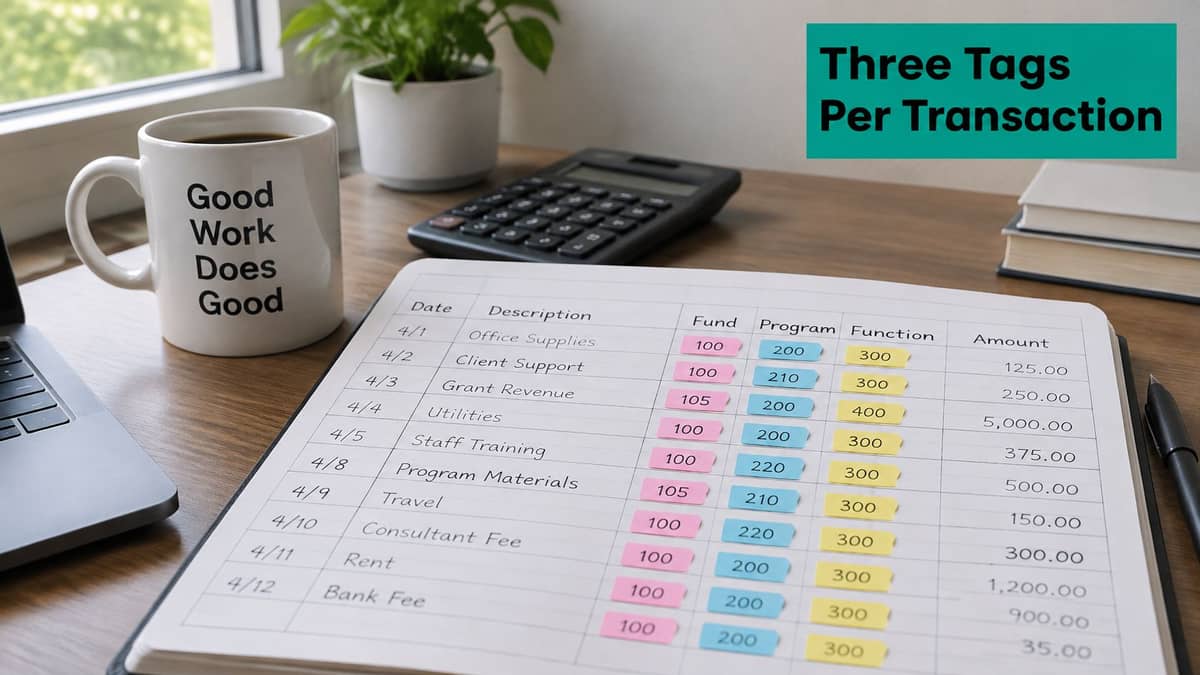
Every transaction needs three tags, not one. The fund or grant, the program, and the functional class. A salary line labeled only "salaries" tells your auditor nothing about which award it served, and it can't feed the Form 990 without a second pass in a spreadsheet.
| Shared cost | Allocation basis | Example split | Functional reporting |
|---|---|---|---|
| Salaries and benefits | Time records by program | A director logging 60% of hours on the youth program charges 60% of her salary there | Split across all three functional classes |
| Rent and utilities | Floor area used | Youth program uses 20% of office space | Split using the same floor-area shares each period |
| Software and IT | Number of users or transaction volume | Twelve of fifteen licensed users work in program roles, so 80% of the license lands in program services | Program services where usage is documented, otherwise management and general |
| Event costs | Direct charge to the event's fund | A gala venue invoice posts straight to the gala fund | Fundraising |
The IRS guidance on functional expense reporting treats the method as the point: shared costs need a documented allocation methodology applied the same way every period. Switch from floor area to headcount mid-year and your program percentage jumps for reasons that have nothing to do with program work.
Close the month in four steps. Compare the sum of fund-level expenses with the general ledger. Confirm each restricted cost falls inside its award's purpose and period. Review any functional percentage that moved more than a few points. Tie the functional totals to the Form 990 presentation before the numbers leave finance.
Weak coding breaks four things at once: cost per beneficiary, grant reports, board dashboards, and the 990 itself. They all draw from the same transaction record.
A shared cost is defensible when the rule behind the split is written down before anyone asks. Write the rule, then apply it without improvising. The cost allocation glossary walks through the acceptable bases for common expenses.
Why Fund Accounting Protects Day-to-Day Decisions and Where Teams Go Wrong
On a Tuesday in month nine, the bank shows $420,000. Payroll runs Friday. The roof invoice just landed. Open the funds and $310,000 of that balance sits inside three grants with tight allowable-cost rules. The account looks solid. Most of the cash is already promised to a purpose.
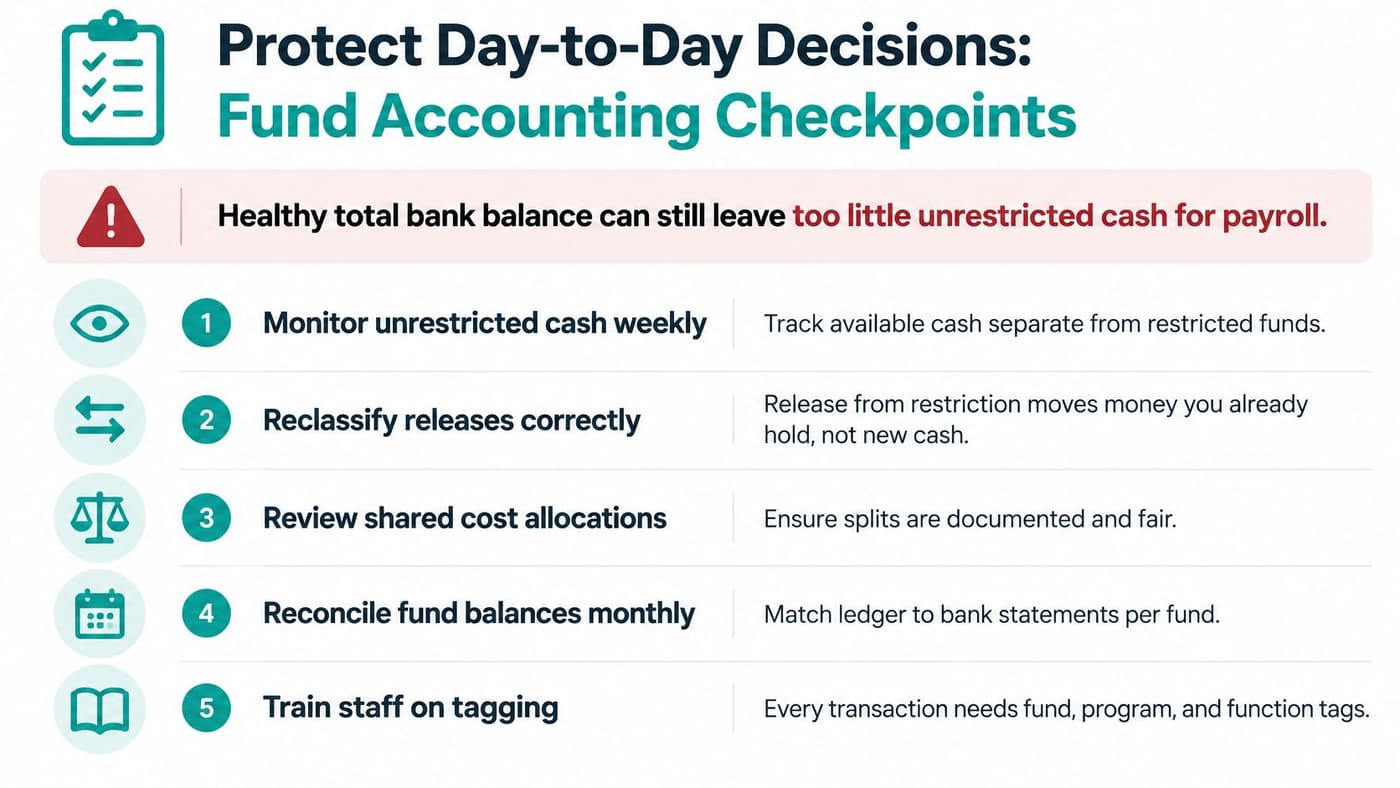
The cash rule: qualifying spending triggers a release from restriction, and that release reclassifies resources so the statements reflect the donor's purpose. It creates no new cash. A fund can be fully compliant and still leave you short on payroll.
The Monthly View That Prevents a Cash Crunch
Five numbers, ten minutes, once a month. Available unrestricted cash. Restricted balance by grant or fund. Committed expenses for the next 90 days. Upcoming restriction releases and their dates. The unrestricted share of shared costs, meaning what general operations absorbs. Boards ask about that last figure. Finance teams skip it more often than the other four.
The stakes shift by organization type. The mechanics stay the same. Churches and schools hold designated gifts for memorials, scholarships, and building projects, and each one carries a promise the operating account cannot spend. Grant-funded nonprofits often spend ahead of reimbursement, so the receivable has to sit next to the cash. Otherwise, the forecast treats money you do not hold as spendable. Fiscal sponsors carry the heaviest version: a fiscal sponsor receives and administers donations on a project's behalf, which means answering for a dozen projects separately while producing one consolidated report for the board.
Four Things Directors Get Wrong
"Fund accounting only matters at the year-end audit." Restrictions change the day a gift arrives and the day a check clears. Reconstructing those decisions in February means guessing at intent.
"Restricted money is untouchable." It is spendable, just not for anything. Payroll for the funded program is a legitimate charge. Unbudgeted rent is not.
"A signed grant is always revenue." A condition that still has to be met is a barrier. Until that barrier clears, the award is not revenue you can spend, and the cash forecast has to treat it that way. A restriction on purpose is different: the money can already be yours, and still be off limits for payroll or the roof.
"Class tags in a general ledger are fund accounting." A class tag labels a transaction after the fact. A fund carries its own budget, release rule, and running balance, and it can be reported on its own without an export.
Where Simple Systems Still Fit
QuickBooks with class tracking handles an organization with two or three restricted funds and a bookkeeper who knows the workarounds. Aplos serves small ministries well, and its fund reports are usable. Both are sensible starting points, and their pricing reflects that scope.
Sage Intacct and Blackbaud Financial Edge give larger finance teams strong controls, clear audit trails, and consolidated reporting across entities. A controller and a monthly close calendar are what make that cost earn its keep.
The gap shows up in the middle. Fund logic then lives in class tags, spreadsheets, and manual release entries that someone has to remember each month. That holds until restrictions change monthly or the board asks for fund-level results at every meeting. Class tags stop being enough. A fund analytics view shows each fund's balance and releases without rebuilding the report in a spreadsheet.
Confirm Your Fund Structure Before Your Next Board Meeting
Three actions, this week, no new software required.
- List every restricted gift and grant with its purpose, its time limit, and the condition that releases it. The first pass usually turns up restricted money with no clear owner and no documented purpose.
- Reconcile each fund balance to the bank statement and the general ledger. Any difference is either an unrecorded restriction change or an expense charged to the wrong shelf.
- Write a one-page fund summary for the board. Cash by fund, releases expected this quarter, and the unrestricted share of shared costs.
Our fund accounting keeps restricted and unrestricted dollars tied to their purpose from gift through report. Fund accounting, bank feeds, and standard reports are included in the Plus plan, and accounting starts on Plus. If you want a guided walkthrough, a free setup call takes you through fund accounting, donations, and reporting on your plan. Start with the board reporting health check if you'd rather test your current reporting first. All three actions above work in any system, including a spreadsheet.
AlignMint runs fund accounting, donor management, fundraising, events, and volunteers on one operating record, so every restricted dollar stays connected to the gift, the fund, and the report that proves it was spent as promised. Free is one user for nonprofits with up to $100K in annual donations, and no credit card is required. Plus adds teammates, and Enterprise is the plan with unlimited teammates. Visit AlignMint and see what your next board report looks like when the fund ledger is already done.
Frequently Asked Questions
It tracks each dollar by purpose, source, and restriction instead of treating cash as one pool. The leader's operating guide is a separate page, and so is the side-by-side restricted versus unrestricted comparison.
Fund accounting, bank feeds, and standard reports start on Plus at $199 per month, or $1,704 billed annually. Free is one user for nonprofits with up to $100K in annual donations, and no credit card is required.
Ready to try AlignMint with your nonprofit?
Start free — set up donor tools, giving pages, and Minty. Upgrade when you need accounting.