

Gross receipts of $200,000 or more, or year-end assets of $500,000 or more, generally trigger full Form 990 filing. Gross receipts normally $50,000 or less generally point to Form 990-N, but a small budget doesn't settle your obligation.
The common advice to check revenue alone misses important exceptions. You can choose the right return by checking your receipts, assets, and legal status before preparing anything.
Quick Answer: Who Must File Form 990
Who must file Form 990 starts with organization type, then gross receipts and assets. $200,000 in receipts or $500,000 in assets generally means the full return. The 990-N postcard, the 990-EZ requirements, and the new-nonprofit guide each cover a narrower question.
Start with Form 990 Builder and Form 990-N. For the EZ size test, see Form 990-EZ requirements. For the three-form comparison, see the Form 990-EZ guide. For a first return, see the Form 990 guide for new nonprofits.
Which Form Applies to Your Organization
A small budget doesn't settle whether you must file an annual return or notice. Choosing the wrong form creates extra work, especially when someone must reconstruct records close to your deadline.
Your answer starts with organization type, followed by gross receipts and year-end assets. Don't start with whichever form your predecessor filed.
Which return applies to which organization
The IRS Form 990-EZ instructions distinguish full Form 990 filing at $200,000 in gross receipts or $500,000 in year-end assets from smaller-organization options.
| Return | Who generally files | Trigger |
|---|---|---|
| Form 990 | Larger exempt organizations | Gross receipts of $200,000 or more, or total assets of $500,000 or more at year-end |
| Form 990-EZ | Smaller exempt organizations below both thresholds | Gross receipts under $200,000 and assets under $500,000, if eligibility rules are met |
| Form 990-N (e-Postcard) | Very small organizations | Gross receipts normally $50,000 or less |
| Form 990-PF | Private foundations | Annual filing regardless of revenue or assets |
| Form 990 or 990-EZ | Section 509(a)(3) supporting organizations | Annual filing even when receipts are normally $50,000 or less, subject to narrow exceptions |
| No annual return | Certain churches, integrated auxiliaries and eligible government units | Generally excepted from the Form 990 requirement; confirm your status |
Read the status rows before applying the size rows. A private foundation doesn't become eligible for the e-Postcard because its receipts are small.
Likewise, religious affiliation doesn't automatically establish a church filing exception. Confirm the organization's actual classification rather than relying on its name or mission.
Make these checks before choosing
- Check gross receipts for the tax year. Use your organization's complete records, not its operating surplus or bank balance.
- Check total assets at year-end. Review the balance sheet, including property and investments, rather than cash alone.
- Check your organization's status. Identify any church exception, supporting-organization classification, or private-foundation status before selecting a return.
Keep your determination letter, governing documents, and previous filing together. Your preparer can then compare the classification with the financial records without chasing separate folders.
If the terminology is unfamiliar, this 501(c)(3) glossary entry provides useful background. Tax-exempt status and exemption from annual reporting aren't the same thing.
The first matching row after you account for special status identifies your likely filing route. Don't treat the table as permission to overlook an exception.
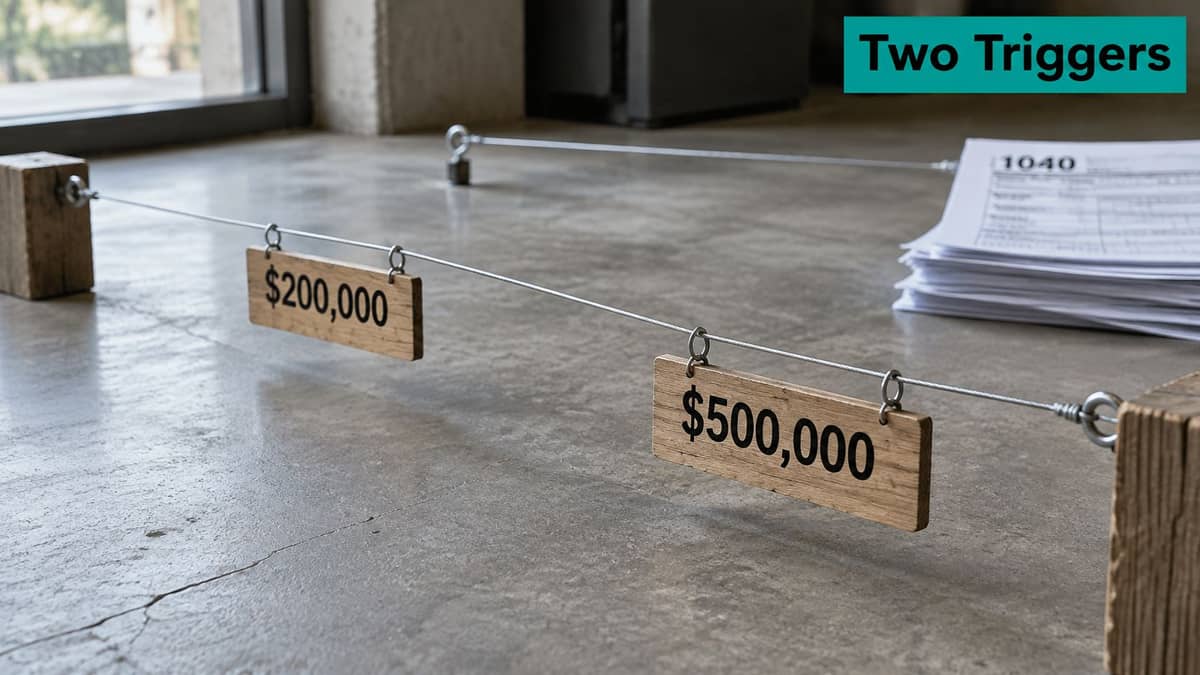
The Two Thresholds That Trigger Form 990
Check both financial measures before assigning anyone to prepare your return. Think of them as separate tripwires, not conditions you must meet together.
Under the IRS Form 990 instructions, gross receipts of at least $200,000 or total assets of at least $500,000 at year-end generally require the full return.
Practical rule: Either threshold is enough. Low annual receipts don't cancel a qualifying year-end asset balance.
When assets change the answer
Say a food pantry receives $150,000 in donations and holds a $600,000 building reserve at year-end. These are hypothetical figures, but the filing result is straightforward: the asset test requires the full return.
Its director might reasonably describe the pantry as small. That description doesn't change the balance sheet or determine which return applies.
A restricted building reserve still needs review when you calculate total assets. Don't substitute money available for everyday spending for the organization's complete asset figure.
Now consider a hypothetical organization with $220,000 in gross receipts and $40,000 in assets. It also files the full return, this time because receipts meet the filing test.
These examples expose the same mistake from opposite directions. Neither the annual budget nor the checking account provides the complete answer.
Build the check into your year-end close
Ask your bookkeeper for a year-end balance sheet and a gross-receipts calculation before return preparation begins. Have your preparer resolve classification questions while the supporting records are easy to retrieve.
For a practical recordkeeping foundation, use the Jumpstart Partners nonprofit bookkeeping guide. It's a useful companion when organizing the records behind your filing decision.
Clubs should also keep return selection separate from questions about member and nonmember receipts. The nonmember income calculator addresses that different compliance concern.
Organizations below both financial thresholds may qualify for the shorter return, subject to its eligibility rules. Don't assume that last year's form remains appropriate after a major gift or property transfer.
A pending exemption application doesn't pause annual reporting. Organizations awaiting recognition, including those that haven't yet applied, still need to assess their filing obligation.
Exceptions That Can Still Require a Filing
Faith-based organizations get caught when they assume that a small budget excuses every affiliated entity from reporting. Supporting-organization status can produce a very different answer.
The IRS guidance for supporting organizations generally requires section 509(a)(3) supporting organizations to file Form 990 or Form 990-EZ annually, even with receipts normally $50,000 or less.
These organizations generally can't choose the e-Postcard. Their classification matters more than how modest their fundraising looks.
Religious affiliation isn't a filing classification
The IRS generally excludes these categories from the annual Form 990 requirement:
- Churches and church associations. This includes conventions or associations of churches.
- Integrated auxiliaries and qualifying affiliates. Not every separately organized ministry automatically qualifies.
- Qualifying church-affiliated schools. The exception covers qualifying schools below college level.
- Certain religious orders. The organization must meet the applicable exception.
- Eligible governmental organizations. Qualifying governmental units and affiliates may also be excepted.
Start with the entity that exists on paper. A ministry operated directly by a church isn't necessarily the same as a separately incorporated charity.
Review the charter, governing documents, board appointments, and determination letter. A shared pastor, mailing address, or donor base doesn't establish the answer by itself.
A religious mission describes your work. Your legal classification determines which filing rules you must apply.
The narrow religious-support exception
A small religious supporting organization needs a more careful review, not an automatic decision to file or skip filing. The IRS church and religious-organization guidance includes a narrow carve-out for certain organizations supporting a 501(c)(3) religious organization, with receipts normally $5,000 or less.
Don't apply that exception to every small ministry. Confirm both the supported organization's status and the supporting entity's eligibility before relying on it.
The same IRS guidance explains that private foundations generally file Form 990-PF annually, regardless of revenue or assets. Their filing route doesn't follow the ordinary public-charity size comparison.
A donor-funded foundation therefore needs a classification check even when it has little activity. An inactive bank account isn't a substitute for that review.
Check control and relationships
Fiscal sponsors, church ministries, donor-supported affiliates, and cross-border organizations should pay particular attention to their legal relationships. The practical question is which entity owns the records, receives the gifts, and carries the reporting obligation.
For fiscal sponsorship, identify whether a project operates within the sponsor or through a separate legal organization. Don't assume that every project needs its own return, or that sponsorship removes a separate entity's duties.
Schools should likewise distinguish direct church operations from separately governed educational charities. Keep the documents supporting that conclusion with the annual filing file.
Ask your board or preparer these questions:
- Who controls the organization? Identify appointment powers and governing authority, not just the people handling daily work.
- Does it support another charitable organization? Confirm whether that relationship creates supporting-organization status.
- Is it a private foundation? Check the determination letter rather than relying on the organization's public description.
For clubs managing another set of exemptions, the social club compliance guide provides a separate starting point. Don't transfer church or charity exceptions into a club's filing decision.
Finally, discard outdated threshold charts. Older materials using $25,000, or $100,000 in receipts and $250,000 in assets, don't reflect the current framework.
How to File the Form 990-N e-Postcard
Eligible small organizations can meet their annual notice requirement without preparing the long return. The important step is confirming eligibility before opening the electronic filing system.
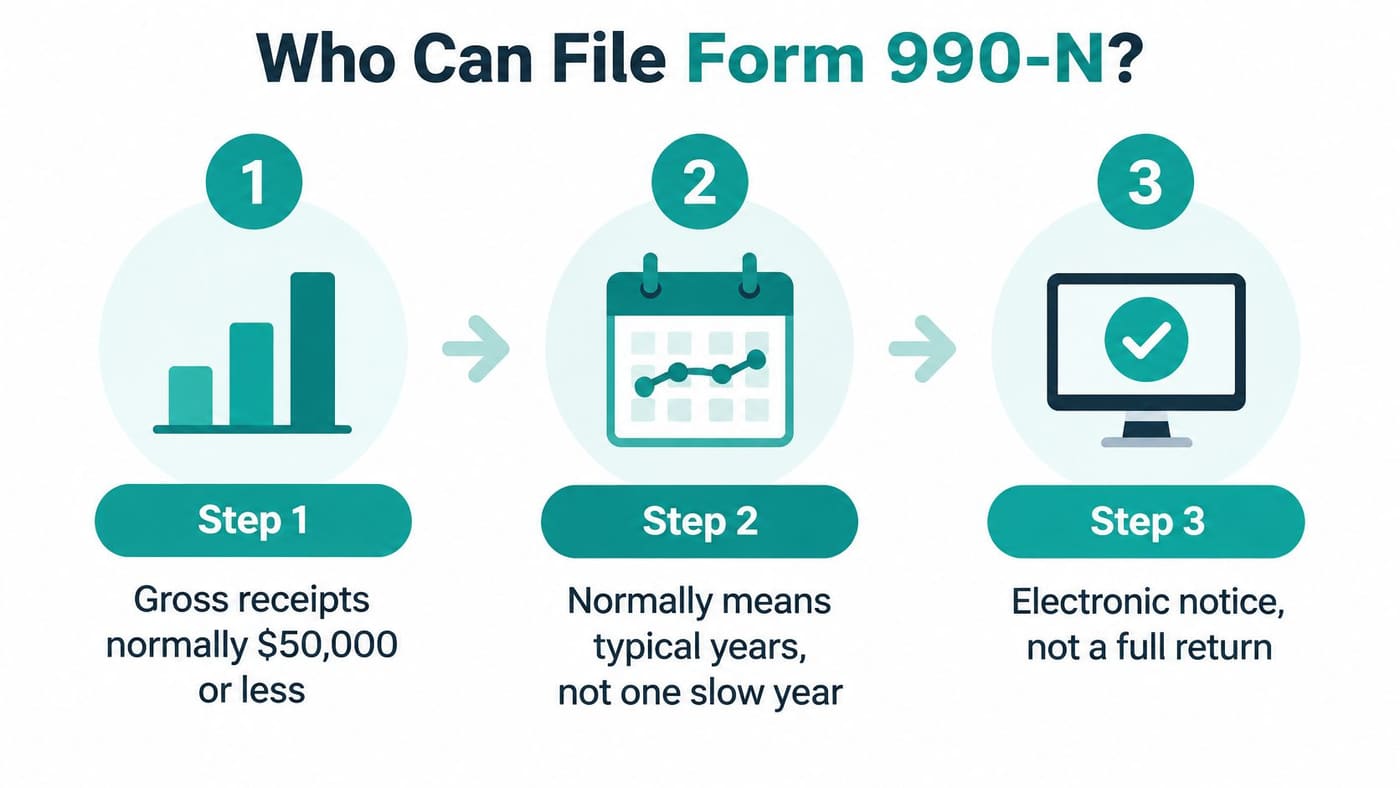
According to the IRS e-Postcard eligibility guidance, most organizations with gross receipts normally $50,000 or less must submit Form 990-N unless excepted.
Normally doesn't mean one slow year. Review the applicable IRS receipts test rather than choosing whichever recent year gives the easiest answer.
Gather the details before signing in
Prepare the organization's legal name, EIN, mailing address, and website address if it has one. You'll also need the principal officer's name and address.
Have the tax-year information ready, including its ending date. You must confirm eligibility based on receipts and indicate whether the organization has ended operations.
Keep those details in a shared filing folder with controlled access. That saves the next responsible person from reconstructing basic information.
Submit and keep the confirmation
- Confirm eligibility. Review typical receipts and special organizational status so you don't submit the wrong notice.
- Gather identifying information. Check the EIN and principal officer details against your organization's records before entering them.
- Submit electronically through the IRS system. The e-Postcard is an electronic notice, not a paper version of the full return.
- Save the confirmation. Keep the submission record where your director, treasurer, and preparer can find it.
For organizations preparing a detailed return, the Form 990 preparation feature page addresses a different workflow. Preparing financial information doesn't itself decide which return your organization owes.
Most supporting organizations can't use Form 990-N. Organizations above the small-organization receipts limit generally need Form 990 or Form 990-EZ instead.
Deadlines and Extensions for Form 990
Put the filing deadline on your calendar before your preparer asks for records. Your fiscal year, not the date you received your exemption letter, determines the regular filing schedule.
The IRS annual reporting procedures set the deadline as the 15th day of the fifth month after tax-year close, generally May 15 for calendar-year organizations.
If that date falls on a Saturday, Sunday, or legal holiday, use the next business day. Apply that adjustment to the actual filing year.
Form 990 due dates by fiscal year end
| Tax year ends | Form 990 due date | Extended due date with Form 8868 |
|---|---|---|
| December 31 | May 15 | November 15 |
| June 30 | November 15 | May 15 |
| September 30 | February 15 | August 15 |
| March 31 | August 15 | February 15 |
These are standard calendar dates before weekend and holiday adjustments. For an additional planning reference, consult Form 990 deadlines for nonprofits from Bookkeeping and Accounting of Florida Inc.
Assign responsibility before requesting more time
- Find your tax-year end. Confirm it against your records and previous return instead of assuming a calendar year.
- Count forward to the filing month. Mark the regular due date on both the director's and treasurer's calendars.
- Check weekends and holidays. Record the adjusted deadline so everyone works toward the same date.
- Request an extension when needed. File Form 8868 before the regular deadline for an automatic six-month extension.
An extension gives you preparation time. It doesn't fix missing reconciliations, unclear restrictions, or unresolved questions about which entity must file.
Ask your preparer what remains outstanding before submitting an extension request. Assign each missing document to a named person and set an internal delivery date.
Calendar habit: Keep the filing deadline, preparer handoff, and board review as separate calendar entries.
Clubs can organize their wider reporting schedule with the social club filing calendar. Keep federal return preparation distinct from other filing responsibilities.
Form 990-N and Form 990-PF follow the same general fifth-month due-date rule. However, don't treat an e-Postcard as eligible for the return extension.
Late returns can bring penalties, so begin the calendar check early. Keep the accepted filing or extension confirmation with your permanent annual records.
Confirm Your Filing Requirement and Next Step
You should finish this process with a documented filing decision and enough time to prepare the right records. Start with your organization's classification, then confirm the financial measures against your year-end books.
Write down which return applies, who confirmed it, and who will submit it. A short filing note is more useful than an email chain nobody can find.
Build a file your preparer can use
Keep the determination letter, year-end balance sheet, receipts calculation, and governing documents together. Add the regular deadline and any applicable extension deadline to your calendar this week.
For help understanding the reports behind those figures, consult the Grantlas guide to nonprofit financial statements. Use the balance sheet alongside the statement of activities rather than expecting either report to answer every question.
- Confirm the legal entity. Make sure the EIN, organization name, and financial records belong to the same filer.
- Resolve unusual transactions. Flag property gifts, transfers, and sponsored-project activity before your preparer starts.
- Record the decision. Keep the explanation for any filing exception with the documents supporting it.
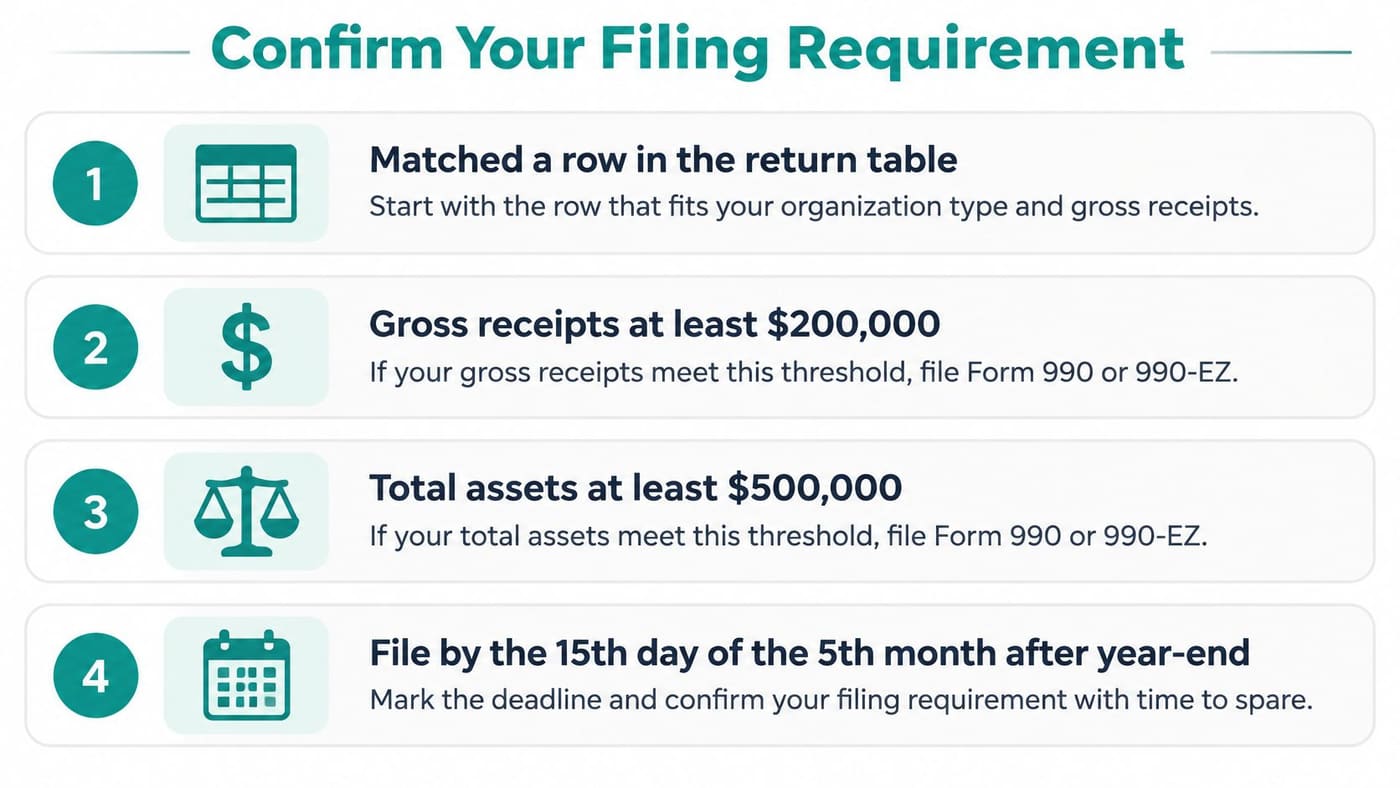
Use the filing rules in the text when choosing your return. Meeting either full-return threshold generally requires Form 990, not Form 990-EZ.
Choose records you don't have to rebuild
Your software should make the financial review easier without pretending to replace your preparer's judgment. Clean fund balances matter more than another dashboard.
QuickBooks is a familiar general ledger, and classes help organize activity by program. Classes alone aren't a substitute for maintaining restricted and unrestricted fund balances through a complete fund-accounting process.
Raiser's Edge is strong for donor records. You don't need to discard a useful donor system merely because you're reviewing your accounting workflow.
At AlignMint, we keep restricted and unrestricted dollars tied to their purposes through true fund accounting. Our accounting, donor management, volunteer management, events, and payments share the same operating record, with marketing and online giving tools supporting fundraising work.
That shared record gives your team a common basis for communication about gifts, programs, and year-end balances. Minty, our AI assistant, can answer questions about your records. Form 990 Builder starts on Pro and prepares filing information from connected financial records.
We offer solutions for nonprofits, churches, schools, and fiscal sponsors. Plan limits differ, so choose access and accounting features that match the people doing your work.
Free is one user for nonprofits with up to $100K in annual donations, and no credit card is required. Confirm the return first, then select the tools that help you maintain its supporting records throughout the year.
We help you keep nonprofit records together and prepare filing information from connected financial records. Visit AlignMint to start with the free plan, then confirm your return and deadline with your preparer before filing.
Frequently Asked Questions
Organizations with gross receipts of $200,000 or more, or year-end assets of $500,000 or more, generally file the full Form 990. Gross receipts normally $50,000 or less generally point to Form 990-N. Exceptions still apply.
No. Free is one user for nonprofits with up to $100K in annual donations, and no credit card is required. Form 990 Builder starts on Pro.
Ready to try AlignMint with your nonprofit?
Start free — set up donor tools, giving pages, and Minty. Upgrade when you need accounting.