

A church that meets the federal definition generally doesn't file Form 990 or Form 990-N, but supporting organizations and some affiliates still must file. The usual advice that churches are exempt leaves out the decision that matters: which legal entity you're managing. You can reach a defensible answer by classifying each entity, identifying its remaining obligations, and preparing the right financial records.
Quick Answer: Form 990 for Churches
A church that meets the federal definition generally does not file Form 990 or Form 990-N, but a related entity often still must. Classify each legal entity before you decide who files.
Start with fund accounting and Form 990 reporting. For the small-return choice, see the Form 990-EZ guide.
Who Must File Form 990 for Churches
The useful question is not whether churches skip Form 990. It is which legal entity you are managing. Two ministries can share a pastor and a building, then fall into different filing categories.
Form 990 filing status by church-related entity
| Entity | Form 990 or 990-EZ | Form 990-N | What decides it |
|---|---|---|---|
| Church meeting the federal definition | No | No | Legal status, not offering size |
| Convention or association of churches | No | No | Same church exception |
| Qualifying integrated auxiliary, such as certain schools, missions, or youth groups | No | No | Integrated in fact, not only by name |
| Section 509(a)(3) supporting organization | Yes, unless an exception applies | Generally no, even at $50,000 or less | Files unless a narrow exception applies |
| Exclusively religious activities of a religious order | Generally no | No | Narrow exception to the supporting-organization rule |
| Small supporter with normally $5,000 or less in gross receipts | Generally no | Yes | Supports a section 501(c)(3) religious organization |
| Religious organization that isn't a church, normally $50,000 or less | Generally not required | Yes | Normal small-organization notice |
| Non-excepted organization with gross receipts of $200,000 or more, or assets of $500,000 or more | Full Form 990 | No | Standard full-return threshold |
| Non-excepted organization below those limits and above $50,000 | Form 990-EZ generally available | No | Smaller-filer return |
Read the church row as your starting point: a qualifying church generally files none of these annual information returns. A larger offering, by itself, does not move the congregation into the filing category.
The IRS filing requirements for churches and religious organizations distinguish churches, qualifying auxiliaries, and other religious organizations. Sharing a pastor, mission statement, or building does not establish that every affiliated corporation receives the same treatment.
Apply classification before financial thresholds
Under the IRS annual reporting exceptions, most eligible organizations with normally $50,000 or less in gross receipts may submit Form 990-N, but churches are excluded. The guidance also identifies different treatment for certain supporters of religious organizations with normally $5,000 or less in gross receipts.
For organizations outside an exception, the full Form 990 applies at $200,000 or more in gross receipts, or $500,000 or more in total assets. Eligible filers below those limits and above $50,000 may use the shorter 990-EZ.
Those thresholds answer which return an organization files. They do not answer whether the church exception applies in the first place. Thresholds sort returns by size; classification decides whether a return is owed at all.
Practical rule: Settle the entity's legal category before looking at its bank balance.
Separate religious purpose from church status
A religious purpose and a church filing exception are not interchangeable. Section 501(c)(3) covers a broad range of organizations, and our guide to section 501(c)(3) explains that broader tax-exempt category. A ministry can hold a valid exemption and still owe an annual return, because the church exception rests on what the entity is, not on what it believes.
A concrete example: your congregation operates a school and established a separate foundation. The congregation's position does not automatically resolve the school's or foundation's obligations. Each corporation gets its own analysis.
Before your next board meeting, list every legal corporation, not just every ministry name. Include entities that have not received donations recently, since inactivity is not a classification decision.
For each entity, assign someone to confirm its category and preserve the supporting documents. Your board needs a reasoned answer, not an assumption inherited from the previous treasurer.
How to Classify Each Ministry Entity
Start with the legal entity, then decide which IRS category fits it. A ministry name may describe a program, but the filing responsibility belongs to the corporation behind that program.
For each entity, determine whether it is the church itself, an integrated auxiliary, a supporting organization, another exempt entity, or a taxable affiliate. Treat the entities like separate accounts in one chart: they can coordinate their work, but their legal positions and balances should remain distinct.
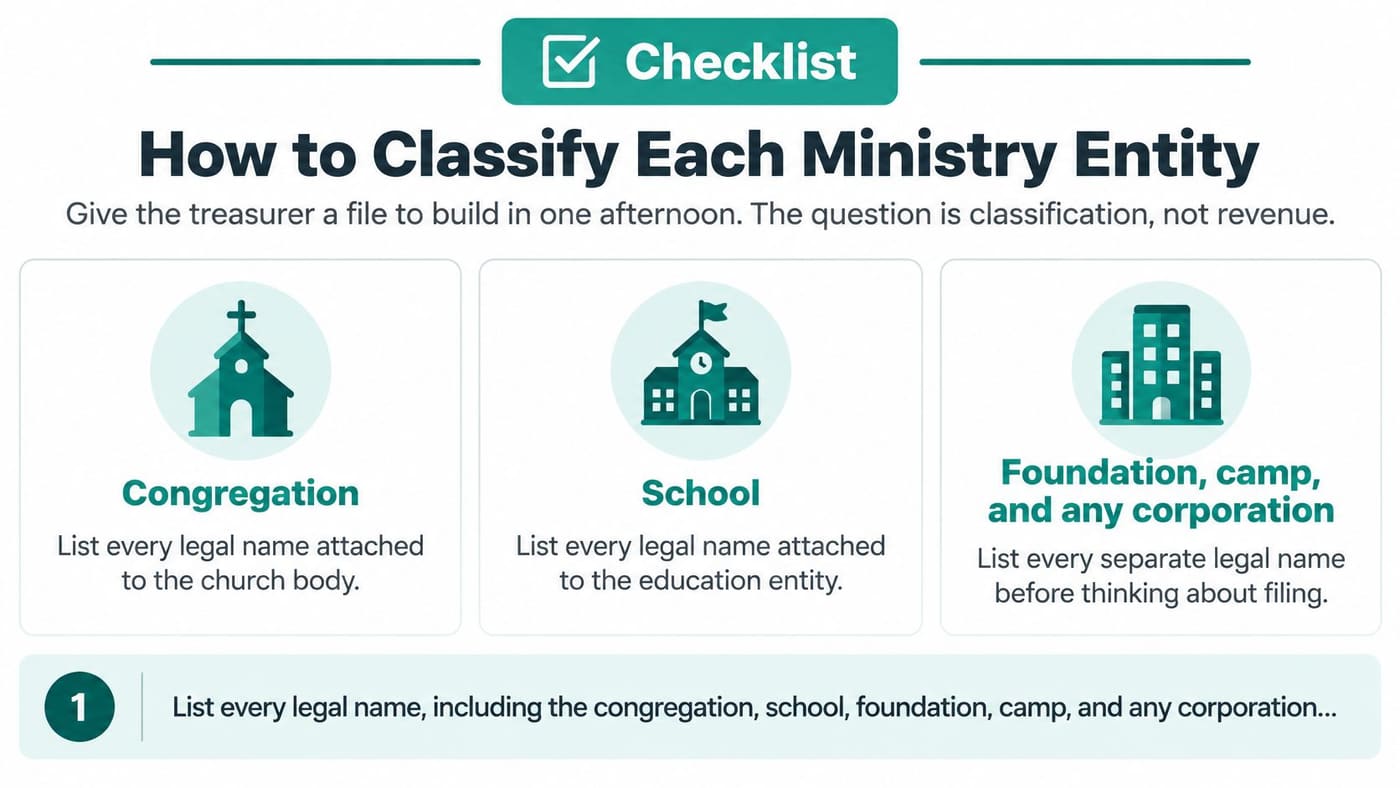
Use this checklist to keep the congregation, school, and other corporations separate.
Build the classification file
-
Match ministry names to legal names. Include the congregation, school, foundation, camp, and any corporation your board created. Record each entity's identifying information beside its legal name.
-
Collect governing documents. Pull the articles, bylaws, and determination letter, if one exists. Treat a missing letter as a question to resolve, not as a conclusion.
-
Document board control. Write down who appoints directors, removes them, and approves major decisions. Attach the provisions that establish those powers.
-
Describe actual activities. Record what the organization does, whom it serves, and how it receives support. Worship and pastoral care require a different analysis from tuition-funded education or grantmaking.
-
Test integrated auxiliary status. Ask counsel to evaluate the applicable affiliation and support requirements. Church control and religious purpose need documentary support, not merely matching names or website language.
-
Review supporting-organization status. The IRS's annual filing requirements for supporting organizations generally require section 509(a)(3) organizations to file even when gross receipts are normally $50,000 or less, while identifying narrow exceptions for qualifying integrated auxiliaries, exclusively religious activities of religious orders, and certain religious supporters with normally $5,000 or less in receipts. Filers must identify supported organizations, their Type I, Type II, or Type III classification, and certify that disqualified persons do not control them.
-
Flag other categories separately. Keep section 501(d) religious organizations, taxable entities, and potentially unrelated business activities on separate review notes. Do not force them into the congregation's classification.
-
Approve and retain the conclusion. Date the position, record board review, and store the supporting analysis with financial statements. Have your adviser identify changes that would require another review.
Keep administration connected without merging entities
Once the classification is settled, administration should connect the work without merging the entities. Shared staff can support several corporations, but each entity still needs its own approvals, bank activity, fund balances, and reports.
For the operational side of that shared workload, HolyJot's guide to managing day-to-day ministry tasks can help with routine responsibilities and handoffs after counsel defines the legal boundaries.
Your reporting structure should preserve those distinctions after the paperwork is complete. AlignMint's multi-organization documentation offers a useful reference when planning records across separate organizations.
Fiscal sponsorship deserves the same care. Record which legal entity receives gifts, holds funds, and accepts reporting responsibilities before assigning a project its own financial reports.
Finish with a short position for each entity: classification, supporting documents, filing conclusion, unresolved questions, and adviser approval.
Filings Churches Still Owe Without Form 990
You avoid surprises by tracking the obligations that remain after the annual information-return exception. Start with unrelated business activity, then review payroll, donor documentation, and state requirements.
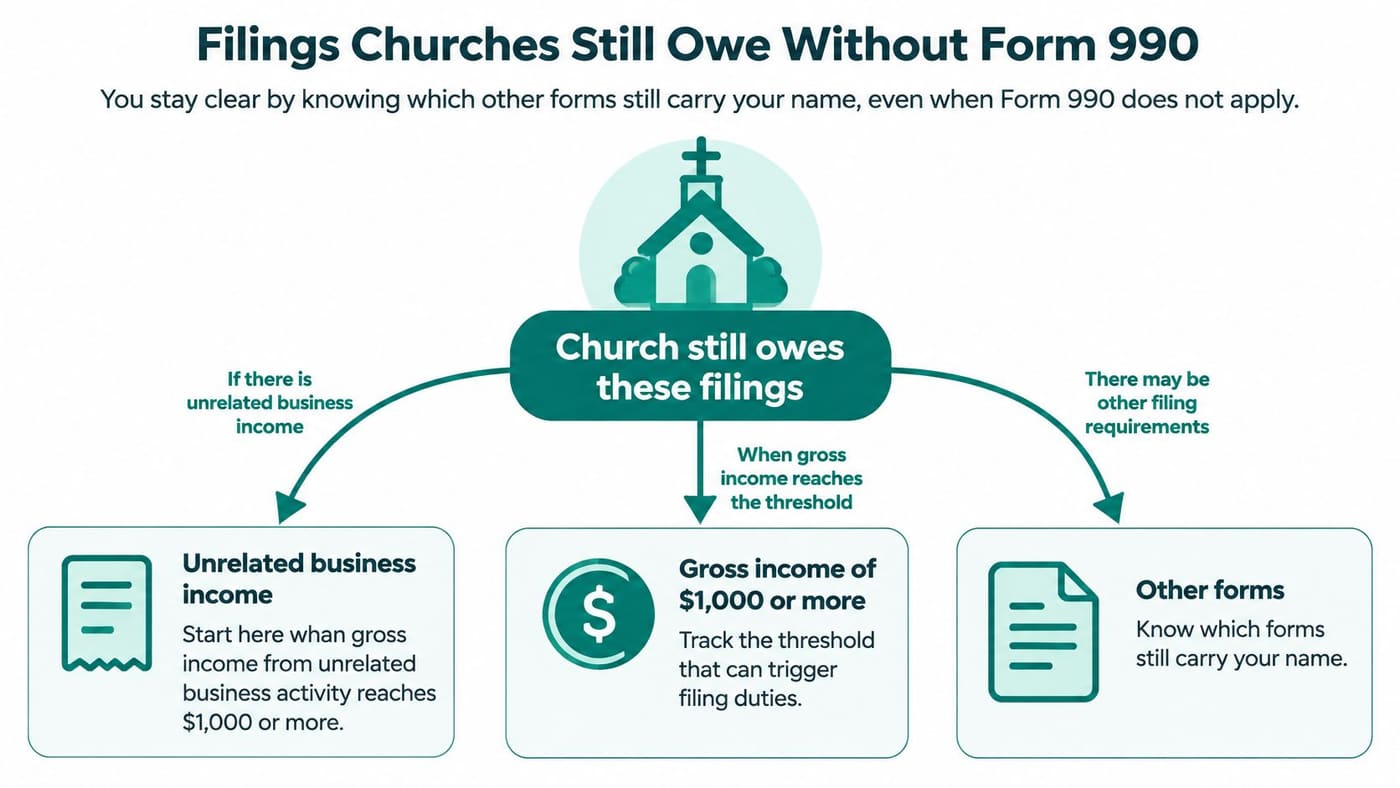
According to the IRS Tax Guide for Churches and Religious Organizations, $1,000 or more in gross income from an unrelated trade or business triggers Form 990-T filing. The guide also addresses written acknowledgments for contributions of $250 or more and disclosure requirements for quid pro quo contributions over $75.
Use the following map to identify the work your finance team still needs to evaluate.
Check each remaining duty
Filings that can remain after the church Form 990 exception
| Duty | Trigger | Waived by the church 990 exception? |
|---|---|---|
| Form 990-T | $1,000 or more of gross income from an unrelated trade or business | No |
| Employment returns, wage statements, and deposits | Employees and applicable taxable wages | No |
| Written gift acknowledgment | Contribution of $250 or more, for donor substantiation | No |
| Quid pro quo disclosure | Contribution over $75 when the donor receives goods or services, subject to applicable exceptions | No |
| State charitable solicitation registration | Soliciting in a state that requires it | No, state law is separate |
Don't assume every bookstore sale, hall rental, or parking arrangement creates unrelated business income. Ask your CPA to evaluate the activity and applicable exclusions before deciding how to report it.
For payroll, identify who handles employment returns, wage statements, and deposits. Put clergy compensation and housing arrangements on the adviser's review list rather than treating them like ordinary payroll settings.
Donor acknowledgments deserve a clear owner too. When gifts involve meals, tickets, or other benefits, preserve the benefit description and good-faith valuation alongside the contribution record.
Keep federal and state obligations separate
IRS Publication 557 explains that qualifying churches generally receive section 501(c)(3) treatment without formally applying for recognition. That federal treatment doesn't settle every employment, fundraising, or state reporting question.
Online giving pages can attract gifts beyond your home state. Ask counsel which solicitation rules apply to your activities, including any church-specific state exceptions.
An exception from an annual return isn't an exception from keeping clear records.
Keep purpose-based records so staff can retrieve a gift's donor, restriction, acknowledgment, and deposit without reconstructing the transaction. Our explanation of fund accounting for nonprofits distinguishes restricted resources from money available for general operations.
Use the Form 990 checklist as a working document beside your entity inventory. Mark each duty yes, no, or ask counsel, then assign an owner and review date.
How to Turn Fund Records into Form 990 Lines
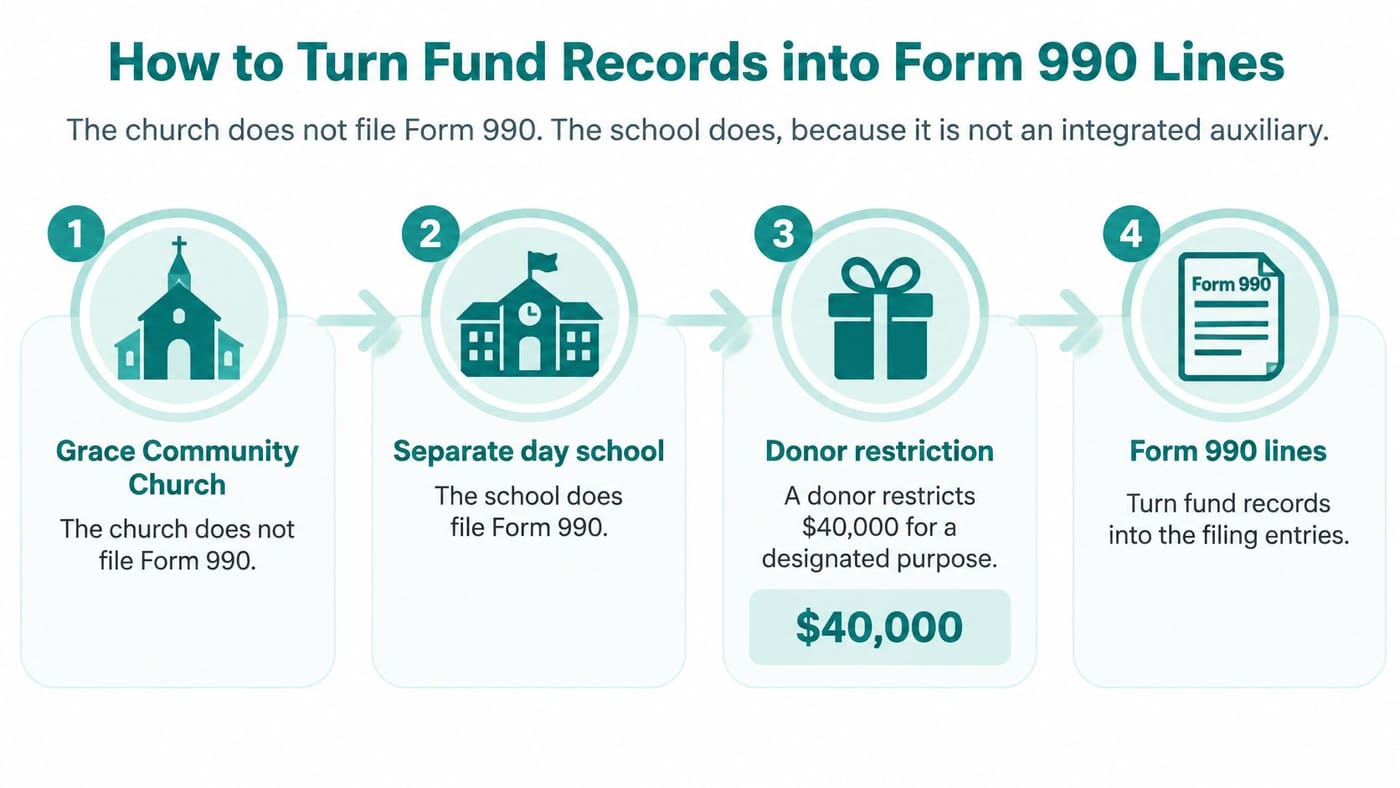
Accurate transaction coding gives your preparer usable reports instead of a collection of year-end guesses. Consider a hypothetical year at Grace Community Church and its separately incorporated day school.
Assume counsel confirms that the church doesn't file, while the school qualifies for no filing exception and must file. Not being an integrated auxiliary alone wouldn't settle every possible school exception.
In this example, a donor restricts $40,000 for scholarships, while the board designates $15,000 as a building reserve. Those balances have different origins and require different controls.
Separate purpose from expense function
The scholarship restriction comes from the donor. The building designation comes from the board, which should document any decision to change it.
Teacher compensation belongs to the school's educational program. The principal's compensation may require a documented allocation between educational work and management responsibilities.
Appeal printing and staff time spent soliciting gifts belong in fundraising. A school-wide expense total doesn't explain these different functions.
The IRS Schedule A instructions explain public-charity classifications, including the church category. Filing preparation also requires attention to functional expenses and applicable specialized schedules, including private-school or hospital reporting where relevant.
Prepare the records in a consistent order
-
Map accounts before transactions accumulate. Connect revenue and expense accounts to reporting categories. Identify program services, management and general, and fundraising separately.
-
Code gifts when deposited. Record the donor, receiving legal entity, fund, and donor restriction together. Keep the original gift instructions.
-
Apply payroll allocations each pay period. Use a written method reflecting employees' actual responsibilities. Update the method when duties change.
-
Reconcile gifts across records. Match donor records, receipts, deposits, and the general ledger. Investigate differences before closing the period.
-
Save the allocation memo. Explain shared facility, payroll, and administrative costs. Retain calculations so another preparer can reproduce the result.
QuickBooks can serve straightforward bookkeeping needs well. Its classes can categorize transactions, but a class label alone doesn't enforce donor restrictions or replace fund-balance controls.
Aplos is a church-focused fund accounting option, while Blackbaud Financial Edge serves more complex nonprofit finance needs. Whatever system you choose, test whether functional expense reporting requires separate spreadsheet work.
Our nonprofit accounting software guide provides context for evaluating that reporting work. The Form 990 Builder documentation is another reference for planning the information your preparer needs.
Your handoff should contain agreeing functional expenses, fund balances, and donor records. Give the preparer the allocation memo too, not just the finished totals.
When a Church Should Volunteer to File
Voluntary filing creates a public disclosure record, not just a reassuring document for donors. Decide whether that disclosure solves a specific problem before committing staff to preparing it.
The IRS Form 990-EZ instructions describe church filing exceptions and the reporting framework relevant to exempt organizations. A church considering voluntary filing should review the public-disclosure implications with its adviser before submitting a return.
A grantmaker may want standardized financial information. A denomination may request comparable reporting, or your board may want a more disciplined annual close.
Those are useful objectives. They don't automatically make a public return the best way to achieve them.
Choose the disclosure that serves your purpose
| Consider voluntary filing when | Consider member reporting instead when |
|---|---|
| A grantmaker or denomination specifically requests the return | Your organization clearly qualifies for the church exception |
| Your adviser confirms the correct entity and return | No stakeholder requires a public return |
| Staff can support consistent classifications | Members need understandable financial accountability |
| Your board accepts the disclosure implications | A reviewed internal report meets that need |
Ask whether the requesting organization will accept financial statements and a functional expense report instead. You may be able to provide the needed transparency without creating an unnecessary filing obligation.
If you choose voluntary filing, establish a review process for revenue, expenses, related organizations, and compensation. Changes between years should have explanations, not just different spreadsheet labels.
Give members a useful financial report
An internal report should show income, program costs, management costs, and restricted balances. Explain major changes in ordinary language, especially when available cash differs from the bank balance.
Include fundraising costs where relevant and identify commitments that affect future spending. Members should be able to understand what leadership can spend and what remains committed to particular purposes.
Before publishing: Confirm which entity the report describes and whether the board understands what becomes public.
Settle legal classification before making this voluntary choice. Filing for the congregation won't resolve a separate affiliate's reporting duties, and filing the wrong return can create a record you'll need to explain.
When an Affiliate Must File and Its Deadline
A named filing date turns a general obligation into work someone can manage. Once your adviser confirms that an affiliate must file, build its calendar around its actual tax year.
Ask your CPA to confirm the federal due date, extension procedure, payment obligations, and separate state deadlines. Don't copy another ministry's calendar without checking whether its year-end matches yours.
Give the filing owner responsibility for requesting missing records and escalating delays. Your executive director shouldn't discover an unresolved classification question when the preparer is ready to submit.
Work backward from the confirmed deadline
- Confirm the calendar. Record the original filing deadline, internal review date, and any extension deadline your adviser provides.
- Finish allocation decisions. Approve shared-cost methods before staff prepare final functional expense reports.
- Close and reconcile the books. Resolve donor-record differences, interentity balances, payroll questions, and restricted-fund discrepancies.
- Send a complete preparation packet. Include financial reports, the classification memo, governing changes, and allocation support.
- Reserve board review time. Give reviewers enough time to ask questions without forcing last-minute changes.
An extension to file shouldn't be treated as permission to postpone every related task. Have your preparer identify any payments or other submissions that remain due.
Preserve evidence of completion
Keep the filed return, submission acceptance, supporting schedules, and relevant approvals together. Save the final version separately from working drafts so staff don't circulate an obsolete copy.
Your team communication record should identify who approved the figures and who authorized submission. That record helps a successor understand decisions without searching through individual inboxes.
If the deadline is at risk, contact the preparer before it passes. Ask for a written action plan rather than assuming someone else has requested an extension.
Review the calendar whenever the fiscal year, legal structure, or operating activities change. Filing responsibility should remain clear even when staff or board members turn over.
Confirm the Filing Position and Set Up the Books
Make the classification decision this month, while your team can still organize the records calmly. The benefit isn't just a cleaner return, it's a clear answer when a donor, bank, or grantmaker asks about your finances.
Start with a short decision list your finance chair can approve and track.
- Name each legal entity. Include the congregation and every separately organized affiliate.
- Assign a filing position. Mark file, don't file, or ask counsel, with a named person responsible for resolving uncertainty.
- Record remaining obligations. Include unrelated business review, payroll, donor documentation, and state requirements.
- Prepare transaction coding. Put restrictions and payroll allocations into the accounting process before the next deposit or payroll run.
Choose records that support the decision
Your church-and-school workflow needs more than a general ledger. Staff also need donor histories, volunteer responsibilities, event records, and clear communication about who owns each task.
For fiscal sponsors, preserve project-level reporting without confusing sponsored activities with separate legal entities. For schools, connect gift purposes with scholarship, program, and operating reports.
A connected system should reduce duplicate entry without hiding the underlying records. You should still be able to trace a reported balance to transactions and supporting documents.
We built AlignMint around that workload, with true fund accounting, donor management, volunteers, events, payments, and a built-in marketing suite in an all-in-one platform. Online giving pages connect fundraising activity with donor records, while Minty AI helps you ask questions about your data. Form 990 Builder starts on Pro and prepares filing information from connected financial records. You can export financial reports to PDF or Excel, and the balance sheet starts on Plus.
Bring your entity list to the setup conversation
Use our church accounting overview to frame questions about funds, donations, and reporting. Keep counsel responsible for legal classification, and give your CPA responsibility for confirming the return.
Don't buy software to settle a legal question. Establish the filing position, then choose a recordkeeping process that helps your team maintain it.
We offer a free setup call to walk through fund accounting, donations, and reporting on your plan. Visit AlignMint and bring your entity list so we can discuss the records behind your church's filing position. AlignMint is free for nonprofits with up to $100K in annual donations, and no credit card is required.
Frequently Asked Questions
A church that meets the federal definition generally does not file Form 990 or Form 990-N. A related school, foundation, or supporting organization often still must.
Form 990 Builder starts on Pro. Free is for nonprofits with up to $100K in annual donations, one user, and no credit card. Accounting, including fund reports, starts on Plus.
Ready to try AlignMint with your nonprofit?
Start free — set up donor tools, giving pages, and Minty. Upgrade when you need accounting.