

The board approved the campaign in May. It's October, the thermometer on the wall says $61,000 against a $150,000 goal, and half the thank-you notes are still sitting in a draft folder. The campaign didn't fail in October. It failed in the five decisions nobody wrote down before the first email went out.
Quick Answer: Nonprofit Fundraising Campaigns
A fundraising campaign is five decisions: goal, audience, ask, channels, and measures. This page is that campaign plan. Capital campaigns and campaign videos are separate guides.
Start with fundraising and fundraising for nonprofits. For a building or endowment drive, see what a capital campaign is. For the film, see fundraising campaign video.
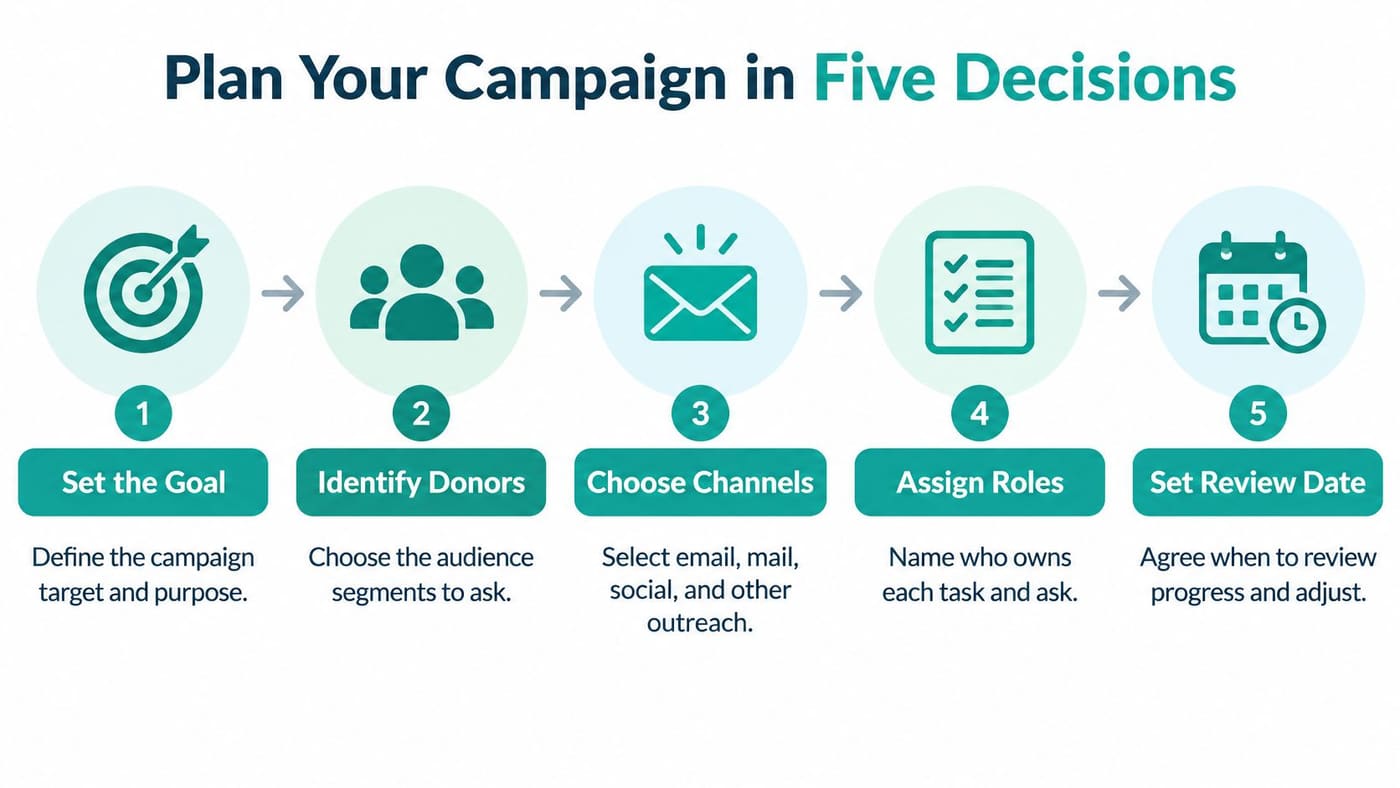
Plan Your Campaign in Five Decisions
Every campaign makes the same five decisions: the goal, the audience, the ask, the channels and the measures. Made in that order, they take an afternoon. Made in whatever order the week allows, they take a year, a board retreat and a donor file you no longer trust.
Start with the outcome you need, not the software that will track it. Once those five decisions fit on one page, you can tell on any Tuesday whether the campaign is ahead and what to change before the next send. The sequence below is the part most campaigns skip.
Do the goal math before you write a word
Take the net revenue you need, add the campaign's own costs, then divide by your average gift. A $150,000 net goal with $30,000 in campaign costs needs $180,000 gross, which at a $200 average gift is 900 gifts. That number is the whole conversation. If 900 gifts isn't plausible against your list, you change the goal or the average gift now, not in week six.
Boards approve net goals and then get nervous about gross. Write both numbers on the same page, with the campaign costs that produced the gap: printing, postage, the giving platform, paid ads, and the staff hours you can count. Costs you can't name are still costs, but they don't belong in the target.
| Decision | Question It Answers | Sample Target |
|---|---|---|
| Goal | How much net revenue do we need? | $180,000 gross, to net $150,000 after $30,000 in campaign costs |
| Audience | Which donor groups receive the appeal? | 2 or 3 donor segments |
| Ask | What amount and deadline do we set? | $200 average gift, 60-day window |
| Channels | Which routes carry the appeal? | Email, direct mail, giving page |
| Measures | What proves the campaign worked? | Gift count, second-gift rate, cost per dollar raised |
The build order
- Set the net goal and the end date. One number and one date, written down and agreed by whoever signs the appeal.
- Name the segments that will receive it. Two or three groups, never "everyone on the list".
- Write the single ask and its deadline. One amount or one small gift ladder, with a date attached.
- Choose two or three channels that reach those segments. Five channels for one staff member is three channels too many.
- Set the measures and the review dates at day 30, 60 and 90. Put them in the calendar before launch, not after the first disappointing week.
The self-check: can you name the goal, the first donor group and the date you will review results? If any of the three is fuzzy, the plan isn't ready to launch.
Donor Segments to Ask First
Before you write the appeal, look at where charitable money comes from. U.S. charitable giving reached an estimated $592.50 billion in 2024, a 6.3% increase in current dollars and 3.3% after inflation, according to Giving USA's 2025 report. Individuals supplied roughly $392.45 billion of that, or 66% of the total.
The rest is a map of the work you're not doing yet. Foundations gave about $109.81 billion (19%), bequests $45.84 billion (8%) and corporations $44.40 billion (7%). Corporate giving rose 9.1% in current dollars and reached its highest share of total giving in four decades, while bequest giving fell 1.6%. The same report notes that the 2024 increase was tied partly to stock-market gains, which is a reminder that your goal rides on conditions you don't control.
| Donor segment | Share of 2024 U.S. giving | Role in your goal |
|---|---|---|
| Individuals | 66% (about $392.45 billion) | Largest base, so start with your own donors |
| Foundations | 19% (about $109.81 billion) | Grant proposals and impact reports |
| Bequests | 8% ($45.84 billion) | Long-term legacy conversations |
| Corporations | 7% ($44.40 billion) | Matched gifts and sponsorships |
The three groups to name first
Your largest pool is almost always people who already know you. Sort your file with three questions. Who gave last year? That group carries most of the goal and deserves the first, most personal ask. Who gave once and stopped? A lapsed donor costs less to bring back than a stranger costs to find, and a short "we missed you" note with a specific purpose beats a mass appeal. Who never gave but already shows up? Event attendees, volunteers and program families have proof of your work in their own lives, and they need an invitation rather than a case for support.
A campaign built on one group is fragile. If your plan depends entirely on a single major-gifts push and one donor's year goes badly, the whole campaign misses. Institutional money, corporate matches and legacy gifts move at different speeds, and that spread is what keeps a bad quarter from becoming a bad year.
When a lapsed donor comes back, the donor management record should show the last gift, the last conversation and the receipt you sent, so nobody greets them as a first-time donor.
- Confirm the counts. Pull the actual number of people in each group before you assign a share of the goal to it.
- Pick the carrier. Decide which segment will produce the largest share of the $180,000, and write that appeal first.
- Write one appeal per group. Same campaign, different opening line and different ask.
Channels and Asks That Reach Each Donor
Email response can be low even when a campaign reaches a large list. In a benchmark of 40 U.S. national nonprofits covering 672 million emails and more than 1.7 million online gifts, fundraising response, measured as gifts divided by delivered emails, was 0.08% in 2010, according to the eNonprofit Benchmarks Study. Treat that figure as a reason to match the message to the donor, not to send one appeal to everyone.

Use recency, giving history, and program interest to shape each ask. Someone who supported the food program should hear how the campaign advances that work, while a donor interested in a building project needs a relevant purpose and clear destination for their gift.
| Channel | Best for | Strength | Watch for |
|---|---|---|---|
| Current and lapsed donors | Low cost and easy to segment | Low response when sent as one broad blast | |
| Text message | Event and deadline appeals | Fast, high attention | Consent and send frequency |
| Direct mail | Older, long-term donors | Personal and tangible | Printing and postage costs |
| Events and peer appeals | Board, volunteers and program families | Personal invitation | Staff time to follow up |
| Giving page | Every channel's destination | Ties the gift to donor and purpose | Long forms and unclear security messages lose gifts |
Choose channels according to the ask and the donor's preferences. Text messages can suit a time-sensitive deadline, but send them only to people who opted in and keep the message brief. Direct mail gives donors who prefer letters a tangible way to respond, though printing and postage add cost. Board members, volunteers, and program families can make personal invitations through events and peer appeals, but staff need time to follow up.
The giving page decides the campaign
Every channel should lead to a page that makes the purpose and next step clear. A 2025 trends report found that 8 in 10 Americans are concerned about online security and 95% worry personal information may be collected and sold without permission. The report also cites a 28% decline in digital giving compared with 2023, alongside concerns about user experience, donor fatigue, and trust, according to the Nonprofit Marketing and Fundraising Trends report.
Use plain language to explain privacy and payment security, and ask only for the fields needed to complete the gift. Make the fund and purpose visible on the page, then ensure the receipt names the fund the donor selected. That connection matters after the appeal, too: it helps the organization track whether restricted gifts went to their intended purpose.
Plan a small sequence of campaign messages, but don't treat three touches as a universal rule. Set the cadence around the deadline, the audience, and the story available to tell. One message can state the goal and ask; a later update can show progress through a donor story; a final appeal can explain when the opportunity closes. Track each send as part of the same campaign with email campaign tools, so results can be considered alongside gifts and donor follow-up.
Keeping Donors After the First Gift
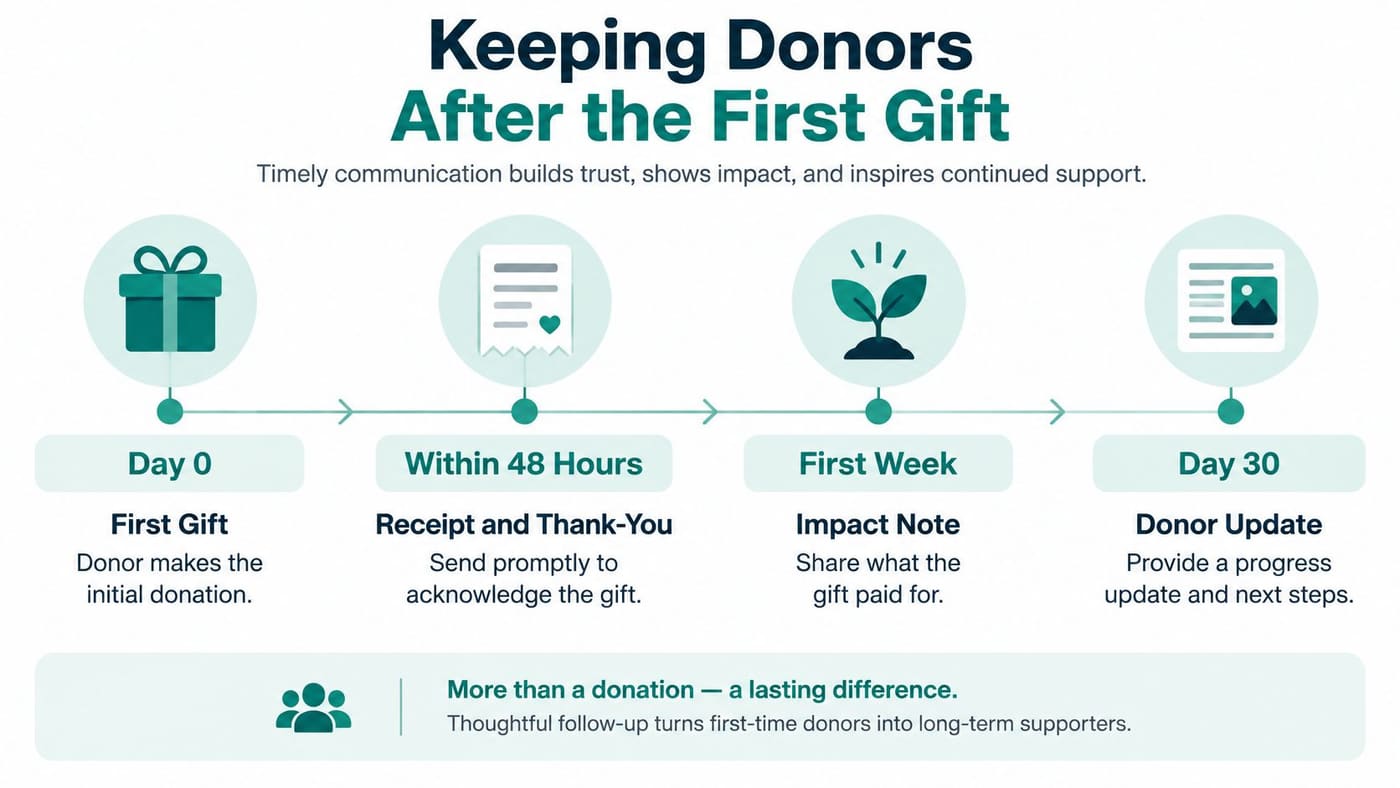
The first gift starts the relationship. What you do in the next 120 days decides whether you have a donor or a transaction. Work the timeline in order and give each step one owner.
- Day 0. The gift arrives. Nothing else happens until the receipt goes out.
- Within 48 hours. Send the receipt and a thank-you that uses the donor's name and the amount. Late receipts are the most common complaint donors make to a board member.
- First week. Send an impact note naming what the gift paid for. One paragraph and one photo is enough.
- Day 30. Share a short progress update on the campaign, with the number raised so far.
- Day 60. Invite the donor to a monthly gift, with a specific amount and a specific purpose.
- Day 90 to 120. Make the second ask. This is the window where second gifts most often arrive.
Recurring donors need a program, not a sign-up
Monthly giving is sold as the fix for retention, and it's only half a fix. A 2025 fundraising outlook found that more than 85% of nonprofits named recurring giving, donor engagement and year-over-year growth as leading challenges, and 88% described recurring giving as at least somewhat problematic, per the OneCause 2025 Fundraising Outlook. The same outlook cites 2025 sector data showing 12-month retention of 57% for monthly donors against 23% for new online donors. Better, but not automatic.
Most failed payments are expired cards, not decisions. Send a card-update message within two days of the failure, before the donor ever sees a cancellation notice. Offer a three-month pause next to the cancel button, because a paused donor usually comes back and a cancelled one usually doesn't. Ask for an upgrade or an annual special gift only after several months of clean payments.
Practical rule: each phase gets one message, one ask and one named person on your team. Shared ownership means nobody sends the day 30 update.
Track the donor retention rate by acquisition month, not as one organization-wide average. A blended number hides which appeal brought in donors who stayed.
Measuring Results Donors Respond To
A campaign passes or fails on one question: did it pay for itself and keep the donors? Everything else is detail. Put the numbers below on one page and review them on a schedule.
| Metric | Formula | Why It Matters |
|---|---|---|
| Delivered-email response | Gifts divided by delivered emails | Shows real giving, unlike open rates |
| Revenue per delivered email | Email revenue divided by delivered emails | Compares segments fairly |
| Second-gift rate | Donors who gave again divided by first-time donors | Shows whether donors stay |
| Days to second gift | Average days from first gift to second gift | Sets the timing of stewardship |
| Cohort retention | Donors retained at 90 and 12 months divided by cohort size | Shows which acquisition source keeps donors |
| Cost per dollar raised | Campaign cost divided by net revenue | Tests whether the campaign pays |
Open rates feel good and pay nothing. A donor who opens six emails and gives once is worth less than a donor who opens one and gives twice, so compare segments on revenue per delivered email instead.
Read the cohort, not the total
Group donors by the month of their first gift, then track how many return at 90 days and at 12 months. The 2011 eNonprofit Benchmarks Study reported a median retention rate of 41% in 2010, with first-time donors retaining at only 25% against 60% for repeat donors, and an average of 108.5 days to a second gift. Retention compounds, and first-gift volume without a second-gift program just adds replacement cost every year.
Say 500 first-time donors gave during your campaign and 120 of them gave again within 120 days. Your second-gift rate is 24%. Now do the cost side: $30,000 in campaign costs against $150,000 net means you spent 20 cents for every dollar raised. Both numbers together tell you whether to repeat the campaign or rebuild it.
If the campaign also ran across several social accounts, FoPost's guide to reporting across networks shows how to compare what each one produced instead of reading five dashboards. Build the campaign view once in your donor reports, and review delivery and response weekly while the campaign is live, cohort retention at 90 days, and the full cost picture after the close.
Keeping Restricted Gifts Separate
Unrestricted cash is not the same as unrestricted spending authority. When a donor gives to the literacy program, that money sits in a restricted fund until you spend it on the literacy program. If it lands in the general account, your balance sheet will tell the board there's money available when there isn't.
The reporting follows the same logic. IRS Form 990 instructions require organizations to classify net assets as unrestricted or donor-restricted and to report the combined total on Part X, line 32. Organizations using the fund method also enter current restricted and unrestricted fund balances. Build the fund into the gift at the moment of entry, not at year end when someone reconciles a spreadsheet.
Tools, named honestly
QuickBooks Online classes can carry a campaign when every dollar you raise is unrestricted. Aplos gives small nonprofits a fund ledger that reads the way fund accounting thinks. Sage Intacct suits a growing finance team with several entities and heavy grant compliance. Each does its job well; the question is whether your records can show a restricted balance without a side spreadsheet, which is what true restricted fund tracking is for.
- Name the fund before the ask. Decide where the money will sit while you're writing the appeal, not after it arrives.
- Record each gift to the donor and the fund on entry. One step, two facts, no cleanup later.
- Allocate campaign costs to fundraising. Shared staff time needs a documented method, because one payroll line often supports programs, fundraising and administration.
- Review fund balances every month. A restricted fund that nobody reads is a compliance problem waiting for an auditor.
Then handle the fiscal sponsor case. When a sponsor holds money for a project that isn't separately recognized as tax-exempt, the sponsor receives and administers those contributions but must keep discretion over how they're used, and reports the income and spending in its own records while honoring donor restrictions, as the National Council of Nonprofits explains. Each sponsored project needs its own view of budget, restricted receipts and remaining balance.
Build Your First Campaign Plan This Month
Start this week, not after the next board meeting. A one-page plan you launch beats a perfect plan that sits in a folder until spring. Write the goal, two donor segments, one ask, three channels and five measures on a single page, and you have something you can hand to a board treasurer.
- Write the one-page plan using the five decisions, including the gross target and the campaign costs behind it.
- Count the donors in each segment so the goal shares are based on your file rather than a guess.
- Set up a restricted fund for any gift that arrives with a purpose attached, before the first one lands.
- Launch the first appeal within 30 days, with the review dates already on the calendar.
We built AlignMint for exactly this sequence. The Free plan covers organizations raising up to $100K a year, includes donor records, giving pages and fundraising drafts for one user, and needs no credit card. A free setup call walks you through fund accounting, donations and reporting on your own plan, so the software fits the campaign rather than the other way around.
Start with the plan. The tools are the easy part, and you already know how to ask.
AlignMint puts fund accounting, donor records, giving pages, events and reporting on one operating record, so the campaign plan you write this month is the same place the gifts, receipts and restricted balances land. The Free plan suits organizations raising up to $100K a year, and a free setup call walks you through fund accounting, donations and reporting on your plan. Visit AlignMint to see how the campaign and the books stay in step.
Frequently Asked Questions
It is the five decisions of goal, audience, ask, channels, and measures for one appeal. A capital campaign and a campaign video are different jobs.
Free is one user for nonprofits with up to $100K in annual donations, and no credit card is required. It includes donor records, giving pages, and fundraising drafts.
Ready to try AlignMint with your nonprofit?
Start free — set up donor tools, giving pages, and Minty. Upgrade when you need accounting.