

Volunteer management is the weekly habit of matching a screened, trained person to a clear role and recording their hours. Start with nine management practices, not a bigger recruiting push, to turn community interest into dependable help. If your roster keeps growing while you still cover empty shifts, the answer starts with supervision, follow-through, and honest costs.
Quick Answer: Volunteer Management
Volunteer management is the weekly habit of matching a screened person to a clear role and recording the hours. A fuller roster does not help if the shift is still empty.
Start with volunteer scheduling and volunteer management best practices. For program design, see the volunteer management program guide.
Why the Roster Looks Full and the Shift Is Empty
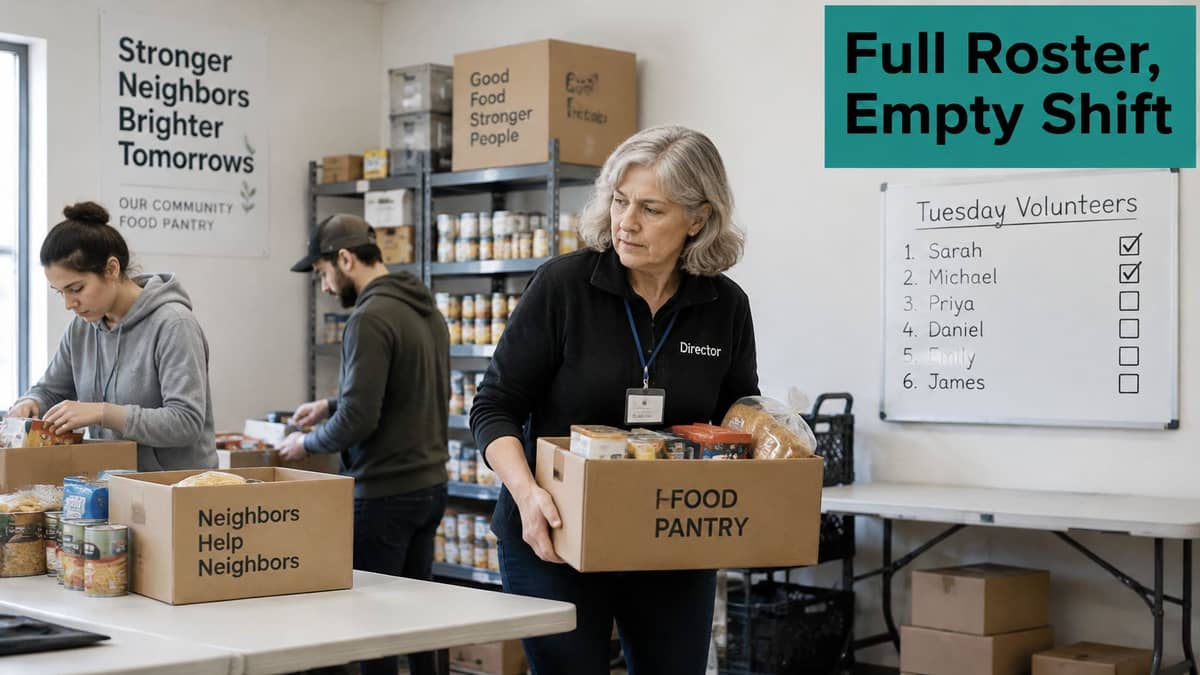
Say your Tuesday food-pantry roster lists six volunteers, but only two arrive, leaving you to carry boxes and cover reception. You could advertise again, but another application form won't explain why the people already registered didn't come.
More sign-ups aren't the main fix. Your real job is helping someone understand the assignment, feel supported, and choose to return.
The 2025 Switchboard evidence summary identifies communication, organizational support, satisfaction, and leader relationships among important predictors of turnover. It also connects orientation and training with stronger retention, more volunteer hours, and longer service.
Find the missing commitment
In that pantry scenario, check what happened between registration and arrival. Did someone explain the lifting requirements, name the supervisor, and ask for a definite commitment?
A person who clicked an interesting opportunity hasn't necessarily agreed to serve. The same Switchboard review warns that web and app recruitment can increase applications while also increasing turnover and no-shows.
Volunteer management for a nonprofit means turning an interested name into someone who can serve confidently. That requires a clear assignment, appropriate screening, a welcoming supervisor, and service recorded against the right program.
Even basic participation measurement remains incomplete: United Nations Volunteers reports that only 64 of 193 UN Member States measured volunteer work through national statistics during its reporting period.
Check the handoffs before advertising
Use a volunteer operations readiness check to identify where your own process stops working. Look at confirmation, preparation, arrival, supervision, and the invitation to return.
A full contact list isn't staffed capacity. Count commitments you can deliver, not names you hope will appear.
Written practices, dependable shift leadership, and an honest coordination budget give you something useful to improve. The win is fewer last-minute gaps, not a longer list.
Nine Practices Worth Writing Down
Nine volunteer practices and the record each one needs
| Practice | Record to keep | If you skip it |
|---|---|---|
| Supervision and communication | Named supervisor and last contact | People drift after the first shift |
| Liability coverage | Insurance status and role risk level | A claim has no paper trail |
| Screening and matching | Check status, skills, and availability | The wrong person lands in a sensitive role |
| Counts of people and hours | Head count and hours by program | You cannot plan next month or report reach |
| Written policies and roles | Role card and policy version | The ask stays vague and no-shows rise |
| Recognition | Thank-you date and what was named | Thanks feel random or get skipped |
| Impact measurement | Hours tied to a program output | Hours get reported as if they were outcomes |
| Volunteer training | Training done and date | New people guess the task and leave |
| Staff trained to work with volunteers | Staff briefing date | Paid staff treat volunteers as extra hands |
The Urban Institute's volunteer management and retention study identifies these nine core practices for stronger volunteer management. Keep a modest record for each practice rather than writing a manual nobody opens.
Make responsibility visible
Start with supervision and communication. A named supervisor prevents the awkward arrival where everyone assumes somebody else will welcome the newcomer.
For liability coverage, record which policy covers the activity and when someone reviewed it. Documentation supports a claim review, but it doesn't replace suitable insurance or advice from your insurer.
Screening and matching require more than a completed application. Keep the approval status beside the assignment requirements, using background-check tools where appropriate for the role.
For people and hour counts, distinguish registered people from people who served. Record the program, not just the organization, so you can see where help is missing.
Written policies and roles should answer practical questions before someone agrees. Include the task, physical requirements, boundaries, supervisor, and cancellation process in a short role card.
Record the support people receive
Recognition needs a date and a reason. Thanking someone for patiently helping a nervous family feels more meaningful than sending an undifferentiated appreciation message.
Impact measurement needs a connection between service and what your program delivered. Packing meals is an output; whether families experience better food security is a different question.
Record volunteer training by role and completion date, not merely attendance at a general welcome session. You can then compare repeat participation among people with different preparation.
Finally, staff preparation deserves its own record. Paid employees need to know what volunteers may do, how to teach tasks, and where concerns should go.
Practical rule: Store the minimum information needed to make a safe assignment and explain what happened afterward.
Don't make the coordinator collect information nobody uses. Pick the three missing rows that create your biggest operational risks, and add those records this month.
From First Interest to Logged Hours
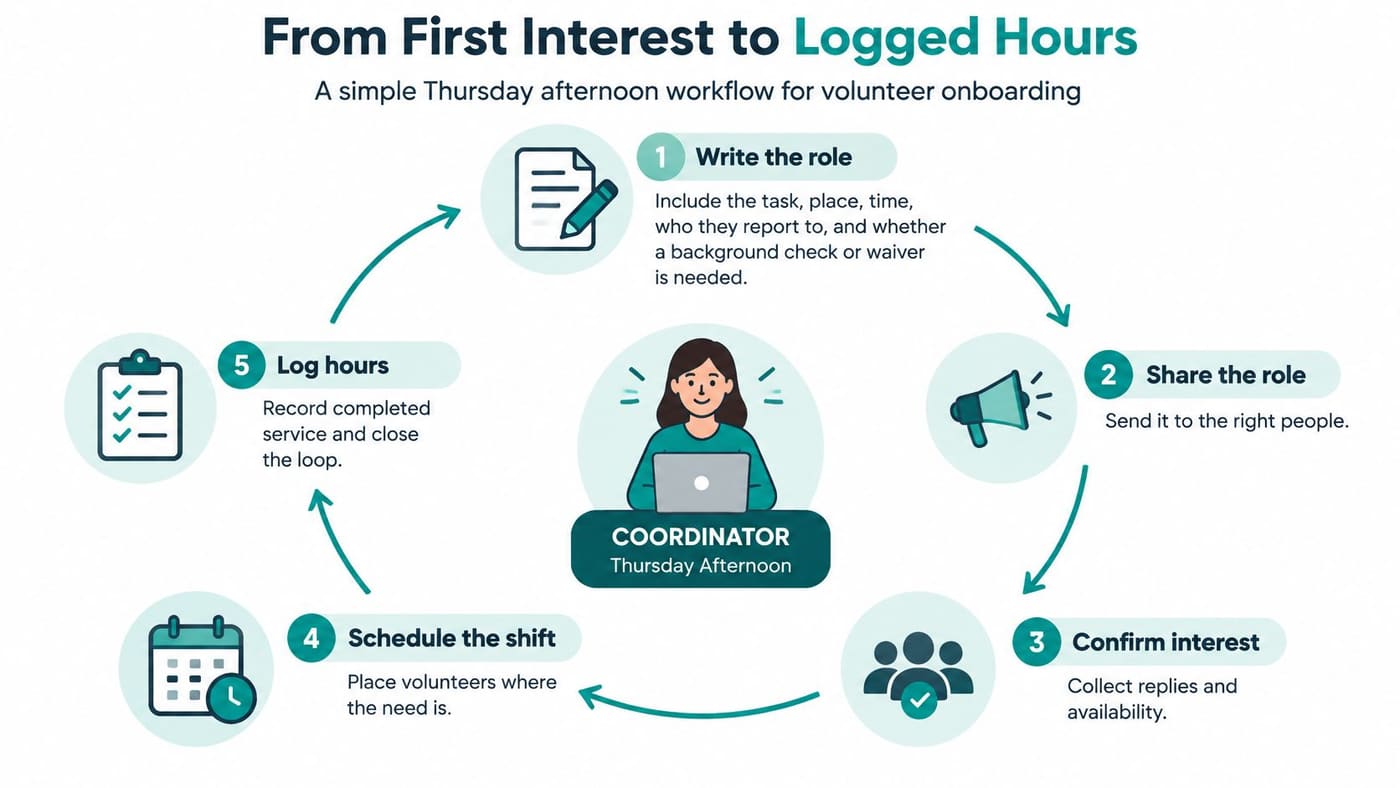
Reliable service starts when your coordinator can finish a placement without hunting through personal messages or remembering unwritten promises. Run the following loop during a regular coordination session, keeping the same record open throughout.
Give every handoff an owner
-
Write the role in a paragraph. Include the task, location, time, supervisor, and any required check or waiver. Without those details, people agree to work they haven't understood.
-
Accept interest through accessible channels. Take replies through a form, phone call, text, paper application, or conversation after Sunday services. An online form shouldn't be the only door into your program.
-
Match readiness and availability. Compare skills and open times with the role requirements before offering a place. Don't assign someone with an outstanding required check or an existing time conflict.
-
Invite a definite commitment. Ask the person to accept or decline a particular assignment, rather than expressing general interest. Encourage a short explanation when they decline, so the coordinator can resolve the actual gap.
-
Assign an experienced shift anchor. Make a particular person responsible for welcoming newcomers and answering immediate questions. Without that assignment, several friendly volunteers can each assume someone else is helping.
-
Confirm through a channel they answer. Send the location, arrival instructions, supervisor's name, and cancellation contact before the shift. A reminder in an unread inbox doesn't help anyone reach your door.
-
Demonstrate the task on arrival. Walk through the work, let the volunteer try it, and check their understanding. Handing someone a badge isn't the same as preparing them to work safely.
-
Record completed service promptly. Log hours by person, event, and program, and distinguish absence from completed work. Reconstructing attendance much later invites guesses and leaves supervisors unable to explain discrepancies.
-
Thank them and offer another date. Make the next invitation specific and leave room for honest feedback. Without follow-up, someone who enjoyed serving may still assume you don't need them again.
Keep the alternatives connected
Your portal can make routine coordination easier without replacing personal help. Keep phone, text, paper, and in-person pathways available for people with limited internet, language needs, or unfamiliarity with online forms.
The coordinator should transfer those replies into the same working record. Otherwise, your accessible approach creates parallel lists that disagree about who has committed.
A volunteer hour-tracking template gives you a practical starting point for recording completed service. Keep sensitive screening documents separate from broadly shared attendance information.
Churches can apply this loop to Sunday hospitality teams, while schools can use it for reading support or event crews. Each assignment still needs a responsible supervisor and an appropriate level of preparation.
The test is simple: you can identify who served, when, where, and for which program without opening a side spreadsheet.
Staff the Shift and Measure Who Comes Back
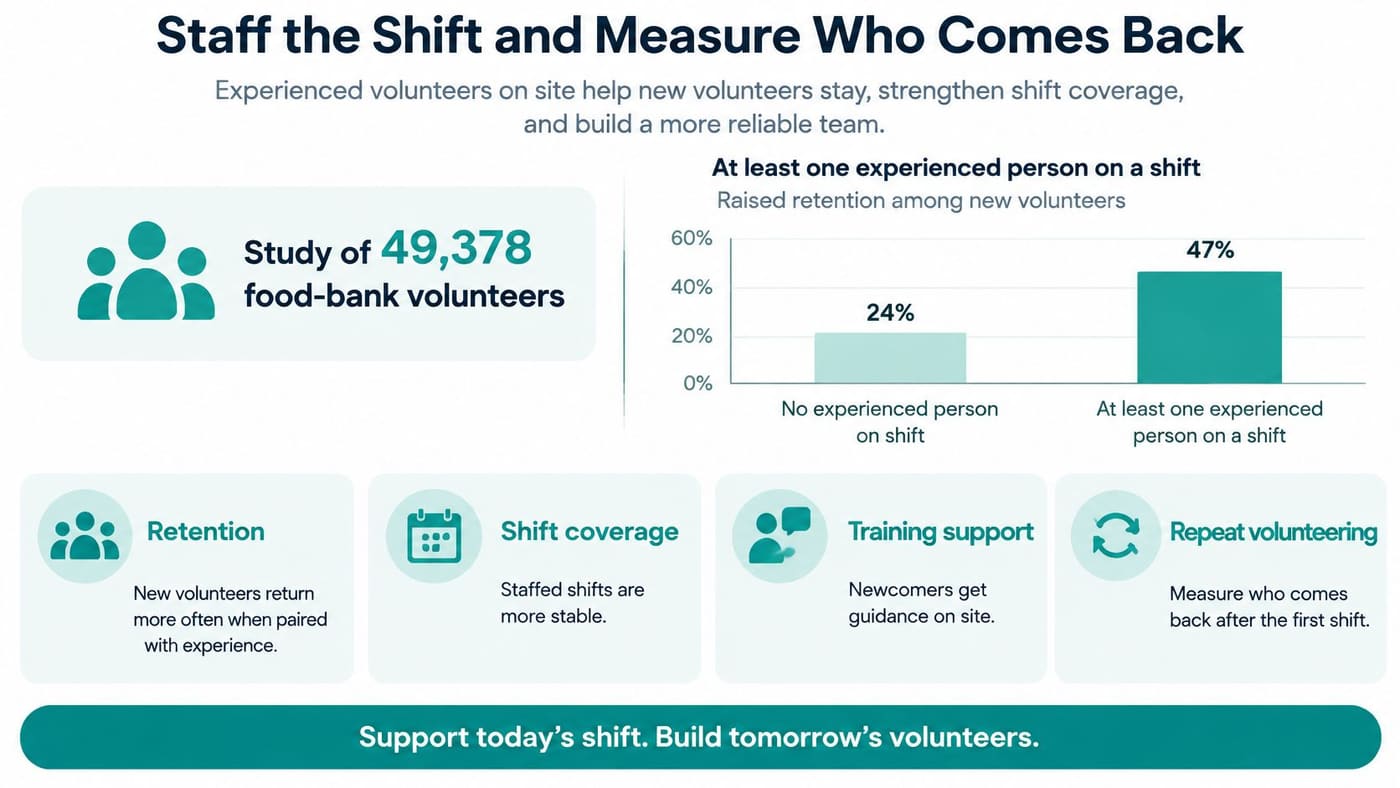
Placing an experienced volunteer beside newcomers can matter more than filling another empty slot with an unfamiliar face. A longitudinal study of 49,378 food-bank volunteers found that an experienced person on a shift increased new-volunteer retention by 52%, reaching 125% for group volunteers.
Those are findings from food-bank shifts, not a promised result for every nonprofit. They do support a practical staffing choice you can test within your own program.
Rotate experience rather than protecting a clique
An experienced volunteer can demonstrate the task, explain unfamiliar routines, and notice when a newcomer looks uncertain. That likely reduces the discomfort of asking basic questions in an unfamiliar workplace.
However, the study also identified a limit: excessive familiarity among experienced volunteers can weaken the benefit, particularly during uncertain tasks. A tightly bonded group may understand each other perfectly while leaving newcomers outside the conversation.
Choose rotating shift anchors, not permanent insiders who own the calendar. Ask anchors to introduce themselves, explain the first task, and make sure newcomers know whom to approach.
An anchor doesn't need to become another manager. Give them a clear welcome responsibility, while keeping supervision, safety decisions, and escalation with the designated coordinator.
Measure the return, not the application
Four measures that beat a raw sign-up count
| Measure | Formula | Question it answers |
|---|---|---|
| Show-up rate | People who arrived divided by people who said yes | Is your reminder and welcome working? |
| Trained-to-active rate | Trained people who worked a second shift divided by all trained people | Does training turn into repeat service? |
| Hours per retained volunteer | Total logged hours divided by volunteers still active at 90 days | Are you collecting names or service? |
| Withdrawal reason | A short note of five words or fewer | Is the problem the schedule, the task, or the welcome? |
Treat the final row as a reason category, not a mathematical rate. Notes such as transport unavailable, task unsuitable, or schedule changed make patterns easier to review without collecting unnecessary personal details.
For the hours measure, use the same observation period and clearly label which volunteers contributed to the total. For retained-volunteer productivity, count only hours contributed by that retained group.
Group your review by starting cohort, task type, shift composition, and whether people arrived with an organized group. Otherwise, a busy corporate service day can obscure what happened to individual recurring volunteers.
Your staffing decision: give new-volunteer shifts an experienced anchor, then rotate that responsibility. Review actual return patterns before assuming the arrangement works equally well across every task.
Price the Seat Before You Add More Names
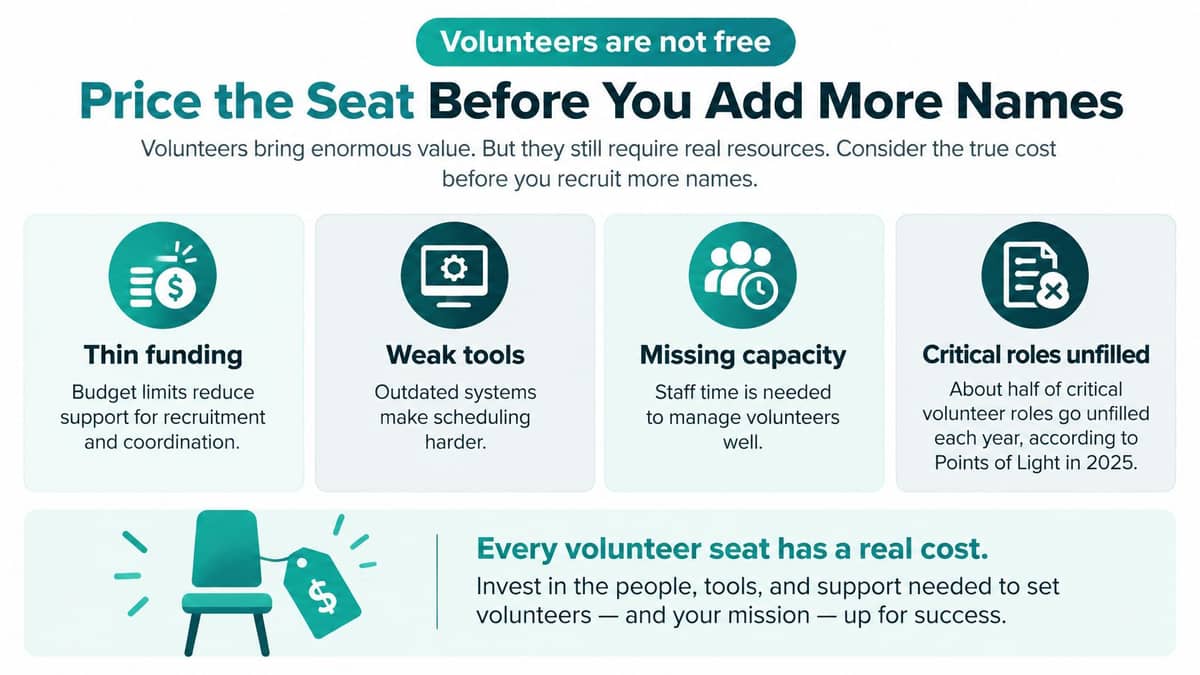
Volunteers aren't free capacity. Your organization still pays for preparation, supervision, coordination, and the consequences of an assignment nobody covers.
In its 2025 investment report, Points of Light reports that about half of critical volunteer roles go unfilled each year. It also highlights inadequate funding, tools, impact information, and infrastructure for understanding volunteering's full costs.
Calculate the cost of dependable help
Put these costs on a single budget worksheet, using actual spending and a reasonable allocation of paid staff time.
- Preparation and protection. Include screening fees, introductory training, insurance, waivers, and staff preparation.
- Ongoing coordination. Count scheduling, supervision, messaging, technology, and time spent replacing absent volunteers.
- Access and recognition. Include transport assistance, translation, accessible materials, refreshments, and planned appreciation.
Use a clearly defined denominator: people who completed at least two shifts during the year. This is a practical management definition of active participation, not a sector benchmark.
Cost per active volunteer = annual volunteer-program costs ÷ active volunteers.
Suppose, hypothetically, your screening, supervision, insurance, texting, and recognition total $6,000, and 40 people complete at least two shifts. Your calculated cost is $150 per active volunteer, before considering whether their work meets your program's needs.
Compare the total expense and delivered work with a part-time employee or contractor doing the same task. Don't compare the volunteer figure with an employee's hourly wage without also comparing hours, continuity, supervision, and work quality.
Use a nonprofit operating budget template to make those assumptions visible to your board. If coordination consumes more capacity than volunteers contribute, simplify the roles before expanding recruitment.
Budget for access and meaningful results
An applicant-paid check, an unreachable location, or English-only instructions can exclude a capable person. Record which barriers prevent participation, then decide which costs your organization should absorb.
For appreciation purchases, Custom Mark's nonprofit merchandise guide offers context for planning nonprofit merchandise. Treat those purchases as a deliberate recognition expense, not a substitute for supervision or transport assistance.
Report program outputs alongside service hours, such as meals packed or students tutored. The fund accounting guide can help you keep restricted support visible alongside program spending.
Coordination time is program infrastructure. Give your board a budget line it can approve, rather than hiding the work in leftover administration.
Choose Software by the Gap It Closes
Keep the simplest tool that supports your actual responsibilities. A shared sheet may be enough when your coordinator reliably confirms assignments, records attendance, and closes the reporting period.
As an adjustable rule of thumb, consider a sheet for fewer than about 15 active people, one program, and no screening requirements. That's a starting point for your judgment, not a research-backed threshold or a reason to ignore risk.
Compare the work left behind
Volunteer tools compared by the gap they leave
| Option | Strength to keep | Gap that still costs time |
|---|---|---|
| Shared sheet | Fine under about 15 active people and one program as a working rule | Check status, reminders, and program hours require manual setup |
| SignUpGenius | Fast public sign-up and a simple yes | Test how skills, screening, and hour history will be maintained |
| VolunteerHub | Nonprofit shifts and hour reports | Donor gifts and fund balances may require connected systems |
| Bloomerang | Strong donor history beside volunteer activity | Confirm how fund accounting connects with shift records |
| QuickBooks plus a sheet | Familiar books for a treasurer | Classes aren't records of people, shifts, or checks |
Compare your intended setup, not merely the product category. Features, integrations, and purchased modules can change what staff must enter twice.
SignUpGenius deserves consideration when the immediate job is collecting public commitments without creating unnecessary administration. VolunteerHub deserves consideration when nonprofit scheduling and service reporting are the primary operational needs.
Bloomerang makes sense to evaluate when donor relationships drive your information needs. QuickBooks may remain familiar to your treasurer, but classes aren't a substitute for true fund accounting or volunteer records.
The wider nonprofit accounting software comparison helps frame the finance side of that decision. Don't replace familiar accounting just because another product has a more attractive calendar.
Run a demonstration with your own difficult case
Choose a realistic scenario: a returning donor volunteers for a school event, needs screening, declines an invitation, then accepts another assignment. Ask the demonstrator to follow that person from invitation through attendance and reporting.
Watch for repeated typing, separate identities, and exports that somebody must reconcile later. A useful volunteer scheduling evaluation starts with those handoffs rather than a tour of dashboard screens.
For organizations coordinating employees alongside volunteers, HR Management 365's guide to workforce management for UK and EU organisations offers a separate workforce-planning perspective. Keep employee requirements distinct from volunteer coordination when assessing either category.
Ask these questions before committing:
- Placement safety. Can you block an assignment when required screening hasn't cleared?
- Volunteer effort. Can someone accept or decline without attending a software training session?
- Program reporting. Can completed hours reach the correct program without a separate export?
If those jobs remain manual, you may still have a useful calendar. Just don't mistake it for a complete management system.
Run One Reliable Shift This Month
A full roster does not guarantee that a shift will run well. Choose the program that most often pulls you from your own work to cover a gap. For its next shift, name a supervisor, designate a returning volunteer as an anchor, and confirm who is expected.
After the shift, compare attendance with accepted invitations. Review coordinator workload and any missing records, then decide whether your current sheet is enough. One reliable shift can reveal more than a long list of names.
Make the decision concrete
- Assign ownership. Name the person who checks commitments and handles cancellations. Shared responsibility can leave a gap when someone cannot attend.
- Review working conditions. For isolated assignments, use the 3rd-i guide to safer lone working to inform safety planning.
- Connect spending and service. The fund accounting software guide can help clarify how restricted money and program records fit together.
AlignMint, built by nonprofit directors, brings money, donors, programs, and people together. Its platform includes accounting, donor management, volunteer and event management, and marketing tools.
Volunteer management covers profiles, schedules, screening, reminders, waivers, and service hours. Coordinators can invite volunteers to assignments and track whether they accept or decline. Minty can help identify donor, fund, event, and volunteer signals that need attention.
Churches, schools, and fiscal sponsors can also use AlignMint. Shared records connect volunteer activity with programs and finances, reducing the need to copy information between separate lists.
Add a platform when duplicate entry is consuming your Thursday, not because another organization bought software. First make the assignment dependable. Then choose a tool that helps your team supervise volunteers and keep service records together.
We offer shared volunteer records alongside accounting, donors, events, and marketing. AlignMint is free for nonprofits with up to $100K in annual donations, with no credit card required. Visit AlignMint to explore a home for your volunteer operations.
Frequently Asked Questions
It is the weekly habit of matching a screened, trained person to a clear role and recording the hours. A longer roster does not staff an empty shift.
Volunteer scheduling starts on Plus. Free includes one user, donor records, and giving pages for nonprofits with up to $100K in annual donations, with no credit card required.
Ready to try AlignMint with your nonprofit?
Start free — set up donor tools, giving pages, and Minty. Upgrade when you need accounting.