

A subledger is the detailed record behind one general ledger account, and the total of its records must equal that account's balance. If your treasurer asks which gifts support a restricted balance, you need more than a bank statement. You need a clear path from individual transactions to your financial reports, plus a practical way to check it.
Quick Answer: What a Subledger Is
A subledger is the detailed record behind one general ledger account, and its total must equal that account. Use it when a restricted balance needs a gift-by-gift explanation.
Start with fund accounting and restricted funds. For the close, see why bank reconciliation matters.
What a Subledger Is in Plain Terms
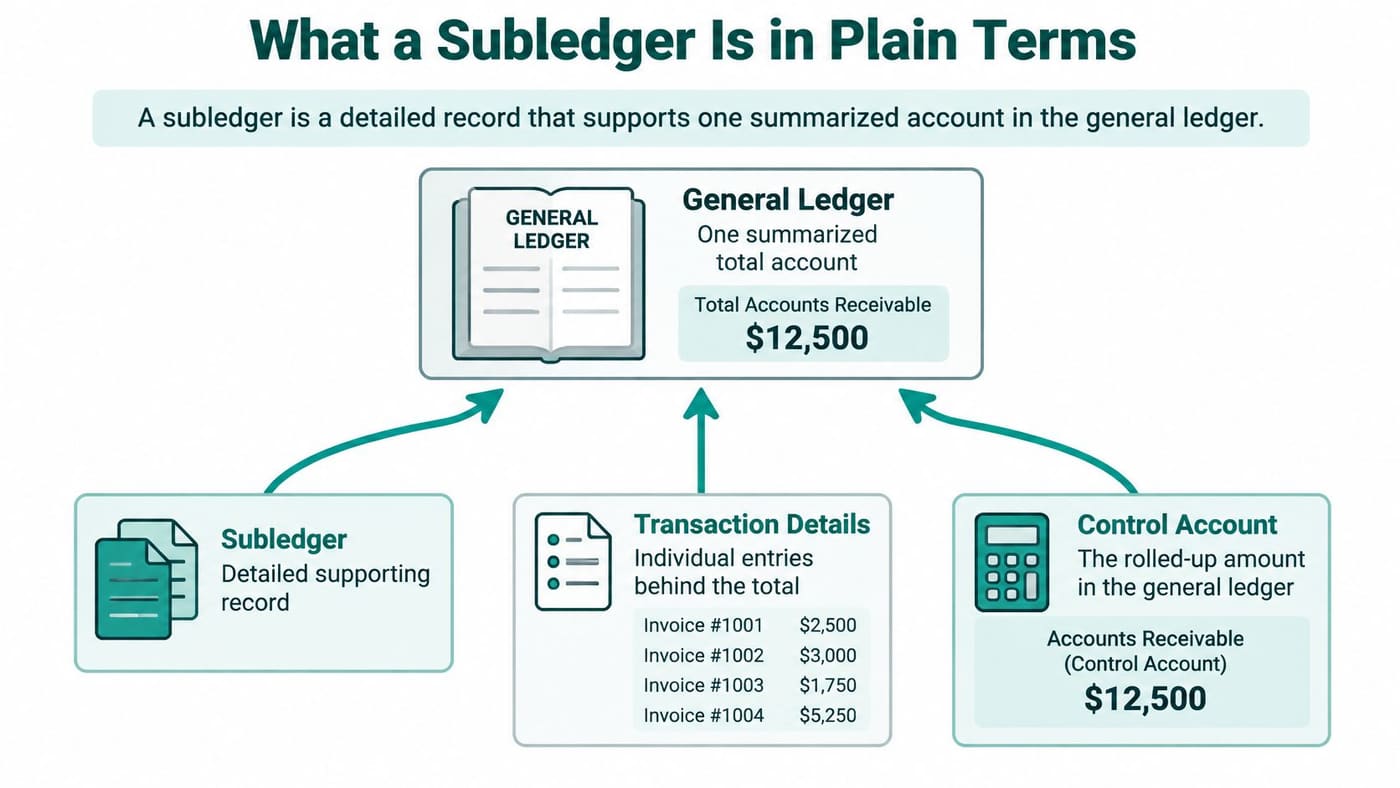
You can answer questions about a balance without searching through every transaction your organization has ever recorded. A subledger, also called a subsidiary ledger, keeps the supporting detail together for a particular accounting purpose.
Think of the general ledger as the total on a statement, with supporting receipts arranged underneath it. The analogy isn't exact, because a general ledger contains accounting entries rather than just bank activity.
Still, the picture helps: leaders read summarized totals, while finance staff need the records explaining those totals. Historical accounting literature on subsidiary ledgers describes this separation and the control account used to check agreement.
Detail lives in the subledger, the summary lives in the general ledger, and the two must agree.
Each supporting record should identify the date, party, amount, and purpose behind the transaction. Depending on the activity, it might also include an invoice, donor restriction, payment reference, or asset description.
Say your board treasurer questions the amount your charity owes suppliers at month-end. Your accounts-payable subledger should show the unpaid bills, their vendors, and any credits reducing those bills.
Familiar records you may already keep
- Vendor bills: Your accounts-payable records explain which suppliers are owed money and which invoices remain unpaid.
- Donor gifts: Your contribution records identify the donors, gifts, designations, and adjustments behind recorded contribution activity.
- Vehicles and computers: Your asset register preserves the purchase details and depreciation supporting your fixed-asset balances.
You don't need to memorize accounting terminology to understand what is a subledger in practical terms. Ask whether the record explains a reported balance and whether someone checks that explanation against the books.
A spreadsheet can serve this purpose, provided someone controls changes and reconciles its contents. The important distinction isn't paper versus software, but supporting evidence versus an unsupported total.
How a Subledger Feeds the General Ledger
You get useful financial reports when detailed activity reaches the books through consistent accounting rules, rather than repeated manual copying. Consider a hypothetical $500 donor gift designated for your literacy program.
The contribution record identifies the donor, gift date, payment reference, and fund designation before accounting entries are generated. Assuming the gift qualifies for contribution recognition, the entry records cash and the appropriate contribution revenue.
The following comparison separates the supporting records from the financial-book summary.
Subledger versus general ledger at a glance
| Feature | Subledger | General ledger |
|---|---|---|
| Level of detail | Every invoice, gift, asset or payslip | One balance per account and period |
| Main purpose | Investigate and support specific balances | Prepare financial statements and Form 990 totals |
| Typical volume | Hundreds to thousands of supporting records | One line per account in a summary report |
| Who works in it daily | Accounts payable, billing, grant and fund staff | Controller, accountant, board treasurer |
| Control check | Sum of records must equal the control account | Balance must match the subledger total |
The volume descriptions are illustrations, not capacity limits: a general ledger can contain detailed journal lines, too. Oracle's ledger documentation explains how detailed transactions generate accounting entries that transfer into the general ledger.
Choose detail without losing traceability
You can preserve each entry individually in the general ledger or transfer matching entries as summarized batches. Oracle's subledger accounting documentation describes individual transfers and summarization by accounting date or period.
Individual transfers make transaction-level review more immediate, but they also increase the number of journal lines. Summarized transfers reduce that volume, making a reliable route back to individual source records especially important.
The subledger retains the source document, counterparty, date, currency, and fund needed to investigate a particular entry. Our general ledger guide provides additional context for understanding the financial-book side of that relationship.
For a revenue account, compare contribution activity for the same reporting period rather than an unrestricted lifetime gift total. For a payable account, compare the outstanding balance at the same cutoff date.
Control rule: A difference is a reason to investigate, never permission to enter an unexplained balancing amount.
The subledger answers which gift or bill you're reviewing. The general ledger answers how that activity affects your organization's totals.
Common Subledger Types and What They Track
You can organize your records around practical questions rather than buying a separate system for every accounting category.
Common subledger types and what they track
| Subledger | What it tracks | Control account in the GL | Nonprofit example |
|---|---|---|---|
| Accounts payable | Each vendor bill, credit and payment | Accounts payable | Each vendor invoice for printing and rent |
| Accounts receivable | Each customer invoice, payment and open balance | Accounts receivable | Sponsor invoices and recognized pledges still unpaid |
| Fixed assets | Each asset, its cost, acquisition date and depreciation | Fixed assets, net | Vehicles, computers and buildings the charity owns |
| Payroll | Each employee's pay, withholding and allocation | Payroll expense and liabilities | Staff time split between programs |
| Grants and restricted funds | Each award, drawdown, expense and remaining balance | Net assets with donor restrictions | A literacy award restricted to approved teaching activities |
| Donors and contributions | Each gift, pledge, fund designation and receipt | Contributions revenue | Each gift that needs a written acknowledgment |
These account mappings are starting points, not instructions to post every transaction into a single account. Asset records support asset-cost and accumulated-depreciation accounts; grant records may also support receivables, revenue, or refundable advances.
Match the record to the question
Accounts payable answers whom you owe, while accounts receivable answers who owes your organization. Fixed-asset records explain what you own, and payroll records explain compensation, withholding, and program allocations.
Grant and restricted-fund records answer a different question: what purpose governs the remaining resources? Contribution records connect that financial activity to the donor relationship and acknowledgment history.
Our chart of accounts guide helps distinguish account categories from the funds and programs attached to transactions. A fund is not just another expense account, and a donor list is not automatically a reconciled accounting record.
Independent nonprofit guidance on restricted funds recommends tracking restrictions by grant or purpose and reconciling them throughout the year. A fund designation doesn't necessarily mean the cash sits in a separate bank account.
Keep operational detail in its proper place
A church might track building gifts separately from general offerings, while a school tracks scholarship gifts and program fees. A fiscal sponsor may maintain distinct project schedules within its overall books rather than separate accounting software for every project.
Volunteer records answer who served, where, and for which activity, but they aren't automatically financial subledgers. Don't turn recorded service hours into cash contribution revenue just because they appear beside donation records.
Make a short inventory: list the supporting records your organization already keeps, then mark those maintained in spreadsheets. Add the person responsible and the general ledger account or reporting schedule each record supports.
How to Reconcile a Subledger to the General Ledger
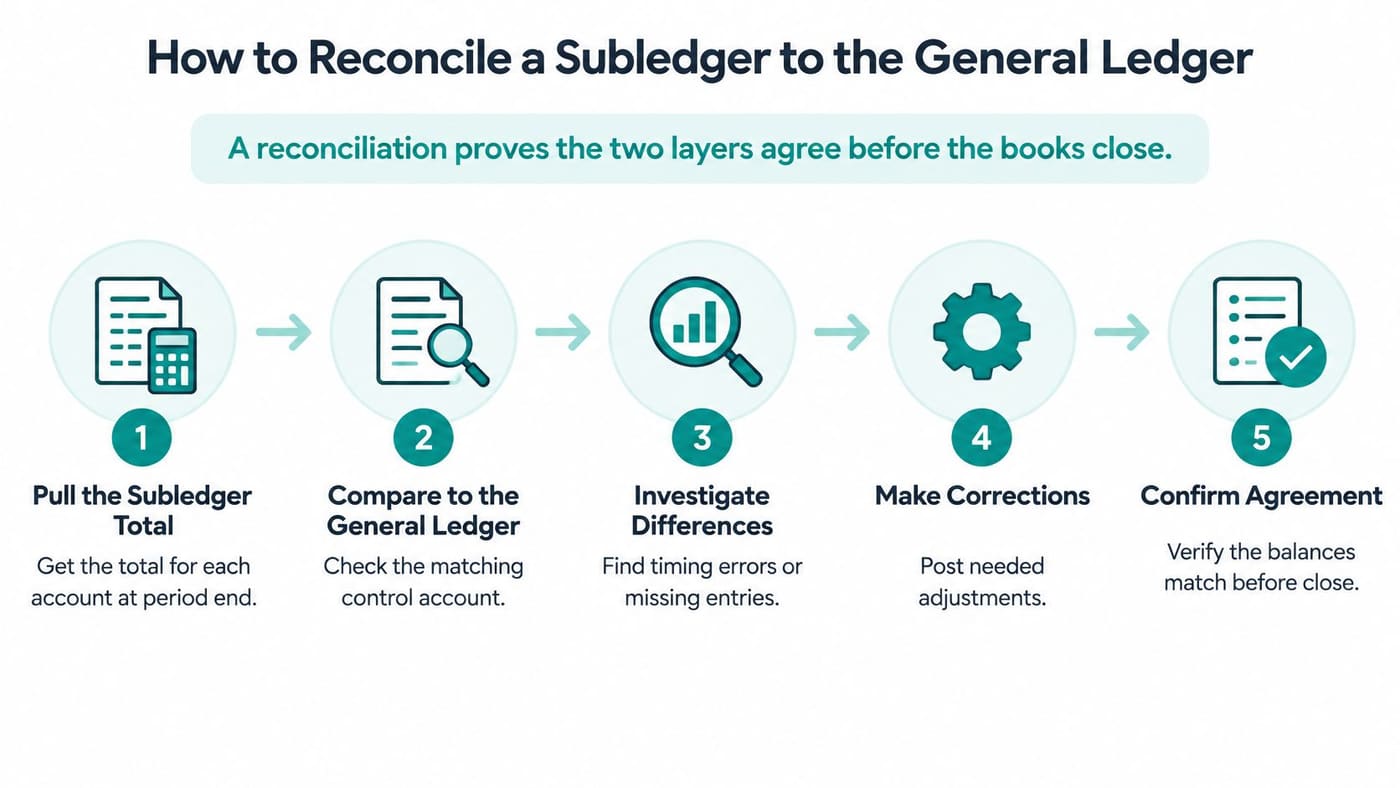
You protect spending decisions by proving the supporting records agree with the books before approving the financial close. A reconciliation documents that comparison, the differences investigated, and the corrections reviewed.
For your restricted literacy fund, you'll need both the accounting balances and a schedule explaining restricted activity. A matching organization-wide total can still hide a gift assigned to the wrong fund.
Follow a repeatable close routine
-
Pull the subledger total at period-end. Save the report with its account, fund, currency, and date filters visible. A common slip is including an unposted gift while the corresponding accounting entry remains pending.
-
Pull the matching general ledger balance. Use the same cutoff and confirm whether you're comparing ending balances or period activity. A bank-feed item posted into the following period can otherwise create an apparent mismatch.
-
Compare by account, fund, and currency. Check the literacy fund separately instead of relying only on the organization-wide contribution total. Opposing coding errors can cancel each other out when staff compare only grand totals.
-
List differences and identify their causes. Trace missing postings, duplicates, wrong dates, and manual journals that bypassed the supporting record. Give each exception an owner rather than leaving an unexplained amount on the worksheet.
-
Correct the original problem through controlled entries. Fix the coding, complete the posting, or record an approved reversal and replacement. Don't overwrite transaction history or make a plug entry merely to force agreement.
-
Record review and sign-off. Save the preparer, reviewer, completion date, supporting reports, and correction references with your close papers. Otherwise, someone can change a report later without leaving evidence of what was approved.
Separate timing explanations from unresolved errors
For vendor balances, AP reconciliation guidance from Loopfour is a useful companion to your payable-account review. For gifts and deposits, use our revenue reconciliation guide to frame the comparison.
A payment processor's pending settlement may explain a cash-clearing balance without explaining a contribution-account mismatch. Match the explanation to the account you're reviewing, and record when any legitimate timing item should clear.
Close test: Both accounting totals match to the cent, and every exception has a written reason and owner.
Automation can help prepare comparisons, but your finance lead still decides whether restrictions and accounting treatment are correct. Keep that judgment visible through approvals, correction records, and a dated reconciliation.
Why Subledgers Matter for Nonprofit Funds and Audits
Suppose a $50,000 literacy grant arrives in your bank account while rent and salary payments are already committed. The deposit increases cash, but it doesn't automatically increase what you can spend on general operations.
Your first question should concern the agreement: which activities qualify, and are there conditions affecting contribution recognition? Your second concerns the commitments already assigned to that grant, including obligations not yet paid.
Follow the restriction through the records
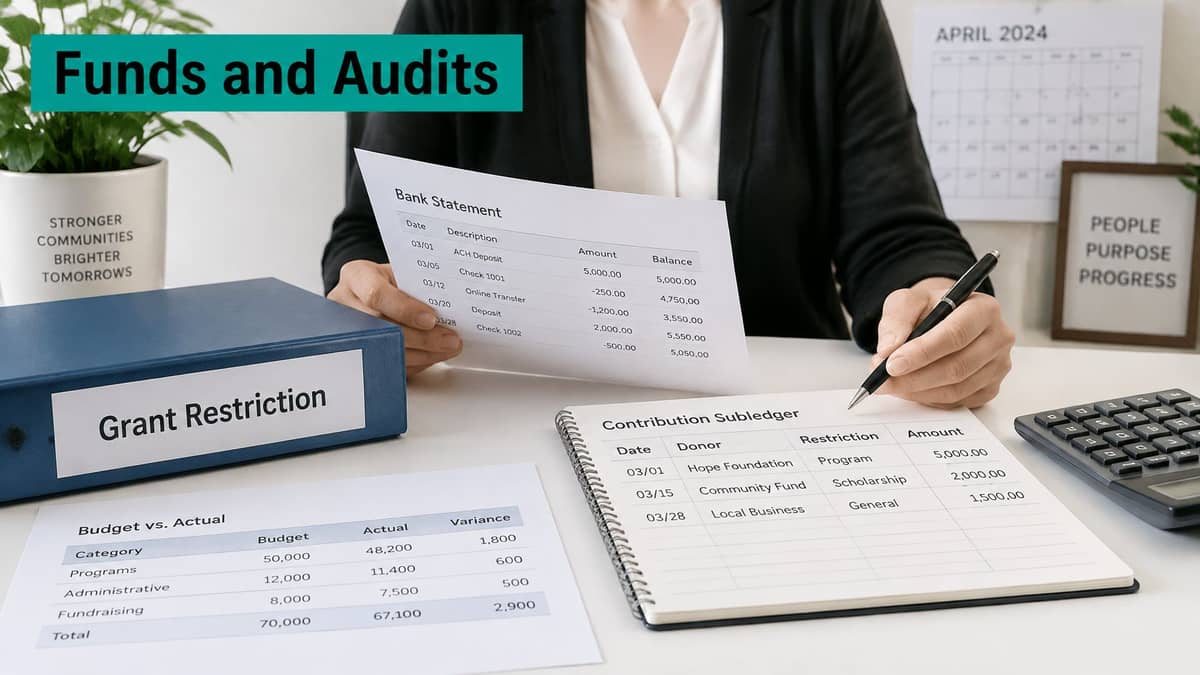
The donor agreement establishes the purpose, while the contribution or grant record preserves the supporting transaction details. Accounting entries then support the general ledger, financial statements, and applicable Form 990 reporting schedules.
Your restricted-fund schedule should explain recognized support, qualifying activity, releases from restriction, and the remaining restricted balance. Our restricted funds guide provides a closer look at that distinction.
An auditor can trace a reported amount through those records to the agreement, gift documentation, and accounting treatment. A receipt alone won't establish that every expense charged against the award qualified under its terms.
Donor communication also creates a specific documentation obligation. The IRS written acknowledgment guidance says donors generally need contemporaneous written acknowledgment for deductible contributions of $250 or more.
That acknowledgment identifies the charity, states cash received, describes donated property without valuing it, and addresses benefits provided. Accurate donor records therefore support tax documentation as well as relationship management.
Evaluate tools by the controls you need
QuickBooks offers familiar general accounting, and its classes can help staff categorize nonprofit transactions by program or purpose. Aplos is a common choice for small nonprofits, while Sage Intacct and Blackbaud Financial Edge serve more complex finance teams.
The gap to test isn't whether a tool can attach a label to a transaction. It's whether your process carries the restriction through approvals, corrections, reporting, and the completed close.
External assurance also doesn't replace your monthly controls or your review of spending commitments. Lighthouse Consultants' discussion of what external audits can miss offers context for distinguishing external assurance from ongoing internal review.
For fiscal sponsorship, keep project restrictions and balances distinguishable within the sponsor's overall reporting and approval responsibilities. For churches and schools, apply the same discipline to building appeals, scholarships, and restricted program gifts.
Your useful answer isn't the amount in the bank. It's which dollars remain available for which purposes, after considering restrictions and outstanding commitments.
Check Your Subledgers Before the Next Close
A restricted-fund balance should be explainable from its supporting transactions and agree with the matching general ledger balance. Before the next board meeting, ask your finance lead to check three things:
- Restricted-fund detail: Each restricted fund has identifiable supporting records or separately reportable subledger detail.
- Documented agreement: At the last month-end, supporting totals matched their corresponding general ledger accounts.
- Owned exceptions: Each unresolved reconciliation item has a written explanation, an assigned owner, and a planned resolution.
A “yes” to all three indicates that the records support a basic control. Keep reviewing grant conditions, approvals, and whether expenses were charged to the right purpose.
Make the next conversation concrete
Bring the fund inventory, a restricted-fund report, and the latest reconciliation to the person responsible for the close. The month-end close checklist can help organize the review and identify missing evidence.
To assess fund accounting software, follow one gift through the workflow: from the online giving page and donor acknowledgment to fund assignment, accounting entry, and financial report. Check that the record remains connected at each step.
AlignMint offers fund accounting alongside donor management, fundraising, volunteers, events, and payments, with these activities sharing the same operating record. Its fund accounting supports restricted and unrestricted funds, a full chart of accounts, and standards-ready reporting.
The free plan is for nonprofits with up to $100K in annual donations, with no credit card required. Accounting starts on Plus, which includes fund accounting, bank feeds, and financial reports. AlignMint also offers a free setup call to walk through fund accounting, donations, and reporting on your plan. Bring your subledger list to the conversation, and start with a restricted fund you need to explain. Visit AlignMint to arrange the call.
Frequently Asked Questions
It is the detailed record behind one general ledger account. The total of its lines has to equal that account before you close.
When someone asks which gifts support a restricted balance. The bank statement shows the cash. The subledger shows the donor, the date, and the fund.
Ready to try AlignMint with your nonprofit?
Start free — set up donor tools, giving pages, and Minty. Upgrade when you need accounting.