

The gala money is already in the bank, and the draft Form 990 is open on your desk. The revenue page doesn't tell the story your board heard, because one deposit was a meal, a raffle entry, and a gift all at once. Form 990 Part VIII is where you take that deposit apart. Get one bundled payment right and the rest of the page falls into place.
Quick Answer: Form 990 Part VIII
Form 990 Part VIII is the Statement of Revenue: the line for each dollar, the columns that must tie, and the split when a payment includes a benefit. This page is that revenue schedule. The full reporting guide, who must file, deferred revenue, and grant revenue recognition are separate pages.
Start with Form 990 Builder and Form 990 reporting. For who files, see who must file Form 990. For cash received before it is earned, see deferred revenue. For award revenue, see grant revenue and restricted funds.
What Form 990 Part VIII Reports
Your board packet has a revenue summary, your auditor has a statement of activities, and the IRS wants a third view of the same money. Form 990 Part VIII is that third view. The IRS instructions for Form 990 title it the Statement of Revenue, and they ask for gross receipts from every source before they ask for anything else.
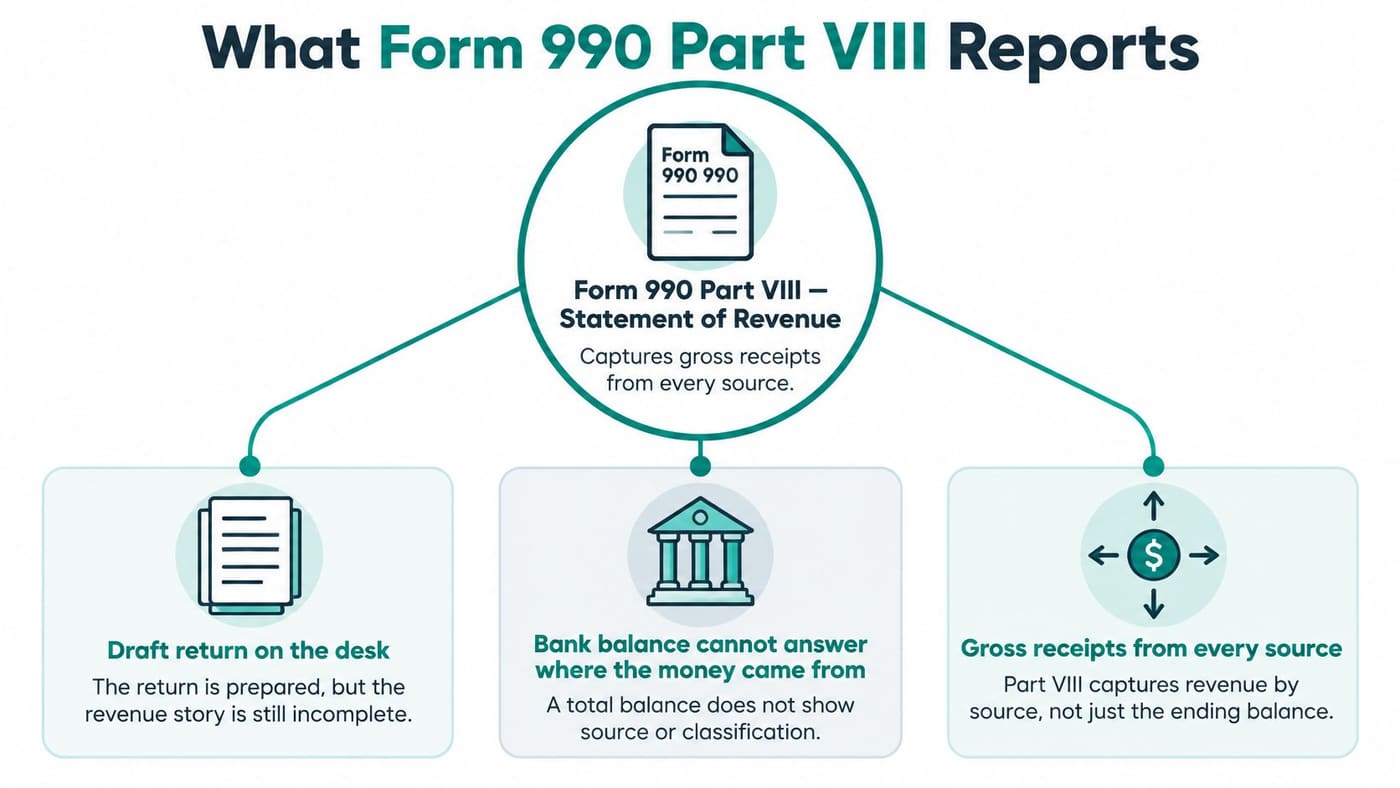
That order carries real weight. A bank balance tells you what's left. Part VIII asks where each dollar came from and what kind of dollar it was. Two organizations with identical totals can look completely different on this page, and that difference is the point of the whole schedule.
Every organization except a section 527 political organization completes column (A). Columns (B) through (D) generally must be completed too, and on each applicable line they have to add up to the amount in column (A). Those three columns are where the sorting happens, and where most of the arguing happens too.
The lines run in a fixed order, so learn the map once:
- Line 1. Charitable contributions and grants.
- Line 2. Program service revenue.
- Lines 3 and 4. Investment income, with income from tax-exempt bonds on line 4.
- Line 5. Royalties.
- Line 6. Rental income.
- Line 7. Net gain or loss from sales of assets.
- Line 8. Fundraising-event income.
- Line 9. Gaming income.
- Line 10. Inventory sales.
- Line 11. Other revenue.
- Line 12. Total revenue.
The distinction that decides most of your coding sits between the first two lines. Contributions and grants are not program service revenue. Fees for services or sales tied directly to your exempt activities generally are.
The dividing line: a contribution arrives with no direct return. A program fee buys something the mission already does.
Unrelated business income is a separate question again, and it can include a business that exploits an exempt function, such as advertising in a journal. That's why the columns exist.
Part VIII isn't on every return. Beginning with tax year 2010, the permanent thresholds for filing the full Form 990 became more than $200,000 in gross receipts or more than $500,000 in total assets, per the IRS redesign announcement. Smaller organizations file a shorter return, and the revenue detail stops there.
Read this page as the revenue foundation for your statements and for a return you can explain out loud to a board. If restricted gifts are tangled with your program fees, start with the guide to fund accounting for nonprofits and keep the Form 990 checklist open while you work.
Where Each Dollar Lands on Part VIII
Open this table before you open the form. For each deposit you are about to code, find the row, read the last column, and ask whether your payment looks like the typical item or the trap. The traps are the ones that survive an audit until someone asks a question.
| Line | What it reports | Typical item | Do not put here |
|---|---|---|---|
| 1 Contributions and grants | Gifts, grants, and the gift portion of a mixed payment | Annual fund gift or foundation grant | Meal value inside a gala ticket |
| 2 Program service revenue | Fees for exempt-function services. Five largest on 2a-2e, rest on 2f, total on 2g | Tuition, counseling fee, or program registration | A pure donation |
| 3 Investment income | Interest, dividends, and similar investment income | Bank interest or dividends | Rent or royalties |
| 4 Tax-exempt bond income | Income from tax-exempt bonds | Municipal bond interest reported on this line | The same interest already reported on line 3 |
| 5 Royalties | Royalty income | License royalty | Program fees |
| 6 Rental income | Gross rents, with rental expenses on the rental lines | Facility rent | A fundraising ticket |
| 7 Asset sales | Net gain or loss from sales of assets other than inventory | Sale of equipment or investments | Inventory sold to the public |
| 8 Fundraising events | Gross event revenue, direct expenses, and net. Gift portion stays on line 1 | The $100 benefit in a $250 ticket | The $150 gift portion |
| 9 Gaming | Gaming gross receipts and the related gaming lines | Raffle or bingo receipts | An ordinary program fee |
| 10 Inventory sales | Gross sales of inventory, cost, and net | Merchandise or thrift sales | Gala revenue that belongs on line 8 |
| 11 Other revenue | Revenue that does not fit lines 1 through 10. A business code is required | Miscellaneous receipts with a documented source | A large program fee that belongs on line 2 |
| 12 Total revenue | Sum of the revenue lines | The control total for the page | A net-income or surplus figure |
Gross, Net, and the Lines People Flatten
Lines 6, 8, and 10 all ask for more than one number, and a clean ledger saves an afternoon. Rental income on line 6 goes in at gross, with rental expenses on the rental lines beside it. Fundraising events follow the same shape: gross revenue on 8a, direct expenses on 8b, net on 8c. Inventory sales run gross, cost, and net.
The habit that fixes all three is simple. Never net a transaction at the point of entry. Record the revenue and the cost as two entries, and let the form do the subtraction where the form wants to.
Column (A) is gross receipts, not your surplus. A modest surplus can sit on top of a very large gross revenue number, and confusing the two makes your organization look far bigger than it is.
One check before you total anything. Pull last month's three largest deposits and write the line number next to each one. If two of the three need a conversation, your coding needs work before the return does.
Why Columns B C and D Must Match Column A
The columns aren't three opinions about the same money. They're one amount, classified three ways. Part VIII is a gross-revenue classification and reconciliation schedule, not a net-income statement, as the Form 990 instructions lay out. Column (A) reports gross receipts from every source. Columns (B) through (D) classify those same amounts as related or exempt-function revenue, unrelated-business revenue, or revenue excluded from unrelated business income under Internal Revenue Code sections 512 through 514.
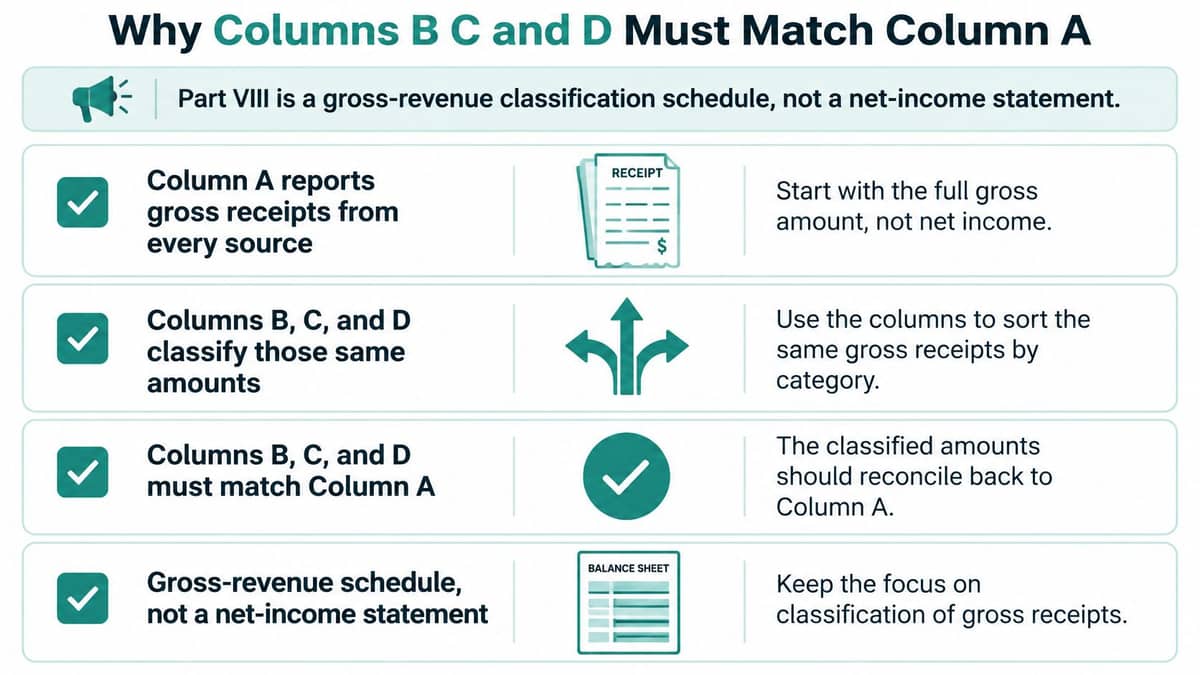
On every applicable line, B plus C plus D must equal A. That built-in control total is the most useful thing on the page. It catches a sponsorship, a facility rental, or a merchandise sale that got mapped to the wrong column, which is exactly the kind of error that hides in a total that happens to match.
The Four Fields That Make the Columns Tie
The reconciliation starts in the ledger, months before anyone types on the return. Build a transaction-level revenue record and hold four fields on every entry:
- Source. Who paid, and for what. A name and a purpose, not just a deposit date.
- Program or fund. Which mission activity or restricted fund the money belongs to.
- Donor restriction. Whether the gift carries a purpose, a time frame, or neither.
- Unrelated-business classification. Whether any part of the payment is commercial activity.
Then subtotal each Part VIII line from that record and tie it to the general ledger before the return is prepared. If you can't produce the subtotal, you don't yet know what the line should say.
Practical rule: when a line won't tie, assume a mapping choice went wrong before you assume an addition error. It's almost always a mapping choice.
Two more items belong on the return itself. Name your accounting method, whether cash, accrual, or other. If you change methods, a section 481(a) adjustment may be required so items aren't permanently omitted or counted twice.
Before you sign off, put this year's line totals next to last year's. Write one sentence for every swing that isn't a real change in activity. That short list is what lets you defend the revenue mix, not just the total.
How to Split a Bundled Payment
Here's the case that trips up more finance committees than any other. A supporter pays $250 for a fundraising event and receives $100 of goods or services. The IRS example in its guidance on Form 990 financial information is unambiguous about the answer. The $100 belongs on line 8a as fundraising-event income. The remaining $150 belongs on line 1c as a contribution. None of the $250 is program service revenue.
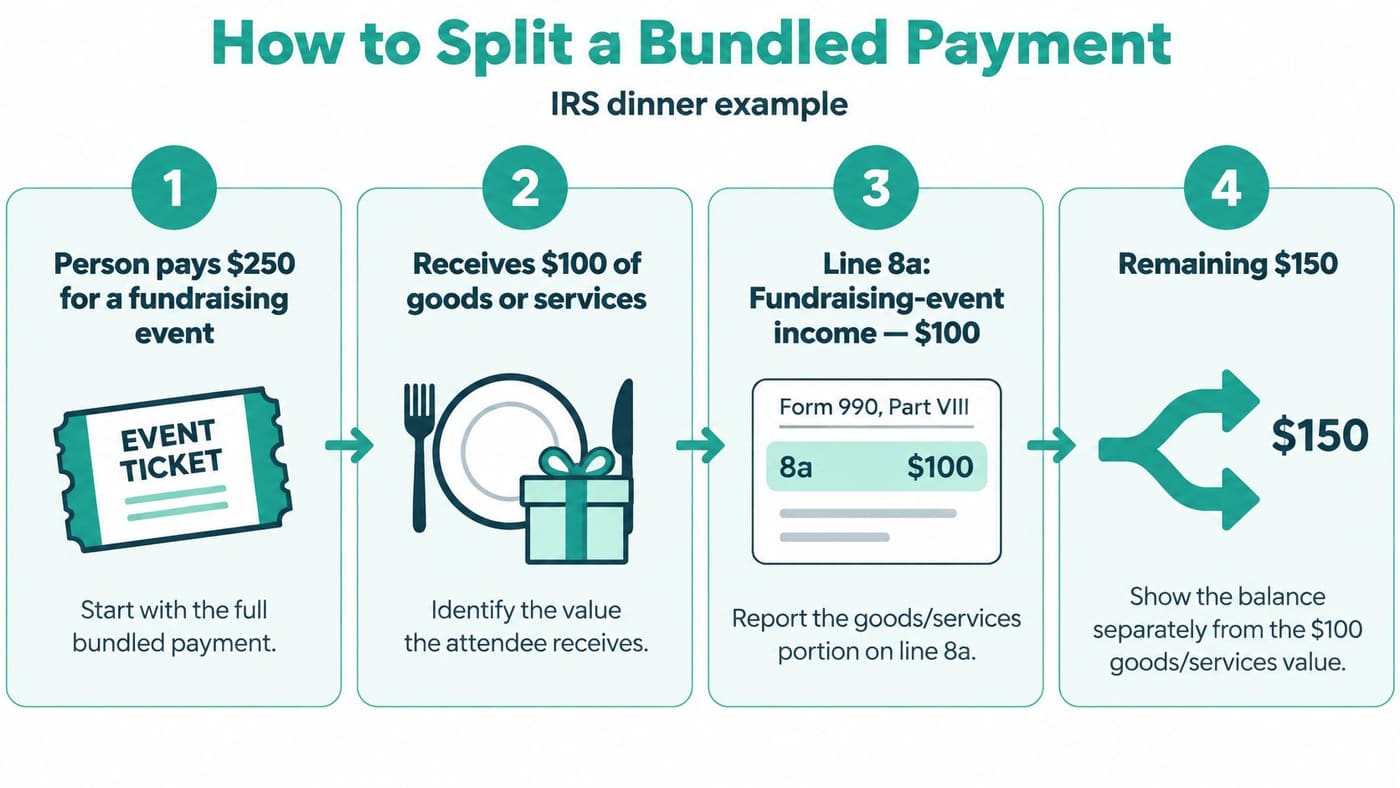
Most explainers stop at the lines and never show this split, which is why so many small organizations record the full $250 on one line and move on. That choice distorts the revenue mix, the fundraising disclosure, and any peer comparison someone runs on your return.
The workflow is the same for a ticket, a membership, and a sponsorship:
- Name the payment and the benefit. What did the person receive for the money?
- Set the fair value of that benefit. Write down the basis, such as the caterer's price for the meal.
- Record the benefit on the activity line. For an event, that's line 8a.
- Record the excess as a contribution. The gift portion lands on line 1.
- Add both pieces and check the cash. They must equal what you received, and land inside line 12 exactly once.
Money taken during a program isn't automatically program service revenue. Ask one question first. Did this person pay for the exempt activity, for a fundraising benefit, or for both?
| Payment | Amount received | Fair value of benefit | Contribution | Where the benefit goes |
|---|---|---|---|---|
| Fundraising dinner | $250 | $100 of goods or services | $150 on line 1c | $100 on line 8a, not line 2 |
| Membership with a tangible benefit | Full payment | Fair value of the benefit | Excess on line 1 | Benefit value follows the activity, not line 2 by default |
| Sponsorship that includes advertising | Full payment | Fair value of the advertising or other benefit | Excess gift on line 1 if any | Advertising may be unrelated business revenue in column C |
| Fee only for the exempt activity | Full fee | None | None | Line 2 when the payment is for the exempt activity |
The side effects are why this matters beyond the form. Your split changes the revenue mix you report, the fundraising total you disclose, the acknowledgment letter a donor receives, and how your organization compares with a peer of the same size.
If you run auctions, the same fair-value logic drives the tax receipt, and the auction quid pro quo tool walks through a single item in a few minutes. Pick one real ticket or sponsorship from last year and split it on paper. You'll learn more from that one exercise than from another read of the instructions.
Program Service Revenue and Business Codes
A single program service total won't survive the return. Line 2 asks for your five largest sources on lines 2a through 2e, every remaining program source on line 2f, and the combined amount on line 2g, per the IRS instructions for Parts VIII through XI. That's a ranking exercise, and it's easier when your revenue records already separate sources.
Picture a school. Tuition is one source, after-school fees are another, and facility fees charged to a program partner may be a third. Picture a counseling nonprofit. Session fees are one source, training fees charged to partner agencies are a second. Neither organization can rebuild lines 2a through 2e from a single "program income" account.
Codes Describe the Activity, Not the Tax Treatment
The IRS requires a business code for each revenue source reported on lines 2 and 11, even when the activity is related to your exempt purpose and isn't an unrelated trade or business. That last clause is the part people miss.
A business code describes what the activity is. It does not decide whether the income is taxable. Those are two different questions, answered on two different schedules.
For each major program payment, keep the source, the activity, the amount, and the classification. Add the code you chose and a one-line description of the activity. Next year's preparer will thank you, and so will your auditor.
Two shortcuts to avoid. Don't drop a small but distinct program into line 11 just to dodge the ranking. And don't copy last year's code if the activity underneath it changed. The program services glossary is a quick refresher when a new service line appears mid-year.
Here's the file test. If you can't name your five largest program sources without opening the form, the source record isn't ready. Fix the record, not the form.
Churches Schools and Other Special Cases
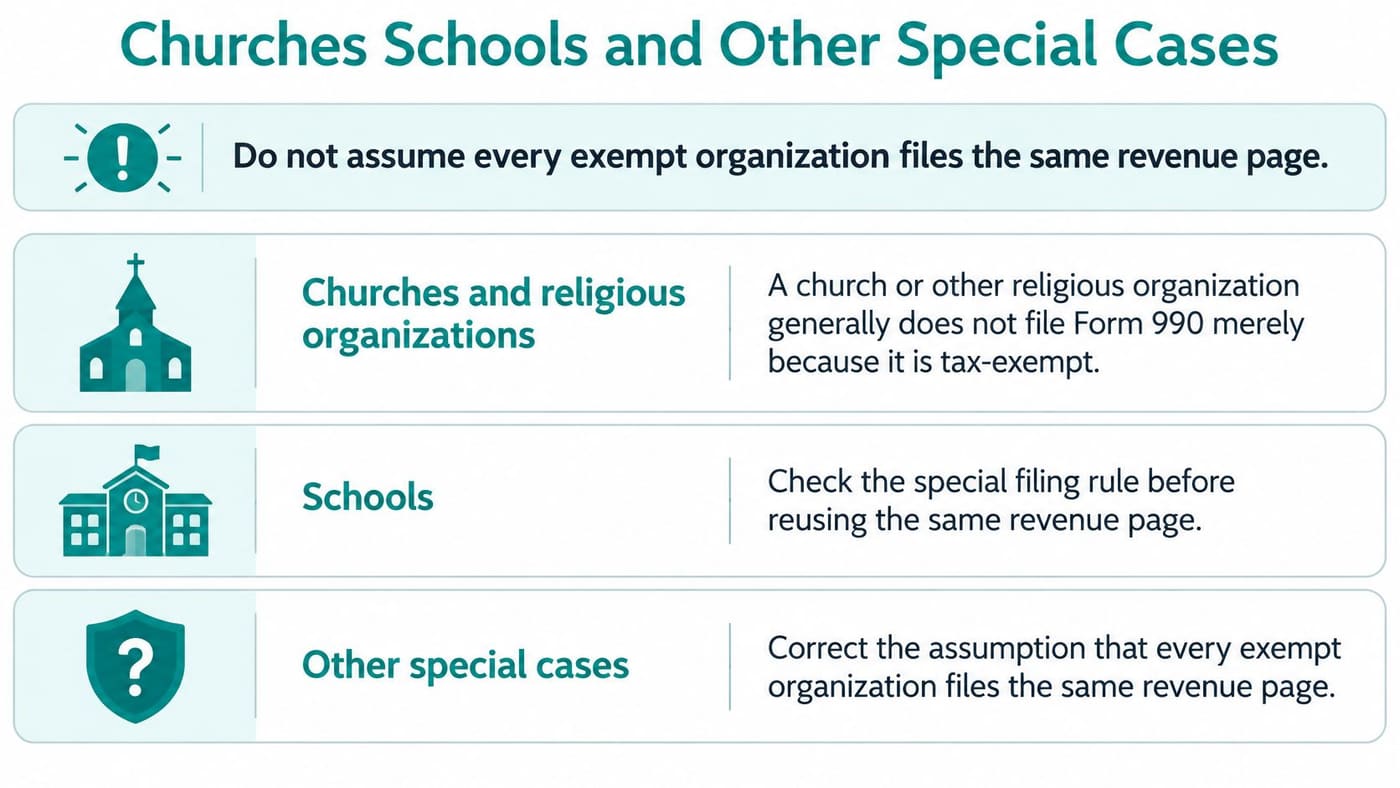
The assumption worth challenging is that every exempt organization files the same revenue page. A church or other religious organization generally doesn't have to file Form 990 merely because it's tax-exempt, as IRS Publication 1828 explains. Unrelated business income is a separate duty, and it doesn't go away because the work is religious.
The numbers to keep in front of your finance lead are specific. If gross income from an unrelated trade or business is $1,000 or more for the tax year, the organization files Form 990-T. Estimated tax payments are required when expected unrelated business income tax is $500 or more. Both rules apply even when the primary activity is charitable or religious.
Church finance test: pull every deposit that came from an outside group, a rental, or paid advertising. If those receipts sit mixed into the offering account, separate them this month.
School payments need the same care, applied differently. Not every parent payment is a gift, and not every payment is tuition. Run the bundled-payment test from the previous section. A dinner, a sponsorship, or a membership with a real benefit needs a fair-value split. A fee for the exempt program, with no gift element, belongs with program service revenue.
Events and side activities deserve their own lines rather than a home in other revenue. Keep the gift on line 1 and the benefit on the event line. Report gaming and merchandise sales on lines 9 and 10 instead of burying them on line 11, where they distort both the program picture and the compliance one. Clubs face a related split between member and nonmember income, and the 501(c)(7) nonmember income calculator works through that math.
Year-end giving adds volume to all of this. If your calendar includes a giving-day push, The Bible Seminary's note on Giving Tuesday and year-end giving is a useful planning reference for the appeal side, while the gift portion stays on line 1 no matter how the money arrives.
One question for the finance lead this week. Which activities this year could be unrelated, and are their gross receipts already separated from donations?
Build Part VIII from Clean Books
Don't start the return from a bank export. Start it from revenue that's already coded to a source, a fund, and a Part VIII line. The remaining pass is short:
- Code each open deposit to a line using the table.
- Split any ticket, sponsorship, or membership that includes a benefit.
- Tie each line subtotal to the ledger.
- Confirm columns B, C, and D add to column A.
- List the five largest program sources and the codes for lines 2 and 11.
If you'd rather do that work in one record, we built AlignMint for it. Fund accounting, donor records, volunteers, events, and payments share the same operating record, so a gift and a program fee don't live in separate tools. Our Form 990 Builder prepares filing information from connected financial records, and you can generate financial reports, including balance sheets and Form 990 reports, then export them to PDF or Excel. The Pro plan includes everything in Plus, plus bank reconciliation, up to 5 funds, and the compliance, close, and Form 990 tools. The Free plan covers donor records and giving pages for one user, for organizations with up to $100,000 in annual donations. There's no per-seat fee, and a free setup call walks through fund accounting, donations, and reporting on your plan.
QuickBooks is a strong bookkeeping system, but classes aren't a fund ledger. Aplos is a familiar fund-ledger choice for many small nonprofits. For a fuller look, read the nonprofit accounting software comparison and the fund accounting software guide, then keep the revenue reconciliation steps beside you during close.
When the split between a gift and a benefit already lives in your ledger, the revenue page takes an afternoon rather than a quarter. AlignMint keeps fund accounting, donations, events, and a Form 990 builder on one operating record, so each coded deposit carries its source, its fund, and its line all the way to filing. Visit AlignMint to see how the pieces connect before your next return is due.
Frequently Asked Questions
Part VIII is the Statement of Revenue. It places gross receipts on a line and classifies the same total across related, unrelated, and excluded columns. Who must file, and deferred revenue, are separate guides.
Form 990 Builder starts on Pro. Free is one user for nonprofits with up to $100K in annual donations, and no credit card is required. Fund accounting starts on Plus.
Ready to try AlignMint with your nonprofit?
Start free — set up donor tools, giving pages, and Minty. Upgrade when you need accounting.