

Nonprofit credit card processing fees commonly run about 2.2% to 3.5% of each transaction, plus roughly $0.30 per payment. Your real cost depends on gift size, so compare net revenue per gift, not just the advertised percentage. You can protect more program funding by separating the charges, choosing a sensible fee policy, and keeping receipts accurate.
Quick Answer: Credit Card Processing Fees
Nonprofit credit card processing fees commonly run about 2.2% to 3.5% plus about $0.30, and the effective rate depends on gift size. This page is that fee math and the absorb, ask, or surcharge choice. The payment-processing walkthrough and Blackbaud's fee lines are separate guides.
Start with payments and nonprofit payment processing. For one vendor's statement lines, see Blackbaud processing fees. For the acknowledgment, see donation receipts for nonprofits.
What Nonprofits Pay on Each Card Gift
You'll make better pricing decisions when you distinguish the card network's charge from your processor's total bill. Those aren't interchangeable figures, even when a proposal presents them together.
For U.S. nonprofits, Zeffy's processing-cost breakdown places typical all-in pricing at approximately 2.2% to 3.5%, plus about $0.30 per transaction, with these illustrative network schedules:
Typical nonprofit interchange rates by card network
| Card network | Typical interchange | Notes |
|---|---|---|
| Visa | 1.48% plus $0.05 | Illustrative nonprofit schedule |
| Mastercard | 1.35% plus $0.05 | Illustrative nonprofit schedule |
| American Express | 2.20% | Percentage rate only in this schedule |
| Discover | 1.56% plus $0.05 | Illustrative nonprofit schedule |
| All-in nonprofit rate | About 2.2% to 3.5% plus about $0.30 | Includes processor and other charges |
These are illustrative schedules, not a quote for your organization. Your approved payment arrangement and actual transactions determine what appears on your statement.
Separate the underlying cost from the markup
Interchange is the portion transferred through the card system to the bank that issued your donor's card. The typical range in Zeffy's breakdown is around 1.15% to 1.65%, although individual schedules can sit outside that range.
Think of interchange as an item's wholesale cost, with the processor's fee resembling the store's margin on top. That analogy helps explain why an interchange figure isn't your final price.
The remaining charges can include network assessments, processor markup, fraud and risk controls, and gateway or platform charges. Some appear separately, while others are included in a bundled rate.
DonorPerfect's guide to donation and credit card processing explains these components clearly. Its useful distinction is between moving money and managing the fundraising records surrounding that payment.
DonorPerfect's fundraising focus can help teams understand donor relationships alongside payment costs. When comparing it with other systems, examine accounting connections separately rather than assuming fundraising software replaces your ledger.
Read your statement in a practical order
Start with the amount donors paid, not the amount deposited into your bank account. Then work through the statement's categories without accepting unexplained totals.
- Gross card volume: Match the processor's starting amount against completed card gifts, excluding failed payment attempts.
- Transaction count: Confirm which transactions triggered fixed charges, including how the provider handles reversals.
- Interchange and assessments: Under itemized pricing, identify the underlying card-system costs before evaluating the processor's markup.
- Processor charges: Separate percentage markup from fixed transaction charges so you can compare proposals fairly.
- Gateway and platform charges: Check whether you're paying separately for payment routing, donation forms, or software access.
- Adjustments and deposits: Identify refunds, disputes, and timing differences before matching the final settlement to your bank.
A processor may show these categories differently, but each charge should have a clear purpose. An unexplained service charge deserves a written explanation, not an assumption.
Practical rule: Compare the full statement against the full proposal. A low percentage doesn't compensate for charges nobody explained.
Your card mix also matters, particularly when your agreement passes through underlying network costs. Heavier American Express use can increase your blended cost under the illustrative schedules shown above.
Flat-rate pricing makes budgeting simpler because eligible transactions use the agreed bundled rate. Interchange-plus pricing separates underlying costs from markup, offering more visibility but requiring closer statement review.
Neither structure wins automatically. Compare both against the same donation history, including transaction count, card mix, and recurring gifts.
For a rough annual range check, apply the published percentage endpoints to annual card volume, then add the fixed charge for each transaction. Keep separately billed gateway and platform costs outside that initial estimate.
Use a payment-feature checklist to organize the operational questions alongside pricing. Your comparison should include receipts, fund assignment, settlement reporting, and who resolves payment problems.
Before signing, confirm whether pricing is flat-rate or interchange-plus, flag unitemized charges, and compare gateway costs separately. Pull last year's card report, estimate costs using its network mix, and request an itemized proposal.
How Gift Size Changes Your Effective Rate
You keep more useful information when you measure fees against gift size, rather than comparing headline percentages alone. A fixed transaction charge takes a larger share of a small donation.
Consider this hypothetical pricing scenario using 3% plus $0.30 for each gift. Read across each row to see the fee and the share of the donation it consumes.
Processing fee and net gift at common donation sizes
| Gift amount | Fee at 3% + $0.30 | Effective rate |
|---|---|---|
| $25 | $1.05 | 4.2% |
| $100 | $3.30 | 3.3% |
| $500 | $15.30 | 3.06% |
The net gift is the original donation minus the fee shown in the middle column. These calculations exclude any separately billed platform costs.
Compare campaigns by the money available for programs
Say your school runs a community appeal attracting many modest gifts and a separate major-donor appeal attracting larger gifts. Even with identical gross revenue, the campaign with more transactions incurs more fixed charges.
That doesn't make small donors less valuable. It means your campaign budget should recognize the payment pattern instead of assuming every donated dollar costs the same amount.
In the same hypothetical scenario, a $50 gift costs $1.80, producing an effective rate of 3.6%. A $1,000 gift costs $30.30, producing an effective rate of 3.03%.
For a hypothetical $10 monthly gift, the fixed charge applies whenever the monthly payment is processed. Sustainer programs need budgets that recognize repeated transaction costs without discouraging accessible giving.
Judge the payment cost, not the donor's worth. A small recurring supporter may still be central to your mission.
Use these formulas when reviewing your campaign worksheet:
- Processing fee: Multiply the gift by the percentage rate, then add the fixed transaction charge.
- Effective rate: Divide the processing fee by the gift amount.
- Net gift: Subtract the processing fee from the amount contributed.
Calculate the effective rate for your most common gift sizes before changing suggested donation amounts. Identify the costliest gift band, then decide whether pricing, payment options, or campaign design needs attention.
Recording Fees So Your Books Match the Gift
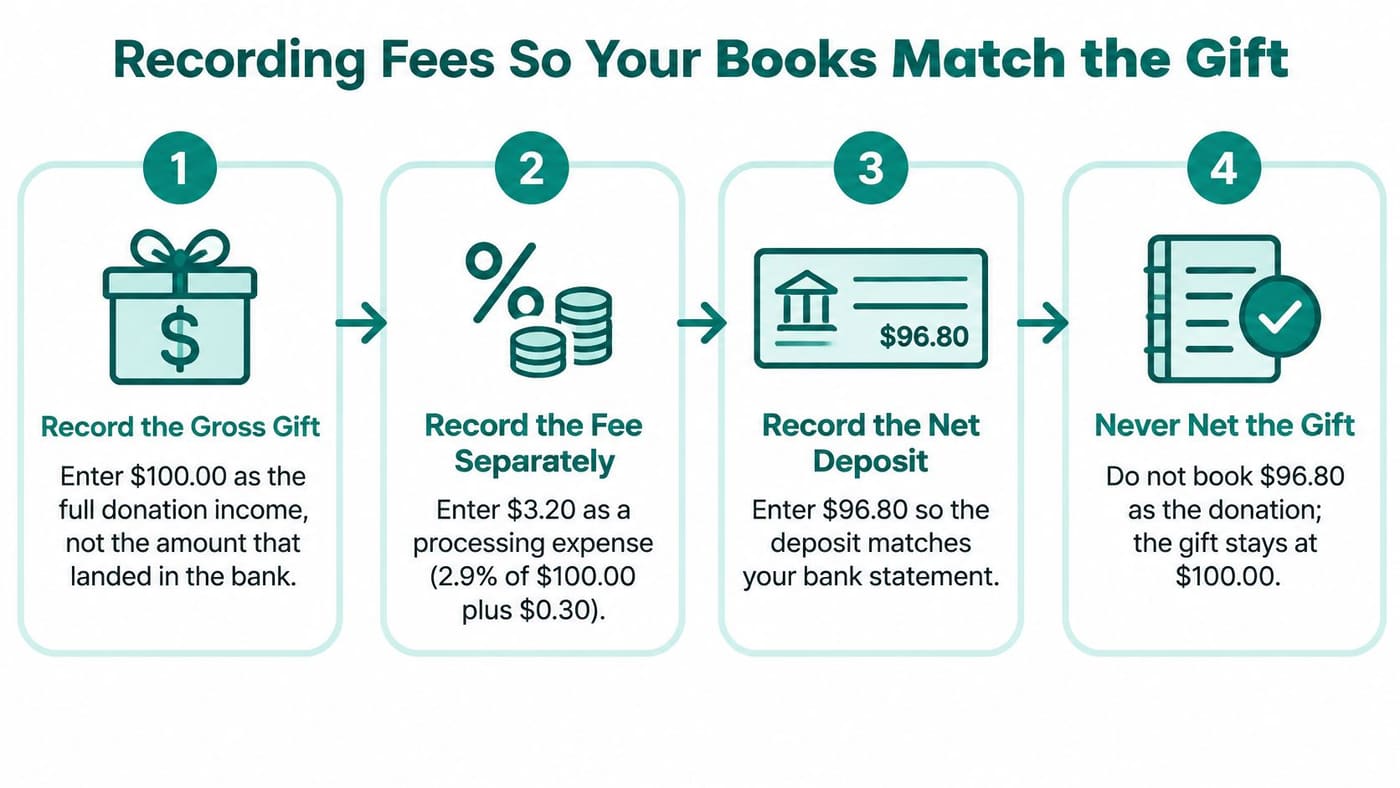
You protect donor records and financial reports by recording the gross gift, processing expense, and net deposit separately. Booking only the bank deposit understates both contribution revenue and operating expenses.
Under IRS Publication 526, a credit-card contribution is deductible in the year charged, regardless of when the donor pays the issuer. Your processor's settlement date therefore shouldn't replace the contribution date in your donor records.
Consider a hypothetical $100 gift at 2.9% plus $0.30: the fee is $3.20, leaving a $96.80 deposit. When your organization absorbs that expense, the donor record still shows the full contribution.
This visual separates the accounting components before you reconcile the payment.
Keep the gift and expense traceable
-
Post the gross gift to the donor record and fund. Preserve the donor's designation and contribution date. This keeps campaign totals tied to what donors contributed.
-
Record the processor fee as an expense. Use a consistent processing-fee account rather than subtracting the charge from contribution revenue. Apply your organization's approved policy for allocating expenses among funds.
-
Reconcile the net deposit to the processor statement. Match each settlement batch to its underlying gifts by date, transaction identifiers, and count. A bank deposit alone won't explain bundled payments or settlement delays.
-
Confirm restricted balances reflect the correct activity. Record the contribution at its gross amount, then allocate any allowable fee expense separately. Donor restrictions and your expense-allocation policy determine which fund bears that expense.
Your restricted-fund report shouldn't suggest the donor contributed less because the processor retained a charge. It also shouldn't overstate available restricted resources when an allowable expense has been allocated against that fund.
Resolve exceptions before closing the month
Use the donation settlement report guide to organize the comparison between processor activity and accounting records. Keep the settlement reference available alongside the donor and fund details.
Document whether optional fee coverage is treated as an additional contribution or another payment component. Confirm what the processor's receipt displays before your finance team closes the period.
For fiscal sponsors, preserve the sponsored project's designation throughout that workflow. Otherwise, staff may reconcile the bank correctly while assigning the income or expense to the wrong project.
Test the process with a single gift. You should be able to follow it from donor record through settlement, bank deposit, expense account, and fund report without rebuilding the transaction.
Choosing to Absorb, Ask, or Surcharge
You may hear that passing fees to donors is the easiest way to protect your fundraising income. That advice overlooks donor choice, checkout completion, and the work required to administer the policy.
Optional donor coverage isn't the same as a card surcharge. One invites an additional payment; the other imposes a payment-method charge under applicable rules.
4aGoodCause's fee-coverage guidance cites estimated opt-in of about one-half to two-thirds when donors are asked plainly. Its cited Visa-related guidance describes a 3% U.S. credit-card surcharge cap, excludes debit and prepaid cards, and requires advance acquirer notice and donor disclosure.
Fee policy options compared
| Policy | What the donor sees | Revenue effect | Compliance and trust risk | Admin burden |
|---|---|---|---|---|
| Absorb all fees | Nothing extra, gift shown at full amount | Full cost carried, nothing recovered | Low | Low |
| Ask donors to cover fees | Optional coverage prompt at checkout | Uncertain, estimated opt-in about one-half to two-thirds when asked plainly | Low to moderate, shaped by wording | Moderate |
| Apply a compliant surcharge | Extra line added to the card total | Recovery capped at 3% on eligible U.S. credit cards under the cited guidance | High, notice and disclosure required | High |
Network guidance isn't a substitute for reviewing the laws governing your organization and its transactions. A permitted network practice may still face additional legal restrictions.
Make optional coverage genuinely optional
You preserve goodwill when donors can decline coverage without feeling they've made an inadequate gift. Leave the choice unselected, explain its purpose, and show the final total before payment.
Avoid implying that an uncovered gift won't support the mission. Your organization incurs operating expenses regardless of whether an individual donor adds money toward processing.
On your online donation pages, test the wording alongside checkout completion and net revenue. More coverage selections won't help if fewer supporters finish giving.
Budget cautiously because optional coverage isn't guaranteed revenue. Compare the amount recovered with any change in completed gifts, average contribution, and donor questions.
Decision test: Choose the policy that produces dependable net income without creating confusion your staff must repair.
Treat surcharging as a compliance project
Mixed donation and merchandise checkouts require more care than a straightforward charitable gift. Recurring payments, event tickets, international cards, and digital wallets can also complicate payment classification and disclosure.
A wallet doesn't tell you whether the underlying credential is an eligible credit card. Your payment system must correctly distinguish credentials rather than applying an extra charge indiscriminately.
Churches should consider how a surcharge will sound to members accustomed to giving as an act of faith. Fiscal sponsors should decide whether sponsored projects can set different policies without creating inconsistent donor experiences.
Schools face another practical issue when families encounter donations, event purchases, and program payments through related forms. Staff need clear transaction categories, not a universal fee switch.
For a small donor base giving mostly larger gifts, absorbing fees can keep administration and conversations simple. High-volume online fundraising may justify testing optional coverage with careful monitoring.
I would reserve surcharging for organizations prepared to obtain legal review and maintain the necessary controls. Maximum fee recovery isn't automatically the best outcome when you include staff time and donor trust.
Donor Receipts and the $250 Acknowledgment Rule
You help protect your donor's deduction by issuing the right acknowledgment for the transaction, not merely a payment confirmation. For gifts of $250 or more, IRS substantiation and disclosure requirements require a contemporaneous written acknowledgment from your organization.
That acknowledgment must state the cash contribution and whether your nonprofit provided goods or services in return. If benefits were provided, describe them and include a good-faith estimate of their value.
The IRS also permits the same document to satisfy the acknowledgment requirement and quid-pro-quo disclosure for payments above $75. Your templates therefore need to distinguish pure donations from payments involving benefits.
A clear acknowledgment also gives your donor-service team a reliable record when supporters ask questions later.

Separate the contribution from any benefit
Consider a hypothetical gala ticket costing $300, with a $120 dinner value. The contribution portion is $180, assuming that dinner represents the full value received.
The receipt should identify the total payment, describe the dinner, and show its good-faith estimated value. It shouldn't describe the entire ticket payment as a deductible gift.
A pure donation needs different wording because no benefit should be invented. Configure the receipt according to what happened, rather than relying on a generic thank-you template.
Check the acknowledgment before sending
Use this operational checklist alongside your donation receipt guidance:
- Organization name: Clearly identify the nonprofit receiving the payment.
- Contribution amount: Preserve the actual charitable amount rather than substituting the processor's net settlement.
- Gift date: Keep the transaction date consistent with the underlying giving record.
- Fund designation: Include the donor's stated purpose when relevant to your acknowledgment.
- Benefit statement: State whether goods or services were provided, adding descriptions and values when required.
- Fee treatment: Explain any additional payment consistently with your documented policy and accounting treatment.
An acknowledgment isn't the place to improvise tax language about optional coverage. Resolve the payment's classification first, then make the receipt match that decision.
Audit your largest recent card gifts and include both ordinary donations and benefit-bearing payments. Confirm that each receipt describes the transaction accurately, not just that an email was sent.
Confirm Your Fee Policy Before the Next Campaign
You can make a sound decision without replacing your software or renegotiating everything immediately. Start with your actual statements, then fix the largest source of unnecessary cost or confusion.
- Pull your last four processor statements. Total card volume, transaction counts, processing charges, and separately billed platform costs.
- Calculate your blended effective rate. Divide total processing charges by gross card gifts, then examine your common gift sizes separately.
- Choose a documented fee policy. Compare absorption, optional coverage, and surcharging using net revenue, donor response, and administrative work.
- Review acknowledgment wording. Check gifts requiring written acknowledgments and confirm that event receipts distinguish contributions from benefits.
Keep the payment connected to its purpose
At AlignMint, our online payments keep confirmed payments connected to the donor, fund, receipt, and accounting record. Our all-in-one platform combines accounting, donor management, volunteer management, events, and a built-in marketing suite, reducing the need to maintain separate operational records.
We provide true fund accounting, rather than treating QuickBooks classes as a substitute for fund balances and restrictions. Minty, our AI assistant, helps you ask questions about your records, while shared information supports team communication across finance and fundraising.
Our online fundraising tools support giving pages alongside those connected records. That connection matters for churches, schools, and fiscal sponsors whose staff need to preserve each gift's purpose.
Our Free plan serves nonprofits with up to $100K in annual donations, requires no credit card, and includes access for one user. Plus includes 10 teammates. Pro includes 25. Enterprise is the plan with unlimited teammates.
Published AlignMint card fees are 2.8% + $0.30 for cards other than American Express and 3.2% + $0.30 for American Express. ACH is 1%. Checkout shows the amount for that payment, and the same schedule is on the payment processing fees page. We show your approved payment profile, charges, and enabled methods during Giving Setup and checkout, so confirm current details before launching.
Our free setup call walks you through fund accounting, donations, and reporting on your plan. Bring your statements and a representative settlement batch so the conversation stays grounded in your actual workflow.
AlignMint offers connected giving records and a free setup call to help you understand where processing fees belong. Visit AlignMint to book a short review of your last quarter's statements and discuss a fee policy your team can explain confidently.
Frequently Asked Questions
Typical all-in pricing runs about 2.2% to 3.5% plus about $0.30 per transaction. The effective rate rises on small gifts because the fixed charge takes a larger share. Payment processing and one vendor's fee lines are separate guides.
Cards other than American Express are 2.8% + $0.30, American Express is 3.2% + $0.30, and ACH is 1%. Checkout shows the amount for that payment. Free is one user for nonprofits with up to $100K in annual donations, and no credit card is required.
Ready to try AlignMint with your nonprofit?
Start free — set up donor tools, giving pages, and Minty. Upgrade when you need accounting.