
There's a pledge in your file that's three months old, and the balance hasn't moved since the first installment. The donor meant it when they signed the card. Life got busy, your reminder never went out, and the gap now sits in a restricted fund your board keeps asking about. A pledge reminder letter template fixes the wording once, so every letter you send is accurate, fund-aware, and kind enough that the donor stays with you.
Quick Answer: Pledge Reminder Letter
A pledge reminder letter stays accurate when every field, including the restriction name, matches the ledger, and the open balance is not described as a completed gift. This page is the letter. Pledge software and the year-end pledge review are separate guides.
Start with donor management and nonprofit pledge management software. For the year-end review, see pledge review. For the receipt after payment, see donation receipts for nonprofits.
Copy This Pledge Reminder Letter Template
A generic pledge reminder letter treats every unpaid pledge as a late payment. It lists the amount, the purpose, the deadline and the payment options, then stops. Nothing in that format tells you whether the donor needs a new payment schedule, whether a card failed, or whether the household can no longer fulfill the commitment at all. With giving concentrated among fewer donors, a letter that pushes for payment without listening trades one installment for the whole relationship.
Here is a version you can send today. Paste it into your donor system, fill every bracket, and keep each entry consistent with how the pledge sits in your records.
Subject: Your pledge to [Organization] and the next step
Dear [First name],
Thank you for your pledge to [Organization]. Your commitment to [program or fund] is what makes [specific result] possible.
Pledge details Donor name: [donor name] Pledge date: [date] Total commitment: $[amount] Received to date: $[amount] Current amount due: $[amount] Due date: [date] Fund or restriction: [exact fund name] Pay securely: [payment link]
We are writing to help you complete your intended commitment.
If your plans have changed, reply to this message and we will find a schedule that works.
With gratitude, [Name], [Title] [Direct phone] | [Email]
Why the thank-you line goes first
Gratitude earns its place at the top of the letter. Research on charitable pledges connects a simple acknowledgment to whether donors follow through, and a UCSD working paper on charitable pledges examines that link directly. A donor who feels seen is easier to remind than a donor who feels billed, so the first line does more work than the payment link under it.
The invitation to change plans is the second control point. A pledge records intent, and intent can survive a hard month even when the payment cannot. Without a way to say so, a donor in trouble has two options: ignore you or feel ashamed. Both end the relationship. The reply line gives them a third, and a donor who renegotiates a schedule is still a donor.
Fill Every Field So the Letter Stays Accurate
Most reminder errors are field errors, not wording errors. A warm paragraph with the wrong balance does more damage than a plain paragraph with the right one.
| Field | What to enter | Why it matters |
|---|---|---|
| Donor name | Exact name as recorded in the donor file | Ties the letter to the right record |
| Organization legal name | Full legal name as filed | Connects the pledge to the recipient charity |
| Pledge date | Date the donor made the commitment | Anchors the original promise |
| Total commitment | Full pledged amount | Shows the donor the whole promise |
| Amount received to date | Sum of all posted payments | Separates money received from promises |
| Current amount due | Next installment or remaining balance | Gives the donor one clear ask |
| Due date | Specific calendar date | Replaces vague wording such as "soon" |
| Fund or restriction | Exact fund, campaign or program name | Lets finance match payments to the right fund |
| Payment path | Secure link, check address or transfer reference | Gives one clear route to pay |
| Human contact | Named staff person with direct phone or email | Gives the donor a way to change plans |
The two fields that cause the most confusion
The fund or restriction field must repeat the name exactly as recorded. Write "Capital Campaign: Roof Repair 2026" rather than "general support". The IRS Form 990 instructions describe how nonprofit reporting separates net assets with donor restrictions from net assets without them, and restrictions can name a purpose, a time period, or both. Precise language lets finance match the payment to the right fund, and it shows the donor what their gift is for.
Then there's amount received to date against current amount due. The first is the sum of posted payments. The second is the next installment or the remaining balance. Mixing them is how a donor gets asked for a total they already half paid.
The organization's full legal name belongs in the letter too. The IRS guidance on substantiating charitable contributions lists a pledge card or similar document identifying the charity among the records that support a deduction, so keep that name consistent across the card, the letter and the receipt.
Practical rule: If any field is blank, hold the letter. A wrong balance breaks trust faster than a late reminder.
Keep the payment path to a secure link, a check address or a transfer reference. Never put full bank account numbers in an email body. And treat the restriction name as the anchor between your letter, your donor file and your ledger. Class tracking inside general ledger software drifts from the donor record over time. When the fund ledger holds the restriction as its own record, the letter can be generated from it, and you can review how pledge tracking connects to the ledger before your next mailing.
Reminder Timing That Keeps Pledges Moving
A pledge needs a sequence, not a letter. The stages below work because each one has a different job.
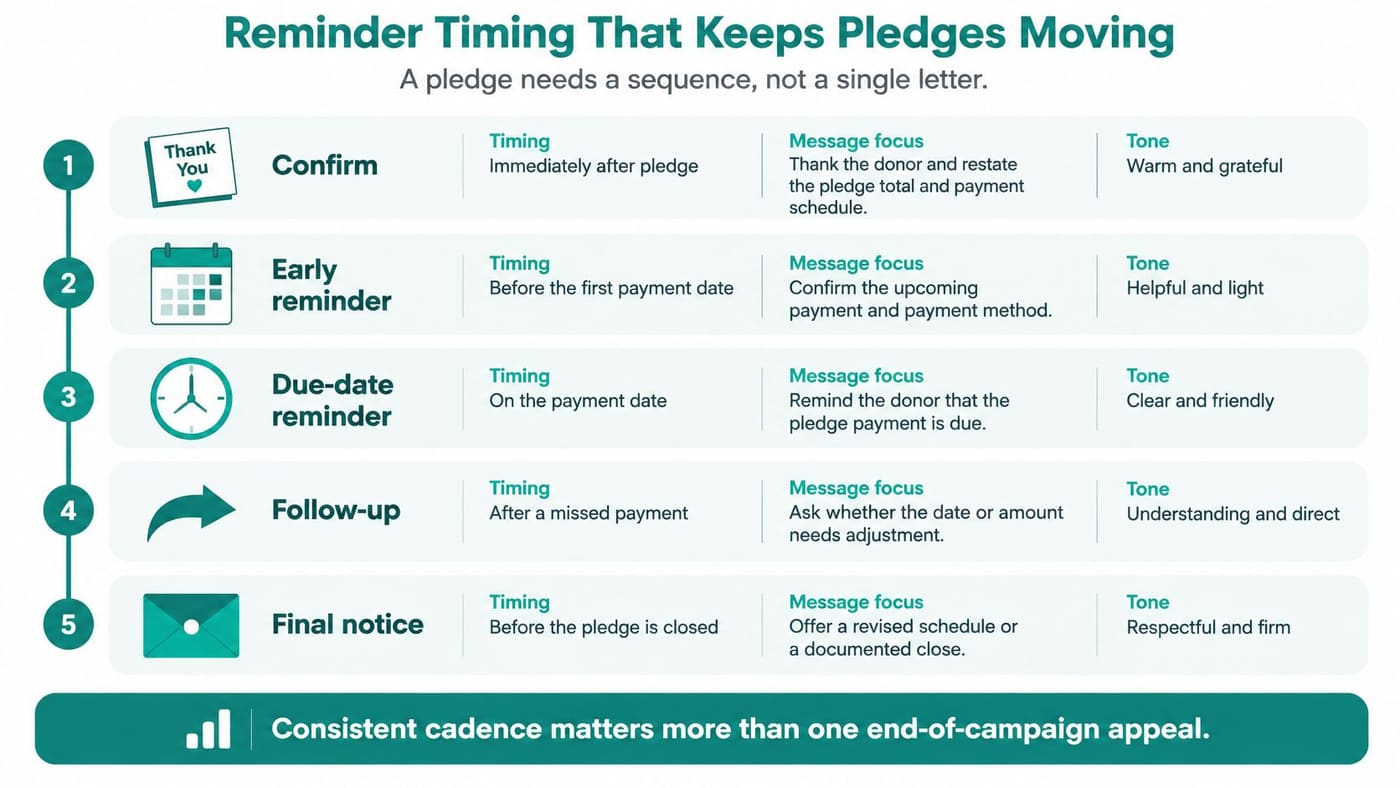
| Stage | Timing | Message focus | Tone |
|---|---|---|---|
| Pledge confirmation | Within 2 business days of the pledge | Total commitment, schedule and how to pay | Thankful and specific |
| Pre-due reminder | 7 to 10 days before the due date | Amount due, due date and payment path | Brief and factual |
| Due-date reminder | On the due date | Amount due today and one payment link | Direct, without guilt |
| Missed installment | 5 to 10 days after the due date | Remaining balance and option to change timing | Nonjudgmental and helpful |
| Final notice | 30 days after the missed due date | Remaining balance and a named human contact | Respectful and personal |
What the evidence says about cadence
Reminders change behavior on their own. A 2015 peer-reviewed online experiment found that weekly or monthly donation reminders increased the probability that a participant would donate by approximately 10% and raised the average number of donation actions by about one. That study looked at recurring charitable donations rather than pledge letters, so don't read it as a promise of a 10% lift on your open balances. Read it as proof that a steady cadence beats a single end-of-campaign appeal.
Four habits keep the sequence clean. Stop it the moment the balance reaches zero. Pause it the same day a donor asks to change the plan. Use the same sender name at every stage so the message is recognizable. And send the final notice once, with a named person to call, then move the pledge to your written review process instead of sending a sixth letter.
The handover point matters too. Once a campaign closes, the work shifts from collecting promises to tracking them, and automating follow-ups after fulfillment opens is a useful reference for teams running multi-year schedules. When you are ready to set the stages up in one place, start with building pledge campaigns that carry their own installment schedule.
How to Personalize the Letter for Each Donor
Personalizing from memory is how wrong amounts reach donors. Start at the donor record, not at the letter, and work through six steps.
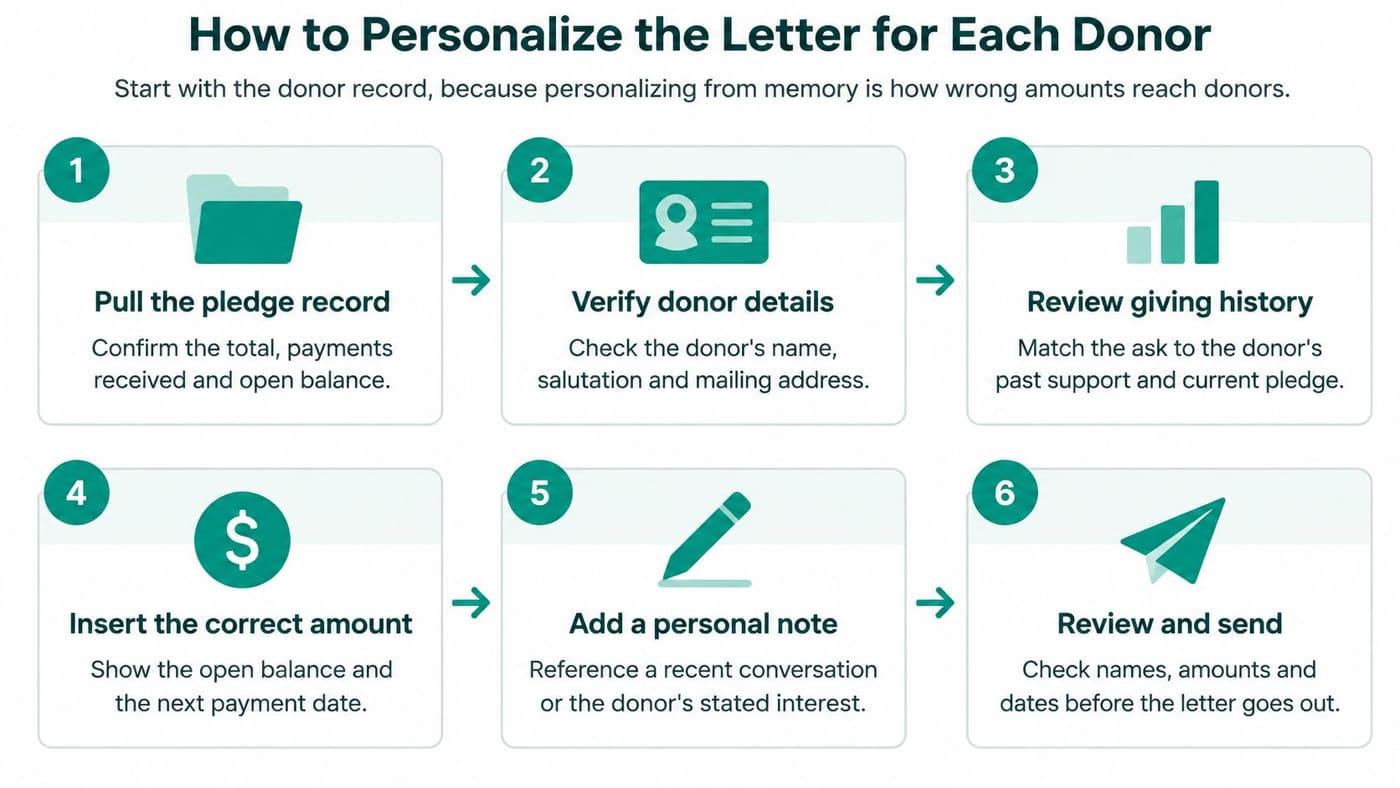
- Pull the pledge record. Confirm the total commitment, the payments received and the open balance before you write anything. If the number in your head and the number in the ledger disagree, the ledger wins.
- Check the fund name against the fund ledger. Not against your memory of the campaign. This is the step that stops a roof payment landing in the general fund and confusing everyone in the year-end close.
- Read the giving history. Look for a recent gift, a missed installment or a note about a change in circumstances. Two minutes here prevents the letter that arrives a week after the donor's spouse lost a job.
- Pick the stage that fits the situation. A pledge that is ten days out needs a brief and factual note. A pledge forty days past due needs a different message and a different tone.
- Adjust one sentence of the opening. A donor of ten years deserves a line that says so. One changed sentence signals a person wrote this, and it costs you nothing.
- Log the letter against the pledge. The audit trail should show the reminder date, the stage and who sent it. If a finance committee ever asks what happened with a large commitment, you'll have the answer.
Build a hardship path before you need one
A donor who has told you their plans changed should receive a letter offering a new schedule, not another payment link. Give them three options in plain words: a later date, a smaller installment, or a written release from the balance. Then confirm the change in writing the same week.
The pledge reminder examples I see most often skip restrictions, documentation and payment realities entirely, as this review of pledge reminder letter examples notes. They also rarely explain what happens if a restricted project changes. Say it in the letter when it applies, and keep the original commitment, installments paid, balance remaining and any approved modification together in one record.
Watch the notes field. A reminder that keeps firing after a donor reports hardship costs more than the balance it was chasing.
For donors outside your home country, confirm the currency and the transfer route before you send. Offer a secure link inside the payment path rather than bank details in the message body.
None of this works if the note lives in one system and the pledge lives in another. Keeping giving history, receipts, notes, pledges and the next relationship step on one donor record is what makes the personalization steps in our donor CRM repeatable rather than heroic.
Tax Wording to Include and Leave Out
Some organizations assume the reminder can double as the receipt. It can't, and the assumption fails in both directions: donors lose a deduction, and your organization makes a claim it can't support.
For a donor's federal tax deduction, IRS Publication 1771 sets the threshold at a single contribution of $250 or more. The acknowledgment must be contemporaneous, meaning the donor generally receives it by the earlier of the tax return filing date or its due date, including extensions. It also has to state whether your organization provided goods or services in exchange.
| Situation | What the letter can say | What to leave out |
|---|---|---|
| Pledge not yet paid | We are writing to help complete your intended commitment | Calling the pledge a tax-deductible gift |
| Payment received of $250 or more | A separate acknowledgment is issued once the payment arrives | Treating the reminder as the receipt |
| Gift tied to a benefit such as a gala ticket | State the charitable portion and the good-faith value of the benefit | Calling the full amount deductible |
| Pledge still open at year-end | Amount paid this year and remaining balance | Implying unpaid promises already count as contributions |
| Donor asks for a receipt | Point to the acknowledgment for each completed payment | Attaching the pledge letter as the receipt |
What the acknowledgment itself must contain
The IRS guidance on written acknowledgments asks for the organization, the amount of cash contributed, and whether goods or services were provided, including a good-faith estimate of their value when they were. One annual summary can substantiate several qualifying contributions. The rules apply to completed contributions, so the open balance on your reminder isn't a deduction for anyone yet.
Benefit events need their own sentence. When a payment includes goods or services and exceeds $75, the IRS guidance on quid pro quo contributions requires a written disclosure explaining that the deductible amount is limited to the payment above the fair market value of the benefit, with your good-faith estimate of that value. Issue that disclosure with the solicitation or when the payment arrives, not as a year-end correction.
Practical rule: Issue receipts from the payment record, never from the reminder template. The letter describes a schedule. The receipt records money that actually arrived.
Ask your accountant to sign off on wording for any event, membership or merchandise pledge before the first letter goes out. Then set up donation receipts that generate from posted payments so the two documents never borrow each other's language.
Send Your First Pledge Reminder This Week
Start with the largest open balances and the confirmation letter. Three steps make this a single sitting rather than a project.
- Fill the ten fields for your ten largest open pledges. Use the field table above, and check every fund name and restriction against the ledger before anything goes out.
- Set the five stages in your donor system. They should fire on the timing sequence on their own, with the same sender name on each one.
- Read every reply the same day. If someone mentions hardship, change their schedule that afternoon and pause the sequence until the new date has passed.
AlignMint sends these stages through built-in email and SMS tools. Free is one user for nonprofits with up to $100K in annual donations, and no credit card is required. Fund accounting starts on Plus. Pledge campaigns start on Pro. On those plans, the restriction name in each letter can match the ledger, and donor management holds each pledge next to giving history, receipts, notes, and the next relationship step. Build the sequence in AlignMint's letter campaigns, then open the pledge tracking view inside donor management to confirm what your open balances look like before the first send. Compare that with what you're running now before you commit to anything.
AlignMint brings pledge tracking, fund accounting, receipts, and donor communication onto one platform, so the balance in your reminder letter always matches the balance in your ledger. If you're still merging letters by hand, that's the first thing worth changing this quarter. Visit AlignMint to see which plan includes pledge campaigns.
Frequently Asked Questions
Every field, especially the fund or restriction name, matches the ledger, and the letter does not call an unpaid balance a completed gift. Pledge software and the year-end review are separate pages.
Pledge campaigns start on Pro. Free is one user for nonprofits with up to $100K in annual donations, and no credit card is required. Fund accounting starts on Plus.
Ready to try AlignMint with your nonprofit?
Start free — set up donor tools, giving pages, and Minty. Upgrade when you need accounting.